
Big storm impacts bird activities
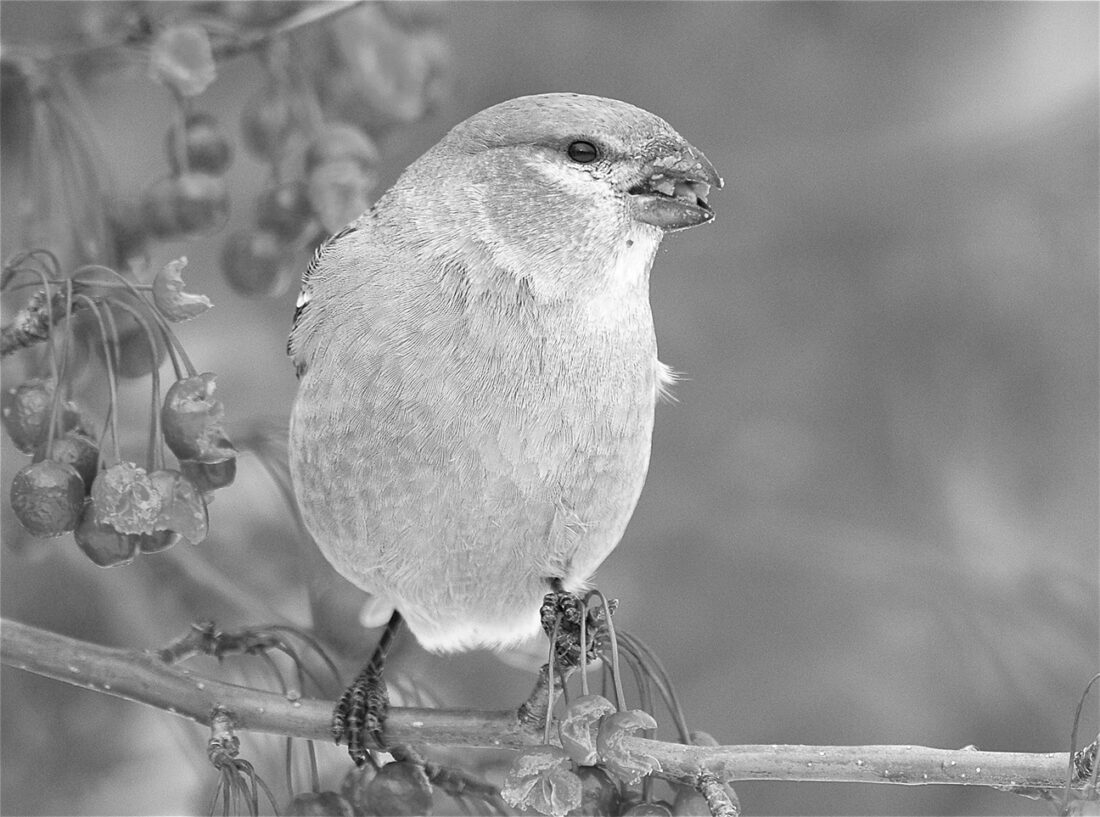
A female pine grosbeak is seen. (Scot Stewart photo)
“Gratitude is not only the greatest of virtues, but the parent of all the others.” – Marcus Tullius Cicero
Some quotes are timeless. It is the time when thoughts of the wonder of all that is good, wonderful, beautiful, and worthy of grateful thanks appears in the headlights. The Upper Peninsula is filled with wonder, and the autumn and early winter months prove over and over the amazing ability to show the U.P.’s ability to amaze, in a season when everything seems to change so fast.
This past week birding surprises continued as the “big storm” grew nearer. Owls have continued in Marquette at a fairly high level of visibility. Sightings have been particularly prominent for snowy owls in south Marquette this past week or so. One was seen feeding on a cottontail at the John Burt house on Champion Street and another seen flying over the same area two days later. As is often the case, the presence of the owls has frequently been quickly, and noisily noted by crows who really do not like owls of any sort in their neighborhood.
Snowy owls continue to be seen along the Lake Superior shoreline too as the area does provide a daytime respite from the crows. The backsides of the breakwalls, including the Upper Harbor marina wall, and the Picnic Rocks are favored spots for the owls during the daylight hours. Some owl pellets have been found on the Lower Harbor breakwall suggesting they may find some time to digest meals there. Whole mice and voles, as well as furry parts of rabbits and some feather portions of ducks get packed in the upper portion of the owls digestive tract and are regurgitated as well-packed pellets and can provide information on owls’ roosting sites.
A short-eared owl may be continuing along the south side of Marquette along the Lake Superior shoreline too. One was seen fling over south beach this past week. One had been seen there about a week before.
At the Rapid River boat launch there was an amazing congregation of swan last Tuesday. 45 trumpeters 8 tundra swans were found there close to the mouth of the river and Lake Michigan. Due to the extremely mild conditions experienced in the Upper Peninsula. Ducks have also continued to provide surprises. On the Dead River a northern pintail has continued for several weeks and was joined by a gadwall this week. Lake Superior has been able to host both white-winged and ongoing black scoters in the Lower Harbor with healthy numbers of long-tailed ducks, numbering over sixty at times. Red-necked and horned grebes, hooded, common and red-breasted mergansers have also continued to cruise the harbor with the mallards.
The waterbirds in the Lower Harbor have drawn a ton of attention this fall drawing many birders from across the central U.P. and beyond. Mild conditions may have encouraged many of the migrants, especially the grebes to stay a bit longer. A truly vagrant western grebe was reported for nearly two weeks. A few questions have arisen about its continued presence though. At least one red-necked grebe has been molting into its winter plumage, resembling more closely the western grebe, especially with its much lighter neck. Frequently the grebes have been foraging fairly distantly out in the harbor making good identifications difficult, especially on overcast days or during rougher lake conditions when spotting scopes are a must to get good looks.
Last Friday long-billed dowitcher was seen foraging at Portage Point, south of Escanaba. Long-billed dowitchers have one of the narrowest, most northerly summer ranges of all the migrants passing through the U. P. during migration seasons. Their summer range lies along the Beaufort Sea above the Arctic Circle in from northeast Alaska, the Yukon and Northwest Territory. These dowitchers use two pathways to get back and forth from the summer range, one through the Pacific and Mountain Flyways and the other through the eastern portion of the Central Flyway.
This one may have lingered there also because of the mild conditions and but may have been slowed because of some physical reasons. They have extremely long bills they work up and down in the mud and muck to find invertebrates in mostly freshwater mudflats and wetlands. They winter across a large area from the southern tier of the Lower 48 through Mexico.
Long-billed dowitcher are often confused with their relatives, yep, the short-billed dowitchers. Their summer range occurs across three areas in central Canada with the most westerly area including part of southern Alaska. It wasn’t until 1950 the two species were split from a single dowitcher designation. While their winter plumage is similar, their habitat preferences and calls are distinctively different. The short-billed dowitcher is more commonly seen in the U.P., especially during spring migration. They winter along both coasts from California and Virginia down too central South America preferring salty and brackish waters. There is an overlapping area where both winter, mostly along the Gulf Coast where they are frequently seen together.
So far, the sightings of redpolls, pine grosbeaks, bohemian waxwings, and white-winged crossbills have been erratic this fall. Some feel the scattered sightings are possibly due to the sizeable amounts of birch, mountain ash and Michigan holly (also known as winterberry and Ilex) the birds are currently finding in outlying areas, and that once the food is gone more of these flocks will wander into to town to take advantage of feeders and crab apple trees. A big storm may change things, but fall has provided so much to be thankful for this year!
Local
Treasury: Individual income tax returns due in month
MARQUETTE – Taxpayers have about a month to file their state individual income tax return, according to the ...
Turkeys on the hunt for a bite
Falling ice closures are again possible at Mackinac Bridge
ST. IGNACE — Falling ice closures are always possible at Mackinac Bridge, bridge officials advise. Here are some ...

‘It only takes a spark’
Superiorland Yesterdays
30 years ago MARQUETTE – Marquette will get a “dream” playground this spring when some 600 volunteers ...
Women’s clubhouse to host piano recital
MARQUETTE — An all-Grieg four-hand piano recital will be presented at the Federated Women's clubhouse, Marquette, ...