
What’s Flying: Pockets of what makes the U.P. a special place
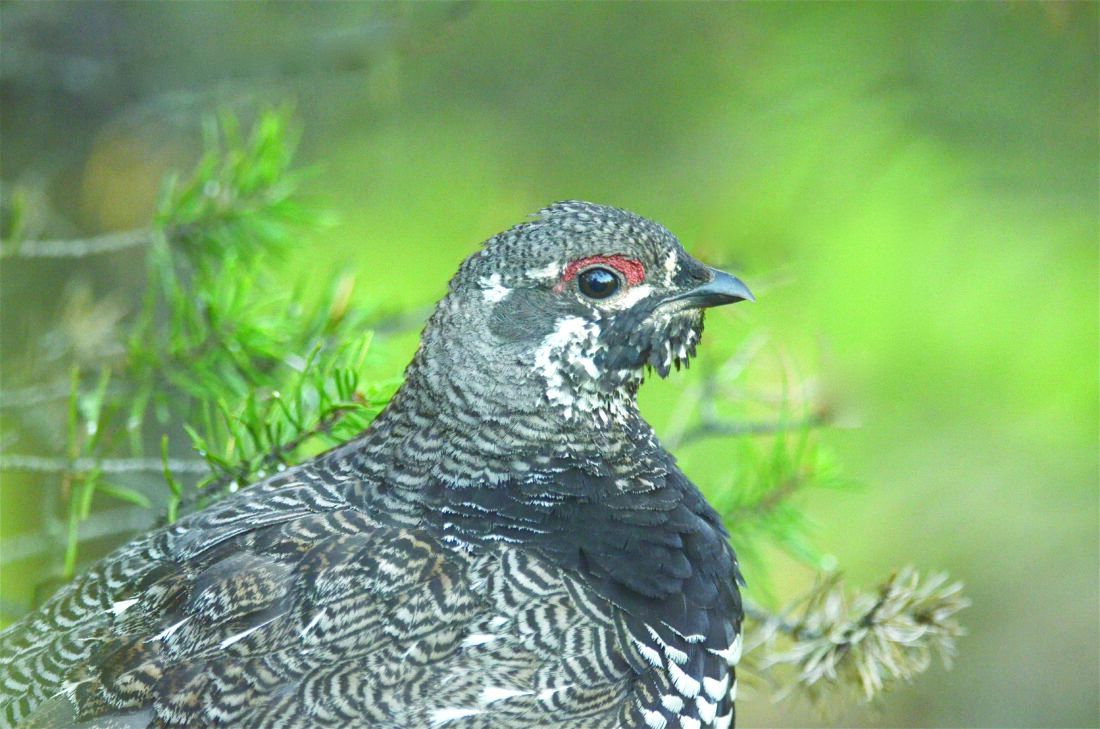
A male spruce grouse looks on. (Scot Stewart photo)
-
- A male spruce grouse looks on. (Scot Stewart photo)
-

- SCOT STEWART
Just as the weather, with its surprisingly erratic stretches the past three or four years has left most wondering what, exactly, is going on this August has provided more of the same. Summer for sure has been here, but more days with unseasonable conditions have dominated some weeks too. The rain has kept most of the vegetation from burning up this year, given to some good blackberries and serviceberries enjoyed by birds and humans alike, and provided some respite for gardeners watering gardens during the recent really warm weather.
Hummingbirds have become numerous at many Upper Peninsula bird feeding stations this week. Five to eight individuals at feeding stations have been about average, but one home in Marquette Township reported 24 seen last Monday. This is a great time to have multiple feeders up around the house to catch a larger number of hummers busy adding on extra weight as they prepare to head south. With the erratic temperatures, it is important to keep feeders filled and clean. On hotter days feeders should be cleaned and restocked every one-to-two days. Sugar to water proportions should be no more than one-part to four-parts. Lesser amounts of sugar are recommended on hotter days to aid the birds in staying hydrated. The sugar can be a bit more concentrated on cooler days when solution should be changed no later than every three days.
There are a few male hummingbirds still around, but most are gone already and some may be migrants from Canada heading south. Once birds have attained the proper amount of fat they will depart and nearly all will be gone by the end of the month. Recommendations again are to keep feeders up beyond this date and they may result in attracting a rarer western species off course on its way south, so photos can be quite helpful in identifying these strays.
Wood duck production on the Dead River and surrounding region in Marquette was apparently quite successful this summer. At least fifteen were spotted in the “Dead River Marshes” between Co. Rd. 550 and Lake Superior. Hooded mergansers have also been seen there recently. The watch continues for the return of trumpeter swans this fall there.

SCOT STEWART
In Chippewa County the Whitefish Point Bird Observatory (WPBO) began its fall waterbird survey August 15 to census migrants heading south past the Point on Lake Superior. Each day a live count is provided online https://www.trektellen.nl/count/view/4209/20250819 on the WPBO website under the research and Fall Waterbird Count (2024 is still shown there) of the birds seen at the Point. The data provides an excellent place to see how the fall migration of ducks, shorebirds, and other migrants, including some hawks is progressing. Birders interesting in seeing specific groups of fall migrants can also get a better idea of their migration patterns and good time to visit the Point.
Saturday August 16 was a particularly good day at the Point with at least eight species of shorebirds seen including a ruddy turnstone, lesser yellowlegs, and Baird’s sandpiper, It was a great day for red-necked grebe numbers flying past the Point too with 1673 counted along with 55 common terns and 65 Bonaparte’s gulls. Red crossbills, a great egret, a merlin, sharp-shinned hawk, a single northern harrier, Caspian terns, horned grebes, and even a great egret were some of the other species tallied during the counter’s official eight hours. A few piping plovers were still hanging out earlier this week at the Point too. The counter will be at the Point through Nov. 15 with daily counts.
Just west of Whitefish Point is a network of gravel roads and two-tracks run mostly parallel to Lake Superior between slender sphagnum-cranberry bogs and shallow ponds. These wetlands were created as the shoreline has slowly lifted following the retreat of the glaciers around 11,000 years ago. It is a beautiful, wild area with a lot of blueberries on the ridges, a few moose, and an unknown number of spruce grouse. NMU’s past biology department’s faculty member Dr. William Robinson’s great book, Fool Hen, chronicled the life of this species, known to be extremely tame and easy to approach, leading to its nickname. Birders enjoy a slow drive on these back roads, hoping to see these relatively tame grouse.
A group of seven spruce grouse on the Vermillion Road was seen there including two adult males and five juveniles this past week. Although females are very similar in appearance to ruffed grouse spruce grouse are darker. Males are easier to distinguish with the red combs over their eyes. The spruce grouse diet is really interesting too. Living in evergreen forests, they spend a great deal of time in treetops eating newer needles of the evergreens. Blueberry leaves and fruit are also important during summer months. Females may lead juveniles around on the forest floor foraging for fungi and insects. The latter is an important source of protein for the young birds.
Spruce grouse, gray jays, boreal chickadees, and black-backed woodpeckers are just some of the bird specialties the Upper Peninsula white-red pine forests and boreal habitats host. The wooded areas can be found on the Peshekee Grade, near Republic in southwestern Marquette County, and in more remote areas of Alger, Luce, and Chippewa County. These pockets with their unique conditions are part of what make the U.P. a special place to not only bird, but to enjoy solitude, beautiful quiet lakes, berry picking, pristine skiing conditions and more.