
What’s flying
Warm weather offers unusual sights
Trending
"February is the border between winter and spring." -- Terri Guillemets
Well, it is a month into the "new year" already and never has a quote about February been truer in the Upper Peninsula. Over at the university snow removal exposed some bare ground areas on campus. Those areas warmed enough to thaw permitting robins the opportunity to forage and find -- January earth worms. One local photographer noted he thought it was a first for him -- witnessing robins eating worms during the deep part of winter.
It has been noted here the season has taken some unusual turns, just like the entire year, changing much of the behavior of both local residents and visitors, used to much different weather, and unfortunately having some detrimental effects to the outdoor activities of many like snowshoeing, skiing, and ice fishing (which has become dangerous again in some areas) and unfortunately creating a serious dent in the entire region's economy.
The wildlife, on the other hand has had an easier time dealing with the condition so far. Temperatures close to Lakes Superior and Michigan have actually been warmer at times than locations like Chicago, and the snow depths in some places again are approaching zero. Northern Indiana, because of the long fetch of winds down Lake Michigan recently recorded more than two feet of snow in a recent snowstorm. Fog and sleet are also pressing the buttons of unusual weather reports more this winter.
Some birding patterns are changing. The open ground at NMU coincided with the appearance of "close to twenty
"robins" at there, according to the photographer catching the worm pulling event. The seesaw of temperatures has also changed the ice coverage on Lake Superior and some rivers changing up the waterfowl scene.
Warmer temperatures in other parts of the U.P. have also allowed ducks to move around in areas usually locked in ice by now in years past. Munising has seen ducks in several areas, the Grand Island Ferry landing and in town allowing long-tailed ducks, mallards, red-breasted and common mergansers to continue there in waters often frozen in by the start of February.
In Marquette the thin skim of ice that had built up on the calmer waters of the Lower Harbor all disappeared last Tuesday, allowing the waterfowl to move more freely again. Several beautiful male long-tailed ducks have been diving in the deeper portions of the harbor as their winter plumage begins to molt into the breeding feathers. Forty-three common mergansers were reported there last week, and trumpeter swans returned to the Dead River.
The top duck seen there the past two weeks continues to be a canvasback. This is a larger diver with a long sloping head and bill. Females and juveniles have dull brown heads while males' are chestnut. Their coloration is similar to redhead ducks although the backs of canvasbacks appear much lighter than the grayish backed redheads. The two species do occasionally congregate and travel together in migration and on their winter ranges. Canvasbacks are much rarer in the U.P. and usually appear singly on Lake Superior and the larger, open rivers like the Dead and Chocolay, feeding on aquatic plants and mollusks. In spring they will move to marshes and pond from Minnesota to Alaska but historically a small population has spent summers in the marshes off the thumb region of Lower Michigan.
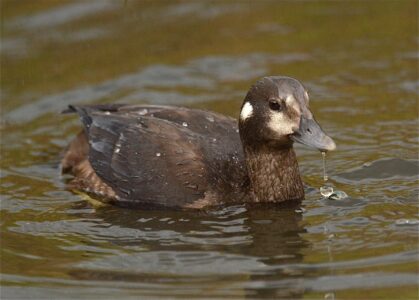
The eastern U.P. has also continued to produce good sightings of waterbirds, with a pair of female harlequin ducks found last weekend at Rotary Park on the St. Mary's River just south of the Sugar Island Boat Landing. Harlequins' are usually winter on the northern portions of the Pacific and Atlantic Coasts. In summer they are found on rapidly flowing waters of inland streams and rivers in Quebec, Greenland, and the northwestern states and provinces. They are somewhat erratic in migration and some winters and have appeared in Marquette in spring and fall too. They are also divers, feeding on aquatic crustaceans, insects, and mollusks.
Females are quite plain with dark plumage and white patches behind their eyes and between the bills and eyes. They can be confused at a distance with scoters. Breeding males though, are quite impressive with slate-blue and chestnut bodies and an array of brilliant white streaks and patches on both their heads and bodies.
An amazing array of gulls, ravens, hawks, and eagles continue at the Dafter Landfill south of Sault Ste. Marie continues too. Twenty-eight bald eagles were found there on Tuesday along with a single red-tailed hawk. The eagles were scavenging, but the hawk was probably looking for rodents attracted the food there. Three different species of gulls were also there. The majority were herring gulls, with over three hundreds counted. But two other species, glaucous and iceland were seen as well. As adults they are sometimes referred to as "white-winged" gull because they lack black tips to their wings. Glaucous, as their name implies are nearly all white, while the iceland gulls are brownish when immature and white as adults. Glaucous are similar in size to herring gulls, while icelands are smaller, closer in size to ring-bills.
In Marquette, because of the lack of ice on many places on Lake Superior, herring gulls are just beginning to return to the Lower Harbor to rest during the day instead of outer island and open water. On the wintry side of birding, large flocks, sometimes over 100, of pine siskins have joined goldfinches at many feeders across the U.P. this past week. That said, it does appear to look like Spring in February.
EDITOR'S NOTE: Scot Stewart is naturalist at the MooseWood Nature Center, a writer and photographer.