
What’s Flying: Might be an interesting conclusion to winter
Trending
Midwinter, as transient as any other shower of moments, has the feeling of permanence, as if it has learned the trick of standing still when none other can. – Angela Abraham
Although winter seems less than a month old, with all its snow and cold temperatures, it is almost February. For those who like short winters, it is just a month until "Spring" migration starts. Although it seems difficult to believe, the first migrants begin returning to the Upper Peninsula in late February or early March when the ring-billed gulls begin returning.
To some, their appearance back atop the Picnic Rocks in Marquette is a true sign of spring. Most everyone knows the end of February, March, usually most of April and even a touch of May are sometimes part of the U.P. winter. But if migration of birds is added to longer days, and fewer below zero temperatures is reassuring sign spring is coming.
In the meantime, there are still a number of birds that should have left knit last year's summer residents to those coming soon. On Marquette's east side, and on the Chocolay River in Harvey several white-throated sparrows have continued to visit feeding stations for several weeks even after the recent snow storms, indicating they may try to stick it out for the entire winter.
With the colder weather there have been fewer sightings of a large group of robins that had been visiting mountain ash trees in Marquette this winter. Two or three had continued around the east side, but many may have finally headed south. They have found company with the large flocks of bohemian waxwings still in the city, visiting mountain ash and crab apple trees across town. The two species were reported together in Marquette's Park Cemetery recently. Flocks of 25 to 30 robins have been seen in crab apple trees in the Chicago area 400 miles south where temperatures last week were colder than Marquette's but with moderating temperatures this week they may remain in that area for a while.
A ruby-crowned kinglet was also reported in north Marquette recently. Unlike golden-crowned kinglets, most ruby-crowns migrate south into the southern half of the Lower 48 states, although some overwinter in the lower elevations old the Rockies and the West Coast. Golden-crowns winter across parts of all the the Lower 48, including a few here in the U.P. They can frequently be found traveling with small flocks of chickadees.
Both species of kinglets frequently forage in the higher parts of trees and both can turn to seeds in winter. The ruby-crowns also look for some fruit and golden-crowns are experts in finding owerwintering insect larvae on tree branches and in bark crevices. A few of each will be around for the summer here in the U.P. after several big waves will pass through during spring migration, usually in late April.
An oranged-crowned warbler is still foraging around the east side of Marquette. It has been reported nearly daily at a suet feeder located next to the side of a house. It has not been reported elsewhere in the neighborhood so it is a bit of a mystery about what else it is eating, but may include more suet, twig insects, berries, seeds and morsels it finds.They normally winter in the southern tier of states in the east, Mexico, and along the West Coast where insects can be found during the winter months.
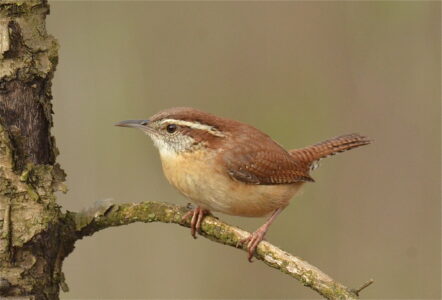
Yet another small species turning up in the central U.P. has been not one, but apparently two Carolina wrens. One has been visiting feeders in Munising and a second has been reported just once in the Marquette area. Carolina wrens are not migratory, and have a range across most of the eastern U.S. except New England and the northern Great Lakes. Their current range does not include Wisconsin and only the lower tier of counties in the Lower Peninsula as their diet consists almost entirely of insects. They do also look for fruit pulp and a few kinds of seeds from shrubs like poison ivy. While wondering here they will visit suet feeders too.
There are several species of wrens -- house, marsh, sedge, and winter wrens found in the U.P. in summer, but they are rarely found lingering here in the wintertime. They all migrate to the central and southern states in the east.
It is a big risk for birds like the sparrows, these single individuals, warblers, wrens, kinglets, and a few robins to test their abilities to find enough food to remain this far north of their normal winter range. Food may be dificult to come by, but if they can, their are well positioned to find and claim the best summer territories to attract a mate and raise their young during the nesting season. It is a big risk, but with climate change it is becoming a little easier to maintain a winter presence here. October, November, and December were particularly mild in 2023, but in the past few years April and early May have supplied some extremely challenging conditions when available foods may be extremely difficult to find.
These birds, because most, especially the kinglets, warblers, may also avoid the new problem of timing their migration to coincide the emergence of spring insects. Warblers, in particular, rely on aquatic hatches along the shores of the Great Lakes to refuel on their spring trips northward, when the timing for reaching summer ranges is critical for claiming territories and nesting. Erratic weather patterns don't always cooperate with the timing of some migrants creating problems finding food some springs. A familiarity with food supplies and present in an area already when insects emerge may be an advantage to birds already here.
There have been other notable birds seen in Marquette this past week. A sharp-shinned hawk has been hunting along the Chocolay River in Harvey and a pair of trumpeter swans has appeared again on the Dead River. With milder conditions again on the horizon, it may be an interesting trip through the rest of the season into spring!
Scot Stewart is naturalist at the MooseWood Nature Center, a writer and photographer.