
What’s flying
Winter arrives at last with heavy snows, icy blasts
Trending
"That's what winter is: An exercise in remembering how to still yourself then how to come pliantly back to life again." -- Ali Smith
Winter provided its first big test of the season this past week and weekend as it delivered a blast of high winds, like the kind needed to achieve blizzard status (over three-hours), varying amounts of snow, piled high in dense drifts over four feet high in places, and then sub-zero temperatures. It is what an Upper Peninsula winter is all about.
At its height, the blizzard conditions drove most wildlife to the cover providing at least a bit of a shield from the driving winds and the horizontally driven snow. Even sure-fire food sources like bird feeders were not in use during the extreme conditions. When the winds did begin to let up chickadees, goldfinches, redpolls, and pine siskins were among the first to come back. Surprisingly, crows were vocal and active early Saturday morning when blizzard conditions were near peak. Last Sunday brought some surprises highlighted with sunshine! It was the first in the northern counties of the U.P. in over a week, and most welcome. The east side of town saw busy feeders, with finches, chickadees, and blue jays out in force, and even a bald eagle circling over the edge of town and part of Lake Superior.
A gold mine of information about birding in the eastern U.P. has been put together by Elliot Nelson, of the Michigan State University Extension called Eastern Upper Peninsula birding update: What to see and where, https://www.canr.msu.edu/news/eastern-upper-peninsula-birding-update-what-to-see-and-where-msg24-nelson24 released Jan. 10.
As the title suggests, it included a wide list of species that have been seen recently from Sault Ste. Marie to Drummond Island and westward roughly to a line from Whitefish Point to Brevort. Like the area around Marquette, the eastern U.P. contains a wide variety of bird habitats - everything, from the rapids and channels of the St. Mary's River, to the boreal forests, jack pine stands, cranberry bogs, and Superior shoreline of Whitefish Point, to the islands of Lake Michigan around Cedarville, and the wide-open agricultural lands surrounding the Pickford-Rudyard Loop.
Probably the number one group of birds most search for there each winter in the fields south of the Soo are the owls. A few are finally beginning to appear, including the first snowy owl of the season and some short-eared owls. Over in nearby Ontario, a few northern hawk owls have been spotted. A second snowy owl was reported on ebird just a short time after the update was released.
Rough-legged hawks and northern shrikes have been seen with some regularity across the entire area. Bald eagles are quite common, with a high count 45 found feeding, unfortunately at the Dafter Landfill in Chippewa County. Glaucous gulls are also regulars, and iceland and greater black-backed gulls have been seen feeding there this winter too.
Three species of grouse are seen frequently in Chippewa County as well. Several spruce grouse have been seen the past few months just west of Paradise and ruffed grouse have been found in good numbers in many places across the area and the rest of the U.P. The open fields in the eastern U.P. are also the home to sharp-tailed grouse.
After extensive logging and fires in a number of areas across the north, this grasslands species was more wide-spread, including a number of places in Marquette County and even on Isle Royale. With reforestation and more fire suppression, much of their preferred habitat has disappeared, but a substantial number of individuals can still be found in those open areas in parts of Chippewa County.
Ducks and swans have also been good this winter, with a Barrow's goldeneye and a harlequin duck seen in the waters around the Soo and both trumpeter and tundra swans plying the St. Mary's below the locks and falls. To the south the large raft of redheads, numbering to at least 8000 has had birders in awe again this winter at the Mackinac Straits.
Townsend's solitaires have shown up at Whitefish Point this winter. This is a western vagrant that frequently shows up in the Great Lakes Region where juniper trees are found. Some of the junipers were introduced, like one at McCarty Cove and several near the breakwall at Presque Isle, but there is a smaller native juniper found along the shores of the Lake Michigan and Lake Superior providing fleshy cones the solitaires like to eat.
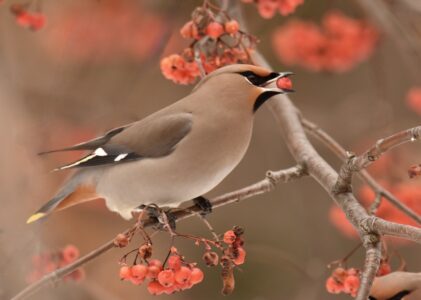
Bohemian waxwings continue to be one of the highlights in the Marquette area. A number of flocks numbering between 100 and 250 have been seen in town and a number of other places in the U.P. this winter. Last Friday, January 12 a much larger flock estimated between of an estimated 500 to 600 on the east side.
They had targeted some crab apple trees in the neighborhood but stayed just short time. A smaller flock returned later but left after a delivery truck arrived near one of the crab apple trees. Last Thursday a flock of over 200 was seen in town in Munising.
With the dropping temperatures, some of the diving ducks seen all through December and early January along the south shore of Lake Superior may be starting to move out. Common goldeneyes and long-tailed ducks seen on Munising Bay may have left and in the Lower Harbor of Marquette tice may squeeze them out of some areas. Cold has not kept all the birds down - shouldn't keep you down either!
EDITOR'S NOTE: Scot Stewart is naturalist at the MooseWood Nature Center in Marquette, a writer and photographer.