
What’s flying
Winter doesn’t mean all birds fly south
Trending
"I prefer winter and fall, when you feel the bone structure of the landscape -- the loneliness of it; the dead feeling of winter. Something waits beneath it; the whole story doesn't show." -- Andrew Wyeth
Winter has finally come to the Upper Peninsula, and humans and wildlife alike are making the adjustment to the season and its "real look"! Some of the changes have brought the sights expected for January, snowplows, huge clumps of giant snowflakes, and thermometers stuck in first gear with daytime and nighttime freezing temperatures. Wyeth's quote has been here before, but it never seemed truer or more appropriate to the season than this year.
The area's birds have reflected many of those truths this winter. The continuing presence of waterbirds has been one. Birders exploring Lake Superior near the Grand Island Ferry Landing stuck gold last Monday, finding twenty red-necked grebes, a horned grebe, eight long-tailed ducks, a single red-breasted merganser and three white-winged scoters.
In a normal winter none of those waterbirds would be there -- the channel would be completely frozen over. Long-tailed ducks, grebes, mallards, and red-breasted mergansers have been lingering in Munising Bay too, another area usually locked in ice by mid-January.
Another sign of a mild start to winter has been the ongoing presence of mountain ash berries. This past fall produced a bounty of the fruits in large, bright red-orange clusters all across the central U.P. Reports from the west end of Lake Superior told of poor crops there and the chance bohemian waxwings might make it around the lake to the U.P. They came. The waxwings arrived in flocks of 200-300 across northern Michigan but for the most part, hit the mountain ash trees, and left within seconds of landing.
It seemed they were extremely skittish, but it may have had more to do with chemistry, than behavior. One residential area in north Marquette had a number of mountain ash trees in a tight area surround by maples and hills. Several days after visiting these trees almost daily, a series of freezing nights a flock of 200+ landed in the trees and began feeding. They came back three straight days until all the full, brightly colored, bite-sized berries were gone. While the birds are not supposed be bothered by the taste of the fruits, several hard freezes reduced the bitterness of the fruit, full of sorbic acid, and vitamins A and C. The fruits contain tannins that provide the bitterness and can also contain parasorbic acid. The latter can be harmful to human kidneys. The hard freezes help break down this latter chemical too and apparently the birds liked it that way.
Both cedar and bohemian waxwings are frugivores, fruit eaters, and rely on tree fruits almost exclusively in winter. Besides mountain ash, they will feed on smaller diameter crab apples, and later in winter will peck at soft winter old apples, often as the apple trees bloom in spring. The other chemical reaction freezes and thaws bring on is fermentation. It is possible for waxwings to become inebriated from eating fruit that has been through the freeze-thaw process numerous times, but usually the fruits are consumed before that happens here.
Joining the waxwings in Marquette were a dozen or more American robins, a few house finches, European starlings, and an occasional black-capped chickadee. During fall migration some hermit and Swainson's thrushes, gray catbirds, brown thrashers, and even scarlet tanagers may stop to grab a few mountain ash berries too. There are still some trees in Marquette full of fruit, especially along busier streets like 7th, Front and Lakeshore Boulevard. For those hoping to catch a glimpse of the beautiful bohemian waxwings in town, watch the tops of the mountain ash trees still bearing fruit. Birds usually start at the top and work their way down. If the appearance of a tree changes, changes lie the berries disappearing from the top, they may be getting visits from small groups and will probably be back.
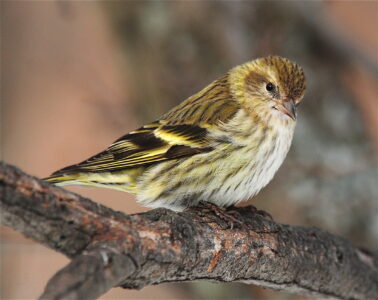
Earlier this winter huge, really huge numbers of pine siskins headed south through Whitefish Point. Few remained on the south shore of Lake Superior. Some wondered where they went. A few have been spotted around Marquette -- a single one with around forty American goldfinches last Sunday. But south to Delta County there are more. Down in the Garden Peninsula, a flock of 110 were seen last Tuesday. This was one of the larger flocks seen in the Lake Michigan Counties recently, but good flocks did turn up at feeders at several sites.
A large flock of 150 common and hoary redpolls was seen on the Peshekee Grade Saturday and another of 120 of common redpolls at Thomas Rock off Marquette County Road 510 near Big Bay the following day.
Many birders noticed their feeders seemed rather quiet through the early part of winter. With the lack of snow cover food for some birds, especially seed eaters, may have been easier to find. The warmer temperatures may have had two effects on birds. Many insects continued to be more active with the warmer temperatures providing food, especially close to the open water of creeks and wetlands. The warmth also reduced the need for extra food to maintain the need metabolic rates associated with activity and normal body temperatures. With the more winter-like conditions, some birders may see an uptick in the bird activity at their feeders this week and enjoy more bird activity from chickadees, nuthatches, woodpeckers, and the winter finches -- goldfinches, siskins, and maybe redpolls. Secrets to the whole story abound!