
What’s Flying: Great birds are all around as the countdown continues
Trending
"I prefer winter and fall, when you feel the bone structure of the landscape. Something waits beneath it; the whole story doesn't show." -- Andrew Wyeth
The year has already reached its twelfth month. Now it comes to the counting down the time to this month, days left in the year, days until the winter solstice, when the days will start getting longer again, and perhaps most importantly for many birders, time until the Christmas Bird Counts start.
In just about two weeks to this year's 124th Christmas Bird Counts https://gis.audubon.org/christmasbirdcount/?_gl=1*1wlgz5g*_ga*MjM0MzgzNDIyLjE3MDExNDgyOTE.*_ga_X2XNL2MWTT*MTcwMTE0ODI5MC4xLjAuMTcwMTE0ODI5MC42MC4wLjA . They will begin in the Upper Peninsula around Dec. 15. As of Tuesday, Audubon, sponsors of the count, had not posted the dates of individual dates of local counts but all will be held between Dec. 14 and Jan. 5.
Most years there are around a dozen counts held in the Upper Peninsula, with the one in Marquette held the first Saturday after the count starts. One in Alger County is traditionally held the following day. These are two of the oldest Christmas Bird Counts in the U.P. with Marquette's count dating back to around 1946. The very first count held nationally was in 1900 as an alternative to game hunting competitions held around the country to see which group of hunters could shoot the most birds and mammals in a day. Most of those were held along the East Coast.
Today the bird counts are held during a 24-hour period in designated circles having a fifteen-mile diameter. Birds can be seen or heard, and an attempt is made to count as many individual birds as possible during that time. The number, ambition, and ability of the counters, accessibility to all areas within a circle, weather both on the day of the count and in the weeks before the count all factor in the success of the count and the totals compiles.
Birders with a familiarity of the area and good information (like feeder station locations, vagrant birds currently in the circle), and ones with good optical equipment increase the changes of adding greater diversity to the counts. Weather conditions can affect the movement of birds in areas where snow, poor visibility, and freezing temperatures force some birds to move south, especially when lakes and harbors are frozen over forcing waterbirds to move on or food supplies are compromised.
The Marquette Count is centered at the Old City Hall building on West Washington Street next to the post office. This site was chosen to create a circle containing the widest variety of habitats from the waters of Lake Superior, the hardwood forests of the Harlow Lake and Sugarloaf areas, the residential areas in Marquette, riverine systems of the Carp, Chocolay, and Dead Rivers, and the sand plains areas south of Co. Rd. 480. It is an impressive area.
A few birders in many circles begin well before dawn listening for calling owls. In Marquette some barred and great horned owls are frequently the first birds found in the morning. In good years snowy owls can be found during daylight hours or at dusk, frequently along the shore of Lake Superior or atop buildings in the city.
When the harbors of Lake Superior are clear of ice and the visibility is good -- no snow squalls, the number of species in Marquette reaches over 50. For the Alger County count centered around AuTrain the number of counters and species is usually a bit lower, with the species count around 30 in some years. Several counts are held in the Copper Country, with others in Dickinson, Iron, Chippewa, Mackinac, and Delta Counties. In January there is one in Gwinn too. Over the past few years, several new counts have been added so it is good to check the Audubon website to find locations, dates, and contacts for coordinators.
In Marquette, the circle is divided into four quadrants, with participants meeting at Mattson Park at 8 a.m. to form groups, matching individuals of various skills, and receive maps, checklists, directions, and other contact information. The social aspects of the counts are always a highlight as individuals share stories, history of past counts, and information about birds and good birding sites.
Another perk is sharing information on good bird sightings of the day. In recent years snowy owls, red and white-winged crossbills, yellow-breasted chats, even ivory gulls have been seen. Other counters are notified so they may have a chance to see some of these great finds.
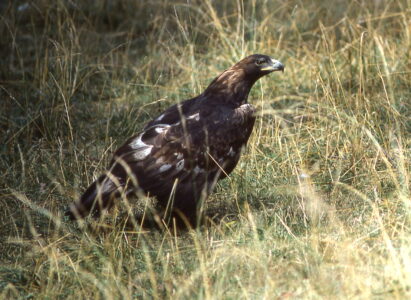
One of the good, recent Upper Peninsula sightings was an immature golden eagle seen flying over Shingleton on Nov. 16. Golden eagles look similar to immature bald eagles. Some of the physical characteristics that make them stand out are golden napes, visible from some angles when seen flying and white bases to the primary (longest wing feathers extending to wing tips) feathers and white base to tail feathers in juvenile birds.
Golden eagles spend summers in northeastern and northwestern Canada, Alaska, and across most of the wilder parts of the western U.S. Wintering birds can be found in the western U.S. and the southeastern U.S. where some juveniles overwinter. The best times to see golden eagles in the U.P. are during migrations at Whitefish Point and along the higher elevations of the Keweenaw Peninsula.
Unlike bald eagles they don't spend much time along waterways, like bald eagles. They and feed primarily on mammals but will occasionally hunt birds and fish. They be long-lived with the oldest know wild bird to be 31 years old. Great birds and birding away as the countdown continues.
EDITOR'S NOTE: Scot Stewart is naturalist at the MooseWood Nature Center, a writer and photographer.