
What’s flying
Attention focused on Christmas Bird Counts
Trending
Joy in looking and comprehending is nature's most beautiful gift." -- Albert Einstein
Gifts abound at year's end in the community and in the natural world of the Upper Peninsula. For many, the warmer temperatures have made walking and driving a little easier and safer with less snow and ice. That certainly made the early Christmas Bird Counts (CBCs) more complete, as mobility was eased, and visibility much better, especially on the open waters of some lakes and rivers, where waterfowl has been hanging on in many places.
Marquette's CBC was definitely enhanced by the gift of so many accomplished birders participating. Around a dozen experienced birders braved the early morning rain to explore the Marquette area and were not disappointed. At last check 48 species were found, with a good number coming from waterfowl on the open Lake Superior. Long-tailed ducks, greater scaup, a redhead, a ring-necked duck, a pied-billed grebe, and a red-necked grebe, joined the Canada geese, the trio of mergansers, common goldeneyes, buffleheads, American black ducks, and mallards usually here in winter making up over a quarter of the species observed. In past colder winters maybe only three would have been found with Lake Superior frozen over.
A number of other occasional species also showed up. Northern shrikes are visitors from the north and are erratic. At least one is currently in town. Two other species, a common grackle and white-throated sparrow, lingerers usually gone by now were also seen. Flocks of bohemian waxwings, a species becoming more common here in winter were observed at a number of sites around town. Marquette's flourishing number of crab apple trees and bountiful mountain ash trees are providing a good supply of food for them. Wild turkeys were found on Presque Isle. They are a relatively new species for the count, having appeared and become established in Marquette just a few years ago.
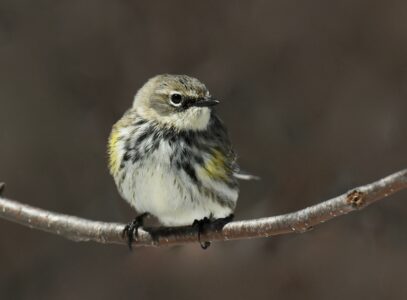
The largest indicator of a warm fall and early winter though came from the warblers turning up on this year's count. Three were found during the count last Saturday before the snow and colder temperatures arrived. Yellow-rumped and orange-crowned warblers have appeared in Marquette CBCs the past few years. They were both seen this week with a palm warbler. Warblers are normally insect eaters, and there were a fair number of midges flying around recently, especially at the end of the week when temperatures were back in the low 50F's. When insects are not available warblers will turn to suet and occasionally local, small fruits.
The added warmth even drew out a spotted salamander seen near the Wetmore Bog, that did not make it back home before the colder temperatures returned. Melting ice on the Dead River and backwaters also opened up a number of places for muskrats to forage, diving in the shallows for aquatic vegetation to eat on floating patches of ice. At least three were seen feeding between Lakeshore Blvd. and the "Dead River Marshes" just upstream.
There were a few birds seen recently that missed the count in Marquette, American, few common redpolls, along with horned grebes. In some years occasion ring-billed, glaucous, and iceland gulls also turn up, but not this year.
Last Sunday, the AuTrain CBC was held. It had some great sightings too. On the AuTrain River nine trumpeter swans and five tundra swans were seen. It was again the presence of open water assisting birds to show up in unexpected places. Trumpeter swan numbers are on the increase across the central U.P. as they have moved into more smaller lakes and ponds to nest each year. Many continue on in fall and early winter in these places possibly to make quicker trips back to claim nesting sites in spring. Trout Lake south of Chatham has become a favored spot for trumpeters to overwinter because of its spring fed open water.
The tundra swans are a little different. They summer in northern Alaska and Canada, and along the shore of Hudson Bay. Western birds usually migrate south to the Pacific Coast from Vancouver Island to California and a number of small inland areas in the western states. Eastern birds usually end up in the Chesapeake Bay area along the Atlantic Coast. Some western birds do head east and usually cross the Great Lakes area through central Wisconsin and southern Michigan. Large numbers are often found on the Mississippi River in fall.
It again may be due to the warmer weather, but more have been seen in the U.P. during fall migration this year. A small family of three stopped briefly on the Dead River this past October, and more were in Kipling, Delta County, this past week.
A really spectacular bird was found in the AuTrain count last Sunday near Eben. A Eurasian goldfinch visited feeders there. It was at a private residence. Slightly larger than American goldfinches, this species is occasionally kept as a pet in this country. They are native to Europe and Africa, but some have escaped, and Michigan is one of the states with semi-regular sightings. They are striking birds, with olive-colored bodies, bright yellow, black, and white wings, and striking red faces. Unfortunately, because it is being seen at a private residence, it is not currently viewable by the public. A Townsend's solitaire turned up in Manistique this past week, so there were hopes it would make in onto the CBC there.
CBC's continue to provide much needed information about bird numbers and effects of global climate change. They are also the gift reminding us of the beauty of wildlife in winter.