
What’s Flying: There’s still time to see some great birds
Trending
"For the last of autumn's glories, go to the lake's edge where its warmth has preserved the last of the season's treasures." -- Anonymous
Some of the fall's best colors splashed across the maples, oaks, and birches along Lake Superior this past week in spectacular fashion. Those trees have remained remarkably green up until just days ago and now have caught fire, ablaze in some of the best crimsons, oranges, and golds of the season.
Migration continues to keep a few tricks up its sleeve, tossing them out along the lake to the delight of those able to catch them. Last week there was a rare appearance by a Ross's goose on the northeast side of Marquette. Ross's geese are small, mostly white geese, just 23-25 inches long. Mallards are 20-26 inches long. White forms of the goose just have black wing tips. There is a "blue" morph or form, like the two forms of snow geese, but blue morphs of Ross's, with dark bodies, white faces, and some white tail feathers, though striking, are very rare.
Besides size, Ross's can be distinguished for s snow geese by the straight-line back sides of their bill and the nearly closed juncture of the top and bottom portions of their bills. Snow geese have curved backs to their bills and a black grin patch or perceived open area when the two parts of the bill meet.
Ross's geese nest with snow geese in a number of areas along Hudson's Bay, the far north of Canada, and one small area in Alaska. They feed on short vegetation and the one currently here is often in the company of a flock of Canada geese. Ironically, there was one in Marquette last spring and spent most of its time in the same area. There was a sighting of a Ross's goose on the Chocolay River in Harvey early Monday morning, but it was not known if it was the same bird.
On Sunday another lovely surprise dropped into the Marquette area at the Dead River, as a family of three tundra swans joined a pair of trumpeter swans not far up from Superior near Lakeshore Blvd. bridge. The tundra swans are also unusual visitors to the Upper Peninsula. Thousands migrate from nearly the same areas where the Ross's geese summer along the west shore of Hudson's Bay and in northern Canada, but also across the north shore of Alaska too. The wintering areas for them is split with some along the Pacific Coast and some isolated areas in the Rocky Mountains and half in the Chesapeake Bay area on the Atlantic Coast.
While the entire Great Lakes region is in the migration path for those headed east, most tundra swans migrate through the northern half of Wisconsin, with many stopping on the Mississippi River. Limited numbers move through the U.P. Just four have been counted at Whitefish Point through this past Tuesday.
Tundra swans are just a bit smaller than the local trumpeters and adults have a small yellow patch between their bills and eyes. Because they rarely feed in shallows where there is much iron in the bottom sediment, most are quite white, in contrast to the locals. The trio on the Dead River included two juveniles, young of the year, still in their gray plumage and their very pink bills with just a touch of black on their tips. Trumpeter young have bills usually with more distinguished black tips and bases.
For all the current visitors, there is no way to know why they stopped here and when they will leave. Weather, illness, hunger, and injury are some of the factors causing birds to stop. Because nearly all these birds lack any sorts of special identifications or tracking devices, it is nearly impossible to follow their progress during migration or know if they successfully reach their winter range.
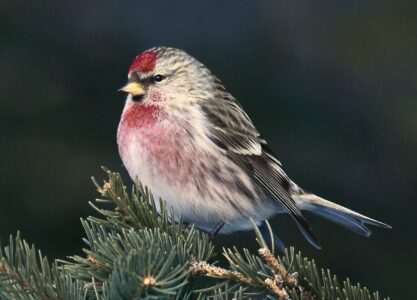
Huge numbers of pine siskins continue to stream southward from Canada into the U.P. Over 20,220 have been counted since the waterbird count has started in August, with these all seen at the tip of the Point. Purple finches kicked up several weeks ago and now over 800 of them have been seen there. On Oct. 12, common redpolls began their move past the point. starting with single digit numbers the first few days but picking up to over 60 this past Tuesday, the same day over 400 more siskins were counted. One of the first redpoll sightings in Marquette was last Monday.
Not to be outdone though, 2,400 long-tailed ducks also made the count on Monday adding to the 3,550 total for the season, and this is just the start. Last year 49,694 were tallied at Whitefish Point. Hardy ducks, they will winter on the norther portions of both the Atlantic and Pacific coasts, the Great Lakes, and even parts of Baffin Island in Canada and western Iceland. Because much of the Great Lakes does receive some ice, the southern tip of Lake Michigan is one of the most popular spots in area to find them in winter. Some will stop off in the Lower Harbor in Marquette, and they may stay until it ices over. Great divers, they may plunge as deep as 200 feet in search of mollusks and other invertebrates.
There are still plenty of mountain ash fruits on the trees in the central U.P. and that is the place to find late migrating robins. A number of them have been regular visitors to trees in Marquette this week. Still time to catch great birds, and no need for snowshoes yet!
Scot Stewart is naturalist at the MooseWood Nature Center, a writer and photographer.