
Colonial Jack’s walk
Trending
By ROSEMARY MICHELIN
Marquette Regional
History Center
Special to the Journal
"Man on a 9,000 Mile Walk is Due to Arrive in Marquette Today" was the Mining Journal headline on August 7, 1908. Who was this transcontinental walker? Thirty-five-year-old John Albert Krohn, also known as Colonial Jack, was attempting to walk around the perimeter of the United States for a wager of $1,000 (equivalent to $25,000 today).
Jack was born in 1873 in St. Peter, Minnesota. One of his first jobs was working in the office of Minnesota Governor Johnson where he learned the printing trade. A few years later he was self publishing a weekly newspaper in Amboy, Minn. After joining a traveling theatrical company, Jack settled in Newburyport, Massachusetts, where he was again a newspaperman.
Early in 1908, he was challenged by 10 businessmen to attempt the 9,000 plus mile walk in less than 400 days. One stipulation was that he had to stop at town post offices to get a stamped certificate, verifying the date of his visit. He was up for the challenge!
Colonial Jack began his walk on June 1st in Portland, Maine wearing old fashioned colonial clothing. He soon abandoned the costume for more practical clothes, a white cotton shirt, blue knee breeches, a black slouch hat, and heavy shoes and socks.
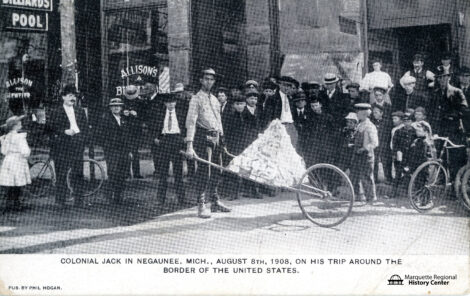
He pushed a contrivance he called the "Sphinx." It was a canvas covered pyramid, two and a half feet square at the base by two and a half feet tall, mounted on a wheelbarrow frame. It also had an odometer to provide accurate milage and prove that he had completed the walk. The "Sphinx" was covered with business cards he had collected in towns along the way. Inside the pyramid, Jack stored food, extra clothes, and a camera.
He also carried commemorative coins and postcards to sell. Throughout his trip, he hoped to sell 70 coins a day at 10 cents each to cover his food and lodging costs. He was also occasionally paid for speaking engagements.
By the time Colonial Jack arrived in Marquette County in August, he had already walked for 68 days, over 1,500 miles through 7 states. His pace was 20-30 miles a day, usually walking for 10 hours. Since train travel was the main mode of transportation through the United States at the time, Jack walked only on railroad grades.
Earlier in the week, he crossed the Straits of Mackinac on a ferry, his first ride since leaving Maine. While walking across the Upper Peninsula he pushed himself to walk 43 miles in one day, in order to arrive in Marquette on Friday for the Fireman's Tournament races and the Parker Carnival Show. He was ready for some relaxation, but a crowd would also be good for sales of his trinkets.
On Saturday he walked to Negaunee and dined at the Breitung House. He was photographed entertaining a crowd in front of Allison's Billiard Hall, 415 Iron Street. People were eager to hear of Jack's adventures and buy souvenirs.
On Sunday he met up with his wife in Ishpeming. She rode the train and promoted his tour by posting fliers ahead of his arrival. She would also bring him extra supplies and collect the pounds of paper business cards weighing down the "Sphinx." Jack did not walk on Sundays, but rested and wrote up the events of the week in his journal.
After a three-day stop in Marquette County, Jack resumed his walk and headed out on the Duluth South Shore and Atlantic Railroad grade towards Nestoria and parts west.
Did Colonial Jack complete his walk and collect the wager? Yes, he did, and even arrived back in Portland, Maine earlier than expected, after 357 days. This weather worn man had lost 11 pounds, wore through 112 pairs of socks, 11 pairs of shoes, and replaced 5 wheels and 3 tires on his wheelbarrow. His 9,000 plus mile journey covered 30 states and was one of the greatest walking trips ever attempted at that time. In 1910 John Krohn published his book, "The Walk of Colonial Jack, the Story of a Long-Distance Walker." He passed away in 1956 at the age of 83.