
Eyeing Native American treaty rights
Trending
MARQUETTE -- According to Anishinaabe tradition, a long time ago, the world was flooded by the Creator to cleanse it of evil; no land could be seen in any direction. Waynaboozhoo (ᐌᓇᐳᔓ in Anishinaabe syllabics), an Anishinaabe spirit and teacher, survived by floating on a log, accompanied by various animals. After drifting in the endless water for a very long time, and seeing no signs of land, he decided to try bringing the land back to the surface himself, with the help of the Creator.
Waynaboozhoo dove into the water, disappearing beneath the waves for so long that his companions thought he had drowned. Yet, when he surfaced, gasping for air, he revealed he couldn't reach the sea floor. He appealed to his companions to attempt the feat, as they had forms far more suited to the water than Waynaboozhoo. One after another, the animals dove down, each deeper than the last, only to resurface empty-handed. That is, until the determined muskrat finally reached the bottom.
He drowned before resurfacing, but as Waynaboozhoo and the other animals pulled his body from the water, they saw a tiny chunk of soil clasped in his paws. Waynaboozhoo placed this soil on the turtle's back. Winds from the Creator blew in all directions, growing the soil upon the turtle's back until it finally became Turtle Island, what we know as North America.
This story demonstrates the spiritual, cultural, and physical importance of land and water within Ojibwe society. The Ojibwe were well established in the Upper Great Lakes Region by the time European explorers came to the area. The Europeans, and later Americans negotiated with them as they would any other sovereign nation. However, the demand for ever more resources brought an influx of Euro-American settlers into Ojibwe lands.
The treaties of 1836, 1837, 1842, and 1854 ceded land which now encompasses most of Northern Michigan and the entire U.P., as well as much of upper Wisconsin, and Minnesota. The land was exchanged for promises of money, education for their children, and other material goods while the Ojibwe people retained their rights to continue using the land for hunting, fishing and the gathering of other materials.
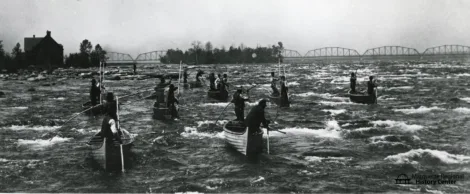
The provisions in these treaties were not always respected, and the government ignored treaty rights wherever it was convenient. For example, the Ojibwe around the St. Mary's River, who had been guaranteed off-reservation fishing rights in 1820, were forced to accept another treaty in 1855 that stripped those rights without compensation. Some of the Ojibwe who had signed the original treaty had passed, yet their names were added as signatories, and the few members that signed for themselves had no legal authority to do so.
Even in areas where the treaty rights remained legally enshrined, Native people were routinely arrested and fined for fishing and hunting off reservation. This trend continued until the late-twentieth century, when tribal members began to push back. In 1965 William Jondreau, a Keweenaw Bay tribal member was arrested and fined for "the illegal possession of lake trout" after fishing in Lake Superior (Gichigami). This citation was overturned by the Michigan Supreme Court, which determined that off-reservation fishing in Gichigami is guaranteed by the 1854 cession treaty.
In 1974, Fred and Mike Tribble, members of the Lac Courte Oreilles Band (LCO), were arrested by the Wisconsin DNR for "possession of a spear, for taking fish from off-reservation waters and for occupying a fish shanty without name and address attached." The brothers had taken a Native law course in university and researched the previously mentioned cession treaties. They repeatedly encountered clauses that guaranteed the Anishinaabe "[rights] to hunt, fish, and trap on ceded land." This ran counter to what they were told growing up, so they asked their professor if anything could be done to gain recognition of those rights. He told the brothers that a test case was needed, and they'd likely end up getting arrested. They decided to set up their fishing shack on the ice of Chief Lake, just over the reservation's border.
Both brothers were found guilty of the charges, but in 1975 the LCO Band sued the State of Wisconsin "on the basis of the tribe's reserved rights" guaranteed in the treaties. U.S. District Judge Doyle ruled that the band had "relinquished their off-reservation rights by accepting permanent reservations." The LCO Band appealed the decision, and in 1983 the 7th Circuit Court of Appeals overturned Doyle's ruling, affirming the band's treaty rights. This decision was reaffirmed by the U.S. Supreme Court.
As a result of this case, in 1984, the Great Lakes Indian Fish & Wildlife Commission (GLIFWC) was created to protect and enforce the treaty rights of its eleven member bands. Mike Tribble said the "impact was a heck of a lot greater than [he] ever envisioned," but now people are out there doing "things their ancestors have been doing for generations, it's maintaining a way of life." Through the cooperation of GLIFWC's member bands alongside federal and state agencies, local environments are now better studied, preserved and maintained than many others worldwide. GLIFWC states that "the freshwater lakes of Northern Wisconsin contain the most studied fisheries in the world." The treaty rights secured by Anishinaabe leaders generations ago are to the benefit of everyone, not just Native Americans.
For a further discussion on the topic of treaties and treaty rights, come to the Marquette Regional History Center at 6:30 tonight. Jason Schlender, the executive administrator at GLIFWC, will be presenting the program Talking Treaties: A Timeline of Anishinaabe Treaty Rights in the Northern Great Lakes.
For more information, please call us at 906-226-3571 or email at mrhc@marquettehistory.org.