
Trending
MARQUETTE - Drought conditions have impacted Michigan these last three months, and meteorologists say this winter's forecast could keep conditions dry into next spring.
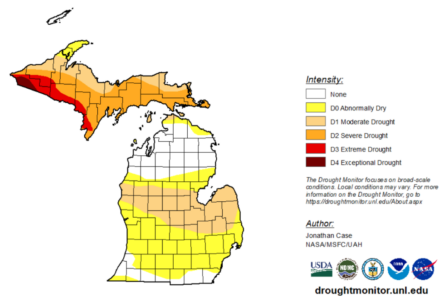
Nearly 79% of the state is experiencing at least abnormally dry conditions, according to the U.S. Drought Monitor.
Just 21% of the state is free from any drought designation, down from 64% in August.
Brandon Buckingham, an AccuWeather meteorologist who helps produce the company's seasonal and short-range wildfire forecasts, said almost the entire Upper Peninsula is in moderate drought or worse.
The worst conditions are in the Western UP, where severe and extreme drought cover a majority of the region. Nearly all of Gogebic County is considered in exceptional drought, the monitor's most severe category.
Late fall is typically the tail end of wildfire concerns, Buckingham said, because the leaves have already fallen and snow has begun cooling and moistening the ground. But even with those changes, fires can still occur.
"Wildfires don't exactly work on a regularly scheduled calendar," Buckingham said.
Stretches of dry, breezy and low-humidity weather could bring short-term spikes in the wildfire risk across the Upper Midwest.
Fallen leaves add to the danger.
"The leaves can obviously ignite very quickly, spread very rapidly if they are dry and we have breezy conditions," Buckingham said. "We call them short-term fuels."
The drought has already played a major role in fires this fall.
Chris Schmiege, a predictive services specialist with the Department of Natural Resources, said three large fires burned in the UP in October, caused mostly by lightning.
"Drought definitely was a factor," Schmiege said. "The fires burned deep and they took a long time to extinguish."
However, Schmiege said drought does not guarantee more wildfires because a fire still needs an ignition source - but it can make fires more severe.
Larger fuels such as limbs, logs and organic material in the soil dry out and become available to burn. Those fires can burn hotter, take more firefighters to put out, cost more and kill more trees, Schmiege said.
The loss of vegetation that stabilizes soil can also lead to erosion after a fire.
Schmiege said drought of this severity is unusual in the UP, which he said had not experienced an exceptional drought in the history of the Drought Monitor, dating to about 2000.
Buckingham said the region needs what meteorologists call system or synoptic snow, which comes from low-pressure systems crossing the Great Lakes and carries more moisture than lake-effect snow, which he described as generally fluffier.
"Every little bit is beneficial," Buckingham said, but "it's going to take some time to be able to chip away at the drought conditions."
Schmiege said recovery from drought depends on repeated rounds of precipitation.
"Droughts take a long time to develop, but it also takes a long time to recover," Schmiege said.
A recent Super El Niño winter declaration by the National Oceanic and Atmospheric Administration adds more uncertainty.
"A Super El Niño winter typically brings a warmer and drier winter across the state of Michigan," Buckingham said.
That could mean little relief.
Last winter, he said, one UP snow site, which he identified as Calumet-Tamarack on the Keweenaw Peninsula, topped 350 inches.
"I would be very surprised if it even came close to that this year," Buckingham said.
Without much precipitation over the winter, the drought could persist into spring, which is typically Michigan's most active wildfire season, according to Schmiege.
Drought lingering into spring could lead to more severe and costlier fires.
Drought, combined with warm temperatures, high winds and dry air, leads to restrictions on the burn permits the DNR issues, according to Schmiege. Fire danger and fuel dryness also determine how many firefighters an agency sends to a fire and how many people it has on staff.
The department also steps up public messaging through social media, news coverage and signs when fire potential is higher, he said.
Because close to 90% of Michigan wildfires are human-caused in a typical year, Schmiege said much of that messaging is aimed at discouraging activities such as burning yard debris.
As for any future outlook, Schmiege said the DNR watches drought conditions daily.
"We just got to see how it plays out," Schmiege said.