
Grants help communities stretch budgets by approving renewable energy projects
Trending
SANDS -- Michigan's Renewables Ready Communities Awards are providing extra funding to encourage local governments to move forward on large-scale renewable energy projects and the recipients including Sands Township in Marquette County are using the money for local projects, including park enhancements and road improvements.
Ian O'Leary, a program manager with the Department of Environment, Great Lakes and Energy, said that funding is given to local government officials once such projects begin construction. Eligible projects include large-scale wind, solar and battery storage facilities, as well as hybrid projects, according to the department. The program sets minimum capacity requirements for eligible projects. For solar development, 50 megawatts of generating capacity corresponds to approximately 400 acres, O'Leary said.
Local governments can receive up to $4,000 per megawatt, with the potential for an increase to $5,000 per megawatt if labor-agreement requirements are met, according to Environment, Great Lakes and Energy.
"The main goal of the awards is to increase the value that local governments see in permitting large-scale renewable energy," O'Leary said.
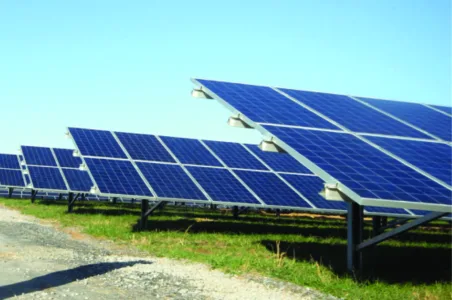
Sands Township will get $748,500 associated with the Superior Solar project, a 150-megawatt solar farm. The money will aid the township's progress on projects outlined in its master and recreation plans, Supervisor Darlene Walch said.
"Without the funds, project timelines extend further into the future," she said
The township expects to spend its money on upgrades at Strawberry Lake Park, including building upgrades, accessible restrooms, a hiking trail, parking improvements and an accessible walkway. Sands Township will also develop a nature trail, remove invasive species and establish a community commons facility with meeting spaces, restrooms and audio-visual technology, Walch said.
"The project is just getting underway so thus far it has had minimal impact economically," she said.
Most residents support the project, although some oppose it, Walch said.
Projects can be developed by private companies on land leased from local property owners, so in some cases local governments receive only small amounts of direct revenue if they approve the projects, O'Leary said.
After construction starts, local governments are free to use the money how they choose, O'Leary said. This includes town hall repairs, recreation projects, cemetery upgrades and zoning software.
So far, 57 municipalities have been approved for awards.
Hart Township Supervisor Abe Kurzer said the $600,000 award has helped the rural township pay for projects that previously lacked funding.
"Being a rural township, we don't have a significant tax revenue to improve infrastructure or for road upkeep," Kurzer said. "The award definitely helps us with some projects we haven't had funding for previously."
The township used some of the money to revise its master plan and zoning ordinance, along with improving roads that had been neglected because of limited funding, according to Kurzer.
The project also has generated significant tax revenue through personal property taxes paid by the solar company, he said.
"The award itself is more than our entire yearly budget, and the tax revenue adds an amount that is just under half our yearly budget for the next six years or so," Kurzer said. "That is an incredible amount of money we wouldn't normally have to improve things in Hart Township."
Community residents have mixed feelings about the solar project, Kurzer said.
Landowners are happy about the income generated from the solar panels, while some neighbors have complained about the look of the panels and fencing. Some of the neighboring landowners have had trouble selling their property, he said.
Sands Township in Marquette County will get $748,500 associated with the Superior Solar project, a 150-megawatt solar farm.
The money will aid the township's progress on projects outlined in its master and recreation plans, Supervisor Darlene Walch said.
Walch said, "Without the funds, project timelines extend further into the future."
The township expects to spend its money on upgrades at Strawberry Lake Park, including building upgrades, accessible restrooms, a hiking trail, parking improvements and an accessible walkway.
Sands Township will also develop a nature trail, remove invasive species and establish a community commons facility with meeting spaces, restrooms and audio-visual technology, Walch said.
"The project is just getting underway so thus far it has had minimal impact economically," she said.
Most residents support the project, although some oppose it, Walch said.
She noted the program provides township residents an opportunity to witness the benefits as the solar project moves forward.
"We've shared progress on the project with residents via our semi-annual newsletter and website," Walch said. "The most important thing for people to understand is that we have not yet received the funds because they are released to coincide with the energy project's construction."
Programs like the Renewables Ready Communities Awards help communities realize the benefits of energy development, said Michael Larson, interim executive director of Citizens Utility Board and a member of the Marquette City Commission.
"When communities host major energy projects, residents should see real economic benefits from those investments," Larson said. "Programs like Renewables Ready Communities can help local improvements, support community priorities and bring resources to smaller communities that might otherwise struggle to pay for those improvements."
Renewable-energy incentives already have positive impacts on local governments, said Tom Lenard, the state director for Climate Power, an environmental advocacy group.
"From Delhi Township's perspective, we've benefitted from the solar options" in a federal law, and "it's been very positive for us," Lenard said.
Lenard also serves as the treasurer of Delhi Township and has first-hand experience with solar incentives.
Laura Sherman, the president of the Michigan Energy Innovation Business Council, said the program can provide smaller communities with significant funding for local priorities.
"For smaller towns and townships, that can mean hundreds of thousands of dollars, or even more than a million dollars, to invest in local infrastructure, public services, parks or improvements that could help lower costs for municipalities and residents," Sherman said.
O'Leary noted that the program is a shift in the way big renewable-energy projects are approved in Michigan. A 2023 law established a state permitting process for certain large-scale renewable projects if local governments have not approved them.