
Cathedral scaffolding to come down after yearslong restoration project
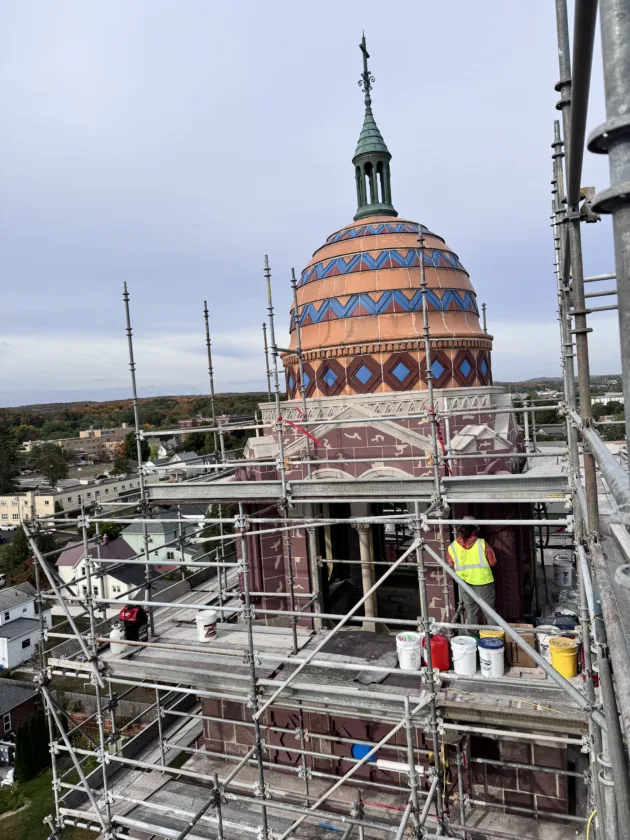
A worker hand-painting the western bell tower in this Tuesday photo. (Journal photo by Annie Lippert)
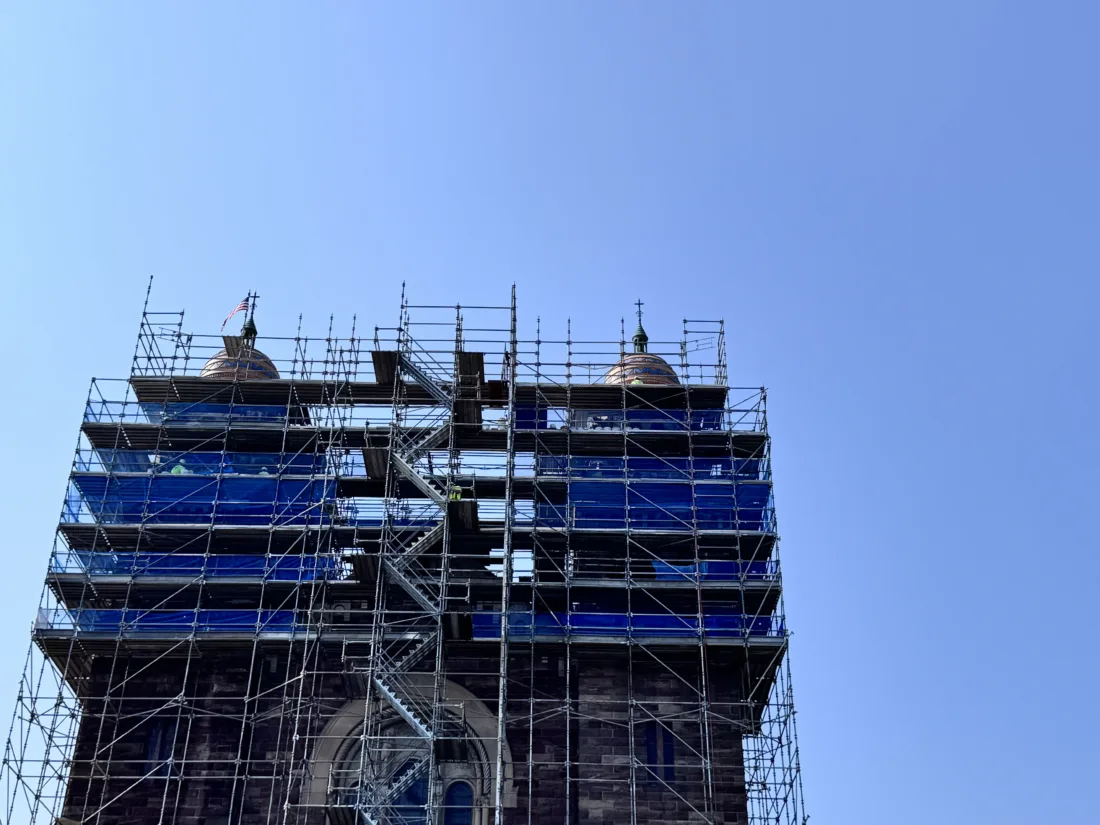
St. Peter Cathedral is seen in this August photo. (Journal photo by Annie Lippert)
A worker hand-painting the western bell tower in this Tuesday photo. (Journal photo by Annie Lippert)
St. Peter Cathedral is seen in this August photo. (Journal photo by Annie Lippert)
Trending
MARQUETTE -- The scaffolding at St. Peter Cathedral in Marquette will be coming down next week, after what has been a yearslong process of fundraising and restoration of the centuries-old building.
"Today is an especially fitting day to celebrate the completion of the St. Peter Cathedral bell tower restoration project," said Father Brandon Oman, during a press conference on the project's completion. "We gather on the anniversary of the dedication of the cathedral in a year that marks 145 years since the cornerstone was laid here in 1881."
This is not the first time that St. Peter Cathedral has had to be restored; after a fire in 1935 caused extensive damage, the building was rebuilt and expanded, including the uppermost 40 feet of bell tower.
"Over the last two summers, we have undertaken a $2.6 million restoration focused primarily on that uppermost section of the bell tower," said Oman. "The greatest concern was structural. Over time, water intrusion and the Upper Peninsula freeze-thaw cycle has severely compromised the load bearing brick, and some of the veneer, exterior sandstone and terracotta."
Over the course of that project, over 30 tons of brick and rubble were removed and replaced, with hand-carving work individually done by Bill Klein, the lead mason on the project with Ram Construction.
The Mining Journal spoke to Klein, as well as local Bricklayers and Allied Craftworkers Union members Adam Saari and John O'Connor, in June, about the restoration and the use of local labor on the project.
The cathedral restoration has truly been a community effort, from fundraising to local labor to even the sourcing of the stone.
The original sandstone on the cathedral was sourced from the Marquette Quarry, which shut down in the early 20th century after producing stone for buildings all over the midwest. That quarry is located in South Marquette, in the area that is now Shiras Hills.
"You can't get those types of stones anymore, they're obsolete," said Saari. "Luckily, (Klein) was able to work with (Shiras Hills)."
"I got a hold of them, and they were willing to donate anything I can use," said Klein, who said that without that stone they'd have had to use a different type of material entirely.
According to Klein, some of those stones were the size of cars, and had to be broken apart first on-site at the quarry and then again at the cathedral before they could be taken up the building. All of those rocks were taken up the scaffolding by elevator, 500 pounds at a time.
While much of the labor for the project came from Ram Construction, there was also an opportunity for local union members to get training to work on the restoration as well.
"We took a bunch of our guys that we had this winter in to do special training, along with our apprenticeship program, to make sure that the guys here locally are highly qualified to do the work" said Saari, who is the Field Representative for the Bricklayers and Allied Craftworkers Local #2.
"We're all highly specialized in what we do, and there aren't many people that know how to do this type of stuff. And we're trying to make sure that it's locally done and locally sourced, so this can be something that's sustainable for our community long-term and provides jobs for the people within our area."
Working on such an iconic building was a once-in-a-lifetime project for many of the masons involved.
"My sister got married here and now I’m working on it, which is crazy," said O'Connor, a local Bricklayers and Allied Craftworkers member who worked on the restoration. "I know that for the rest of our lives we'll be driving by this place, and I can look up and see the work that I did. That's pretty fantastic."
Megan O'Connor, John O'Connor's sister, is further connected to the restoration project by her position as Executive Director of Stewardship & Development for the Diocese of Marquette; a position from which she helped raise the $2.6 million necessary for the restoration.
"It's almost like a family affair," said John O'Connor. "It's a view you're never going to see again, once the scaffolding is down. No one else gets to see that. That's just for me and my coworkers."
Although the major restoration work is done, it is inevitable that future weather will necessitate touch-ups. However, St. Peter Cathedral Facility Director Patrick Markey says that drone technology will hopefully prevent any future scaffolding of the building. Instead of one big restoration, drones could conduct regular visual inspections, and minor repairs could be completed using boom lifts.
Soon enough, the people of Marquette will once again be able to enter the historic structure through its front doors.
"The work of caring for St. Peter Cathedral doesn't end here," said Oman. "We will continue to work to preserve this historic cathedral, so that it remains strong, beautiful and safe for generations to come.
"I want to offer special thanks to Bill Klein for his excellent leadership and craftsmanship, and Ram Construction for their outstanding construction work.
"And above all, I thank the benefactors of St. Peter Cathedral. Without their faith, their trust and their financial generosity, this project simply would not have happened ... The generations before us built and rebuilt the cathedral with faith and sacrifice. It is now our privilege to care for it and hand it on so that St. Peter Cathedral can continue to stand as a house of worship, a house of prayer and a beacon of hope for generations to come."
Annie Lippert can be reached at 906-228-2500, ext. 550. Her email address is alippert@miningjournal.net.