
State corrections officers altered prisoner’s ID with racial caricature, lawsuit claims
Trending
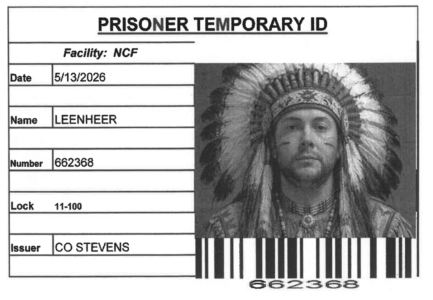
NEWBERRY -- A corrections officer at Newberry Correctional Facility in Michigan's Upper Peninsula digitally altered a Native American prisoner's ID to depict him wearing a feathered headdress, stereotypical Indigenous attire and facial paint, a lawsuit filed in Michigan state court in early August alleges.
Dylan Leenheer, who is Native American and a member of the Gun Lake Tribe, is suing the Michigan Department of Corrections, as well as three individual corrections employees involved in the incident, for violating the state's Elliott-Larsen Civil Rights Act.
The lawsuit claims that Leenheer faced "racial humiliation" from two corrections officers, Jay Stevens and Robert Marsh, and a library technician, JoLynn Cebula. It further alleges that the Michigan Department of Corrections had "institutional knowledge of, and failure to prevent or remedy, a broader pattern of similar misconduct" within the unit.
"That is very telling about the environment and about how people who are Native American, who are non-white are being treated," Maura Battersby, a senior attorney for Flood Law, who is representing Leenheer, said in an interview.
Specifically, the lawsuit alleges that Stevens, a correctional officer at the Newberry facility, created the ID with the racial caricature, and an image of the ID in the lawsuit identifies him as the issuer. Marsh, another correctional officer, was allegedly present in the room and at the computer when Stevens issued and altered the identification card.
Battersby noted that to the best of her knowledge, the correctional officers have faced no internal disciplinary action or repercussions for their actions. Leenheer is no longer incarcerated and has been released from MDOC custody as of the time of the lawsuit's filing.
"That's an approval on some level of the behavior, and truly the brazenness of posting the photo. It wasn't just on his individual ID. They posted it various places with CO Stevens taking credit for it. Just so proud of his work," she said. "The brazenness of it, that tells me that this is a systemic problem that is at least getting distant approval from higher up."
That image was also posted on the window of Leenheer's unit, the lawsuit states, "where it was visible to other prisoners and staff, subjecting Plaintiff to public humiliation on the basis of his race and ethnicity," in violation of MDOC policies that prevent discrimination based on race, religion or ethnicity and prohibit staff from engaging in derogatory or humiliating behavior .
Battersby explained that posting the image made the incident not just a question of humiliation, but also of Leenheer's safety -- especially as there were only three Native American prisoners in the unit.
"It's the COs expressing to everyone that it's okay to treat these people poorly, and now my client has to sit back and wonder what that treatment might be, and know that on some level or certainly fear that the COs wouldn't intervene if someone were to attack them or something like that," she said. "Having the people who are in charge of keeping you safe while you're in there single you out as somebody who it's okay to mess with is dangerous."
The suit also alleges that when Leenheer attempted to make photocopies of the altered identification card for use in court and in an internal grievance about the ID, Cebula, a library technician, refused to make the copies and laughed at the identification card while calling it "funny."
"All allegations of discriminatory harassment are investigated by the department," a spokesperson from the Michigan Department of Corrections, wrote to Michigan Advance when asked to comment on the lawsuit, declining to say anything further due to the ongoing litigation.
Leenheer filed a grievance on May 22, 2026, which was not formally received by MDOC until 33 days later on June 24, according to the lawsuit. In that time, he filed at least six urgent mental health care requests, all of which went unanswered. Also in that time, he was placed on a "loss-of-privileges sanction," despite his own security classification sheet under MDOC that listed him as "misconduct free," which meant he was denied sunlight and access to telephone contact with his family.
The lawsuit further alleges that the problem of racial and ethnic harassment from correctional officers is a broader issue at the Newberry Correctional Facility, including sworn declarations from other prisoners that also say that Stevens had made other derogatory statements about Native American prisoners in the past.
"MDOC knew or should have known of a pattern of racially and ethnically motivated misconduct at Newberry Correctional Facility," the lawsuit states.
The lawsuit also identifies two other alleged incidents in which Stevens and Marsh altered ID photos of two prisoners, one Black and one of "Indian-national-origin," with other racial connotations.
"It's not an isolated incident," Battersby said.
She also raised concerns that this incident -- as well as a string of misconduct citations, after Leenheer had never received one prior -- came just after he became friends with Colby Skippergosh, one of the few other Native prisoners at Newberry, who had also filed a discrimination action against the MDOC with the Michigan Department of Civil Rights.
"If you're going to discriminate against Native Americans, you sure wouldn't want them to be comparing their stories and bolstering each other and supporting each other to, you know, push back on that. My gut tells me that you would want to discourage that," she explained.
Leenheer's complaint comes as MDOC has been under scrutiny for concerns about standards of medical care, especially at the Women's Huron Valley Correctional Facility -- where Battersby and her colleagues are also representing a number of clients. She said that this incident shows a broader pattern of the culture within the state's prison system.
"I think that they've created a system and an environment where this type of behavior thrives," she said, referring to the MDOC. "The common theme is this notion that they can treat people any way they feel like while they're in their custody, and this is just another iteration of that. And so I think that that's a top-down systemic issue."