
Hummingbirds favor Superiorland
But were they late this year?
Trending
MARQUETTE -- Some backyard bird watchers in and around Superiorland report that the usual number of hummingbirds, a favorite to observe and photograph, were late arriving to the area.
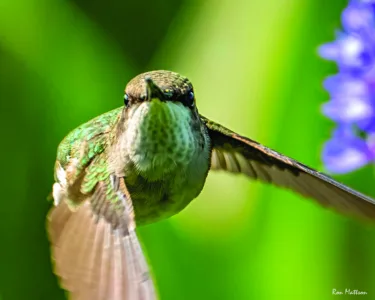
Renowned for their incredible agility, hummingbirds can hover in place and fly backwards, forward, sideways and even upside down by beating their wings in a rapid figure-eight pattern.
The hummingbirds most often seen in the central Upper Peninsula are ruby throated and Rufous hummingbirds although a fairly large number of other species can be found here, said Scot Stewart of Marquette, a longtime bird writer and acknowledged bird expert.
Stewart said the first of the migrating birds -- hummingbirds do not winter in the Upper Peninsula -- arrived as usual in early May, although, depending on where specifically the observers are, they may not have been spotted until sometime later.
"There were a few of them" in early May, Stewart said. Some could have stopped over in Superiorland on their way to Canada, he said. Others coming from the Gulf Coast and South America, will spend their entire summers in this area.
After July, when the females fledge their young, often both young and mature birds start to appear in area gardens and at feeders.
"The numbers can increase," Stewart said.
According to Cornell University, the diet of an average hummingbird consists mostly of flower nectar and insects. Flower nectar provides sugar to support their high metabolic rate, even higher during flight due to their rapid wing flapping rates.
The insects hummingbirds eat provide them with protein, amino acids and necessary vitamins and minerals. The insects must be small enough to swallow whole during flight.
Hummingbird prey includes (but is not limited to) small beetles, flies and fruit flies, gnats, mosquitoes and spiders.
The nectar that hummingbirds drink from flowers is simply a sugar solution. This can be easily replicated for a hummingbird feeder. The most common solution is 1 part table sugar to 4 parts water. The sugar solution should be boiled after mixing to drive off chlorine and kill yeast and bacteria, then cooled. This can then be put in a feeder.
Feeders should be red or have red trim, because red is the best color for attracting hummingbirds. The feeder should be regularly cleaned of insects and the sugar solution replaced. The higher the temperatures, the more frequently the nectar will have to be changed.