
Trending
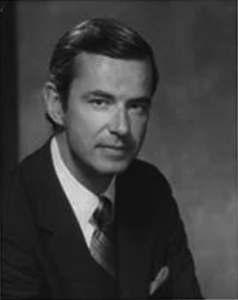
HOUGHTON -- Former Congressman Philip Edward Ruppe died Monday in Bethesda, Maryland, at age 99. He represented Michigan's 11th Congressional District in the U.S. House of Representatives for six consecutive terms, serving from Jan. 3, 1967, to Jan. 3, 1979.
Ruppe’s roots in the Copper Country ran deep. He was born on Sept. 29, 1926, in Laurium, into a pioneering merchant family. His grandfather, Peter Ruppe Sr., a Slovenian immigrant who moved to Hancock in 1864, co-founded the family’s retail business, along with partner Joseph Wertin. The storefront stood at the current location of the Copper Country Community Arts Center on Quincy Street in.
Ruppe and Wertin amicably dissolved the partnership, each operating their own businesses. While the Ruppe venture grew into one of the most prominent mercantile businesses, P. Ruppe & Sons, the Wertin business eventually became the prominent Vertin Bros. Department Stores.
Phil Ruppe graduated from Calumet High School in 1944. Immediately following his graduation, he entered the Navy V-12 officer training program during World War II. The military program sent him to Central Michigan University and the University of Michigan for fast-tracked undergraduate coursework before he ultimately finished his degree at Yale University in 1948. Following his education, Ruppe was called up to operational duty during the Korean War, serving 24 months on active combat duty as a Navy lieutenant (jg).
Following his military discharge, Ruppe returned home to manage the family’s regional investments. He worked extensively in the private sector, managing banking and broadcasting assets across the U.P. while serving as a director for the Houghton National Bank. He also served as a director for the Commercial National Bank of L'Anse.
His work heavily involved directing community capital toward post-war economic development across Houghton and Baraga counties. From 1983 to 1986, he served as president of the Woodlak Company, a Houghton-based, private bank holding company.
In 1966, he launched his campaign for the United States House of Representatives on the Republican ticket, challenging freshman Democratic incumbent, Raymond Clevenger, to win the seat for Michigan's 11th congressional district.
During his 12 years in office, Ruppe frequently worked across the aisle on international delegations, including a high-profile diplomatic reception of Egyptian President Anwar Sadat and future President Hosni Mubarak during a state visit to the U.S.
His work in Congress reflected his private sector goals of economic development and expansion. As copper mining declined across the western U.P., Ruppe prioritized transitioning the region toward a mix of sustainable timber production, light manufacturing and tourism. He pushed for federal aid to stabilize hard-hit northern communities, most notably by sponsoring the Regional Development Act to inject economic assistance into rural municipalities. Serving on the House Committee on Merchant Marine and Fisheries, he was advocated for regional industrial expansion. He defended the maritime economy by securing federal funding for icebreakers to extend winter navigation seasons, directly benefiting U.P. ports, iron ore transport and manufacturing supply lines.
Ruppe actively intervened when federal expansion, such as national lakeshores or military communications grids like Project Seafarer, threatened to landlock local resources or hurt the tax bases of small U.P. communities, continually pushing for a "better business climate" to encourage industries to grow.
In 1982, Ruppe ran for the U.S. Senate, but was unsuccessful. In 1992, he ran for Michigan’s 1st Congressional District, but was defeated by Democrat Bart Stupak.
Ruppe’s personal life was marked by both public service partnerships and family tragedy. He married his first wife, Loret Miller Ruppe, in 1957, and the couple had five daughters. She went on to a prominent political career of her own, serving as national director of the Peace Corps from 1981 to 1989 and as U.S. ambassador to Norway from 1989 to 1993.
Loret Ruppe died on Aug. 6, 1996, in Bethesda, Maryland, at the age of 60. In 2000, Ruppe married Ann Hammond Boutell of Palm Beach, Florida.
In May 2007, Ruppe and Loret’s daughter, Loret Miller Ruppe, died of breast cancer at her home in Cabin John, Maryland, at the age of 45. She was an environmental engineer and an American Association for the Advancement of Science fellow who served as the leading climate change science adviser for the U.S. Agency for International Development. In 2022, Phil’s wife, Ann, died on Christmas Day, in Palm Beach, Florida.
Following his final congressional campaign in 1992, Ruppe retired to private life, but continued spending his time devoted to philanthropy, enjoying Civil War history groups and engagement in civic organizations until he died. He was a lifelong member of the American Legion as well as the Veterans of Foreign Wars. He was also heavily involved with local chapters of Rotary International.
In his final decades, Ruppe focused his efforts on regional philanthropy, which included providing foundational funding to establish modernized learning facilities at his alma mater, CLK Schools.
Considering his accomplishments and achievements, Philip Ruppe seems larger than life, yet at the same time, to those who knew him, he and his family are remembered as deeply human and caring.
Longtime Hancock civic leader and family friend Susi Boxer remembers the Ruppe family’s summer visits vividly.
Boxer said Ruppe was a director of the bank in Houghton, when she was an employee there. After he was elected to Congress, she recalled, he made it a point to the visit the bank.
“He would always stop and say ‘hello’ to you; he always knew your name,” she said. “I don’t think there was a stranger to Phil.”
Boxer said Ruppe was a devoted husband and father and was also devoted to his friends.
“Phil was probably one of the kindest individuals I ever encountered in my life,” she said. “He and his (first) wife, Loret, were community-minded. You could always see both of them stepping up to help if help was needed by anyone. He was just a gentleman and just really and truly made everybody aware of the fact that he was kind.”
Former State Representative Paul Hillegonds, who began his career as an aid to Ruppe, said it was his first job after he graduated from college. “I couldn’t have had a better start in politics or a career,” Hillegonds said.
Ruppe, he said, was a great example of decency, humility and integrity. “In the political world, that’s what you would hope your representative would have: Decency, sincerity, integrity, humility – he had all of those,” said Hillegonds. “The wonderful thing is, he became a lifelong friend.”
Long after Ruppe retired from public life, and into his 90s, said Hillegonds, some of those who had served on his staff would gather with Ruppe’s daughter, Mary and a couple of her sisters and celebrate his birthdays.
Boxer said the kindness of the parents reflects in their children.
“His daughters were very, very kind,” said Boxer, “and they really followed in their parents’ footsteps.”
Mary is no exception. Mary Ruppe Nash is an educational consultant who serves as the CEO of Embassy Row Consulting and the educational and childcare counselor for the International Monetary Fund. She founded ERC in 2018 to assist domestic and international families, foreign diplomats, and corporate entities in navigating the U.S. school system. Her firm specializes in K-12 placement, private school admissions, and global college counseling.
Nash said her father felt fortunate to have had the opportunity to serve the people of Northern Michigan for 12 years with dignity, integrity and dedication.
“Family and public service were deeply ingrained in our parents' lives,” she said. “Together, they made an amazing team on the campaign trail and in life.”
She said her father never forgot how how fortunate he felt he was. “He used to say that, ‘We have by all odds the most beautiful district in the Midwest - and equally great people to go with it'”
Nash said she and her sisters have fond memories of Fourth of July parades.
“Dad would try to hit as many as possible,” she said. “By the end of the day we five girls were exhausted but exhilarated from throwing candy and Ruppe bumper stickers out of the back of the family station wagon.”
Hillegonds said Ruppe would like to be remembered as inspiring confidence in public service and by being truly representative of his district. “He just enjoyed getting to know the people he represented,” he said, “and I think he inspired a lot of public confidence in what representative government was all about.”
Hillegonds went on to say that Ruppe would like to be remembered as a person who cared deeply for the district he represented.