
Sea lamprey control planned for Lake Superior tributaries
Trending
MARQUETTE -- The never-ending war against what some call the granddaddy of all invasive species is scheduled to continue in the Marquette area in the near future.
According to U.S. Fish and Wildlife Service personnel, lampricides will be applied to the area offshore of the Dead and Carp rivers in Marquette County to kill invasive sea lamprey larvae burrowed in the stream bottom. Lampricides are specialized chemical pesticides used to control invasive sea lamprey populations by selectively killing their larvae in streams and rivers before they grow into harmful adults.
Applications will be conducted between Aug. 11-20 in accordance with state of Michigan permits. The dates are tentative based upon local weather or stream conditions near the time of treatment.
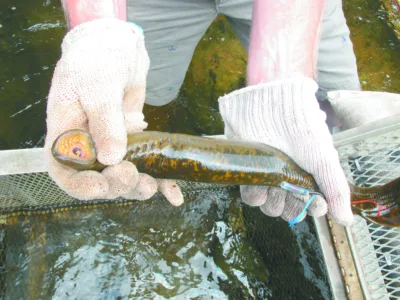
Sea lampreys are parasitic fish native to the Atlantic Ocean that invaded the Great Lakes via
shipping canals in the early 1900s and remain a major threat to the fishery. They attach to fish
with a suction-cup mouth lined with sharp teeth, feed on their body fluids and can kill up to 40
pounds of fish during their parasitic phase. Each spawning pair produces up to 100,000 eggs,
with larvae living for years in tributaries before transforming into parasites that migrate to the Great Lakes to prey on host fish.
Lampricides are selectively toxic to sea lampreys, but some fish, insects, and broadleaf plants are sensitive. Persons confining bait fish or other organisms in stream water are advised to use an alternate water source because lampricides may cause mortality among aquatic organisms stressed by crowding and handling. Agricultural irrigation must be suspended for 24 hours, during and following treatment.
Fish and Wildlife Service officials said the sea lamprey control program is contracted through the Great Lakes Fishery Commission to the Service and Fisheries and Oceans Canada. Established in 1955 by the U.S. and Canadian governments, the commission began chemical control of sea lampreys in 1958 as a response to the catastrophic damage of their invasion. Since that time, the program has contributed significantly to the maintenance of the $5.1 billion Great Lakes sport
and commercial fisheries.
The service works closely with the U.S. Geological Survey to support research, such as the
development of supplemental control techniques to be used in areas where lampricides are
particularly challenging to apply.
In addition, the service maintains a partnership with the U.S. Army Corps of Engineers in developing a comprehensive barrier strategy for sea lamprey-producing streams and is investigating barrier design, traps, attractants and biological control as part of a research program administered by the commission.
To reach the Marquette Biological Station, call 1-906-226-6571.