
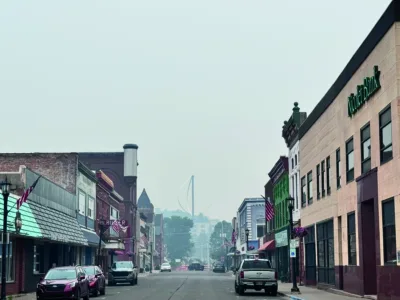
Air quality improves temporarily, expected to worsen over the weekend
\'Could potentially last all summer,\' official says
Trending
MARQUETTE -- The Michigan Department of Environment, Great Lakes and Energy released another statement regarding air quality for Friday and Saturday of this week.
EGLE says that on Saturday, air quality is expected to move from "hazardous" to "very unhealthy" in the Upper Peninsula, but that "when the associated cold front passes through later Saturday, we will be back into northwest winds and more smoke. Those fires have not diminished, so we expect more bad air quality beginning late Saturday and into Sunday."
EGLE continues to recommend that people avoid strenuous outdoor activities, especially those with conditions like heart disease and asthma, and that people watch for symptoms such as wheezing, coughing, chest tightness, dizziness, or burning in nose, throat, or eyes.
Stephanie M. Hengesbach, Meteorology Specialist with the Air Quality Division of EGLE, said that concentrations of pm2.5 (air pollutants which measure 2.5 micrometers or less, such as wildfire smoke) in Michigan have been higher this week than they were during either the 2023 or 2025 Canadian wildfire smoke events. The highest hourly concentration of pm2.5 in Marquette this week was measured at 642 micrograms per cubic meter on Wednesday.
Pm2.5 is different from AQI, which is a scoring system for air quality rather than a measurement number. The official AQI scale maxes out at 500, which Marquette has been hitting and exceeding fairly consistently for days.
When asked about reports from Minnesotan officials that the fires there could last until it snows, Hengesback said that she'd "have to agree with what they said."
Hengesback said that the fires in Minnesota and Ontario are in such rural places that fire crews can't reach them apart from by air.
Canada's boreal forests are immense, estimated at around 1.3-1.5 billion acres, and are very sparsely populated. The contiguous United States, by comparison, is nearly but not quite 2 billion acres.
"(The fires) could potentially last all summer," said Hengesback. "Hopefully they'll get some rain to suppress some of the fires and the smoke. But any time we experience a wind from that direction, there will be the potential of smoke over our region."
Updates on air quality are available at https://air-egle.hub.arcgis.com/. Information on how to keep yourself safe is available at www.michigan.gov/mdhhs/safety-injury-prev/environmental-health/your-health-and-wildfire-smoke/. This page includes information for people with health conditions and for people who work outdoors.
According to Climate Data Canada, "Canadian wildfire activity is increasing in part because human-caused climate change is causing more hot and dry conditions conducive to wildfires, also referred to as ‘fire weather.’"
"As climate change progresses, longer fire seasons and worsening fire weather conditions are expected in many regions of Canada, leading to more intense and frequent wildfires."
Annie Lippert can be reached at 906-228-2500, ext. 550. Her email address is alippert@miningjournal.net.