
City created as port to ship iron ore
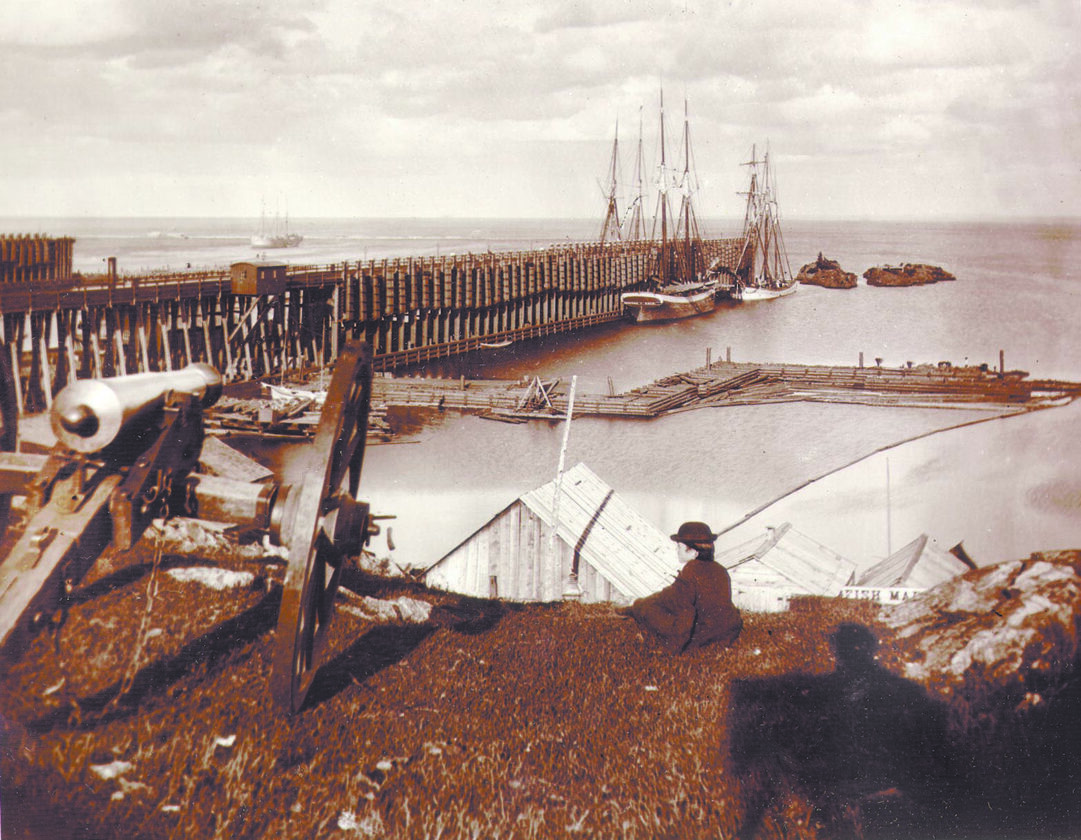
An 1873 view of Marquette Harbor with Cleveland Iron Mining Co. dock. Ripley’s Rock and channel is visble at right. (Marquette Regional History Center photo)
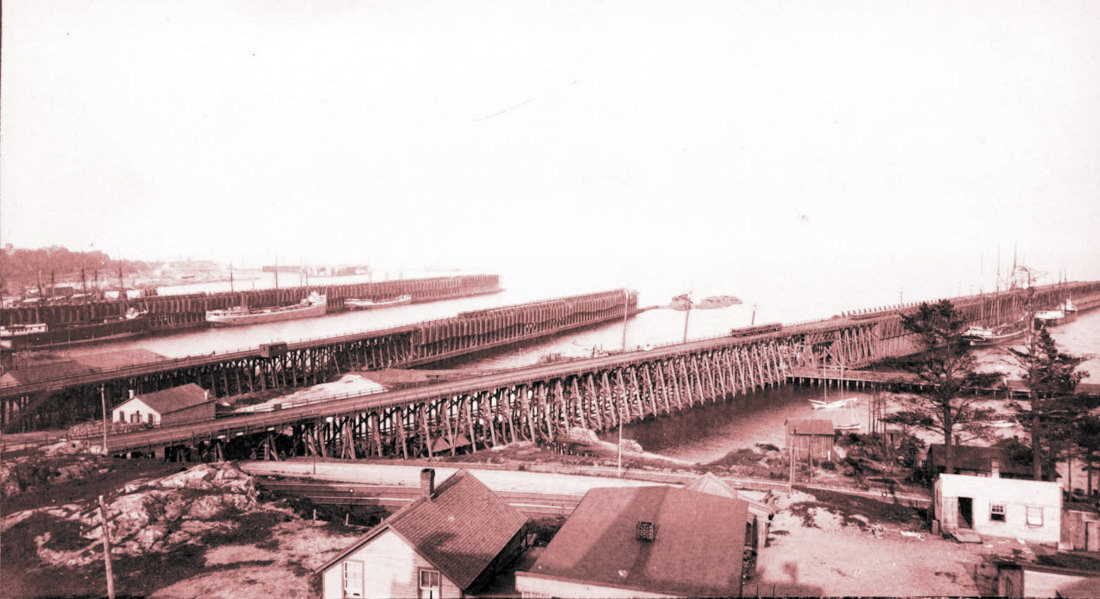
An 1884 view of Marquette Harbor showing, from left, the Marquette, Houghton and Ontonagon railroad dock built in 1864, the Cleveland Iron Mining Co. dock built in 1855 which connects to Ripley’s Rock, and the Detroit, Mackinac and Marquette railroad dock built in 1880. (Marquette Regional History Center photo)
An 1873 view of Marquette Harbor with Cleveland Iron Mining Co. dock. Ripley’s Rock and channel is visble at right. (Marquette Regional History Center photo)
An 1884 view of Marquette Harbor showing, from left, the Marquette, Houghton and Ontonagon railroad dock built in 1864, the Cleveland Iron Mining Co. dock built in 1855 which connects to Ripley’s Rock, and the Detroit, Mackinac and Marquette railroad dock built in 1880. (Marquette Regional History Center photo)
Trending
City created as port to ship iron ore
MARQUETTE -- According to legend, what is now the city of Marquette was founded for the pursuit of "truth, intelligence, integrity, and Christian morality."
Much of the city's growth paralleled developments in the iron mining industry, which was the key to Marquette's beginnings.
History professor L.A. Chase, of what later became Northern Michigan University, write in 1949:
"I suppose there would have been a settlement here in any case, because of the harbor, the find stand of timber, and the excellent soil of the neighborhood, but in reality the origin of Marquette is directly traceable to a wonderful mineral development a dozen miles inland around Negaunee and Ishpeming."
Chase said there had been a small Indian village on the bay before white settlers arrived in 1849, a settlement called Indian River at first, but there was never a large population, because of the lack of game.
The Indian claim to the region, Chase said, was liquidated in 1843 through a treaty with the Chippewas and the area was opened to surveyors within the next year, with settlements in the Copper Country developing. A party of surveyors led by Douglass Houghton and William Burt was brought to a mass of iron ore near Negaunee in 1844, and from there development came rapidly.
Philo M. Everett and Robert J. Graveraet were among the mining pioneers, but soon others were on the scene.
It was under the guidance of Amos R. Harlow, a native of Worcester, Mass., and Peter White, of New York, that the site of what is now the Lower Harbor was cleared for the establishment of the town. The town first was named Worcester in honor of Harlow. Eventually, it was renamed Marquette in honor of the Jesuit priest who had lived and served in the area for a number of years.
With Robert Graveraet's guidance, a dock was built in a record time of 3 1/2 days. They did not realize, however, that the wood cleared from the area was not sturdy enough to hold the structure in place and the dock collapsed as fast as it was erected.
The Jackson Mining Company, led by Everett, was instrumental in the construction of the old Jackson Forge on the Carp River, three miles east of Negaunee. The forge lost money and folded in 1855.
But in 1850, the first shipment of iron ore left the Jackson Mine to be converted into blooms and bars under the direction of Al Crawford. The Marquette Iron Company was founded in 1848 by K.R. Harlow, Edward Clark, and Robert J. Graveraet. It was this group that built the forge near the lakeshore in 1849, just south of Superior Street, in what is now Harvey.
Many of the early settlers came from New England and New York, but others were Germans fleeing their native land after a failed revolution in the 1840s, Chase said. Soon, other nationalities were represented as immigrants came to America in search of a better life.
An important bit of progress was made when Heman Ely proposed in 1851 the building of a railroad from the iron mines to Marquette, so the ore of the hills might be shipped to furnaces in the coal fields near the lower lakes. From this idea, the Iron Mountain Railroad was completed in 1855 under the direction of John Bird and the ownership of Heman Ely. Prior to that, a plank road was built in 1854 from Marquette to the mines. Production of iron ore and charcoal pig iron continued to increase until 1873. More than a quarter of all the iron produced in the United States came from the mines of Marquette County.
Another important landmark in the central Upper Peninsula's history came from a spot many miles to the east. In 1855, the canal at Sault Ste. Marie was constructed, eliminating a frustrating portage from Lake Superior to Lake Huron. The first boat to pass through was the brig Columbia.
As mining spread westward, so did the rail construction, extending from Marquette to L'Anse in 1872. Through the years, the railroad connections tied Marquette to a number of other communities.
Marquette's population grew enormously. In 1852, the population estimate was 200. By 1860, it was 1,664. Over the next decade, the number of residents continued to rise, but economic difficulties in the 1870s stalled much of the anticipated growth. However, the population estimate for 1890 was 10,000 while in 1910 it was 11,000.
Marquette was incorporated as a village in 1859; as a city in 1871; and with its city charter requiring a commission form of government in 1913.
Some other landmark dates in city history include:
• 1820: Gov. Lewis Cass and his staff landed on Granite Point (Little Presque Isle) on June 22 and established American sovereignty in the region.
• 1843: Marquette County laid out by the Michigan Legislature.
• 1851: Marquette County government organized.
• 1852: First circuit court is held on Aug. 5.
• 1853: A lighthouse is established in the harbor.
• 1856: Methodist and Episcopal churches established.
• 1857: The U.S. Land Office is located here. Graveraet is the area's state senator and White is the state representative. Also, St. Peter Roman Catholic Church is established.
• 1863: Lake Superior News and Journal reports that five streets in Marquette are now being paved -- Front, Superior, Washington, Spring and Lake.
• 1864: First national bank authorized.
• 1865: First telegraph wire.
• 1868: A June 11 fire guts the heart of the downtown, destroying many businesses.
• 1869: The fire motivates the establishment of the city's first waterworks. This is also the year the first gas lighting was introduced.
• 1871: The city is established with Henry H. Stafford; the Weather Bureau establishes a station.
• 1873: The Panic of 1873-1878 is a major turning point in Marquette's economy, with many prominent families moving from the area.
• 1888: In March, a Citizens Association formed to further employment opportunities for people in the city. Also, the same year, the Marquette Branch Prison is established.
• 1889: City begins to furnish itself with hydroelectric power from the nearby Dead River.
• 1891: A lifesaving station is developed and a private company begins to operate the electric railway within the city to Presque Isle.
• 1899: Northern Normal School, now Northern Michigan University, is chartered.