
Converting public schools to clean energy will create jobs, group says
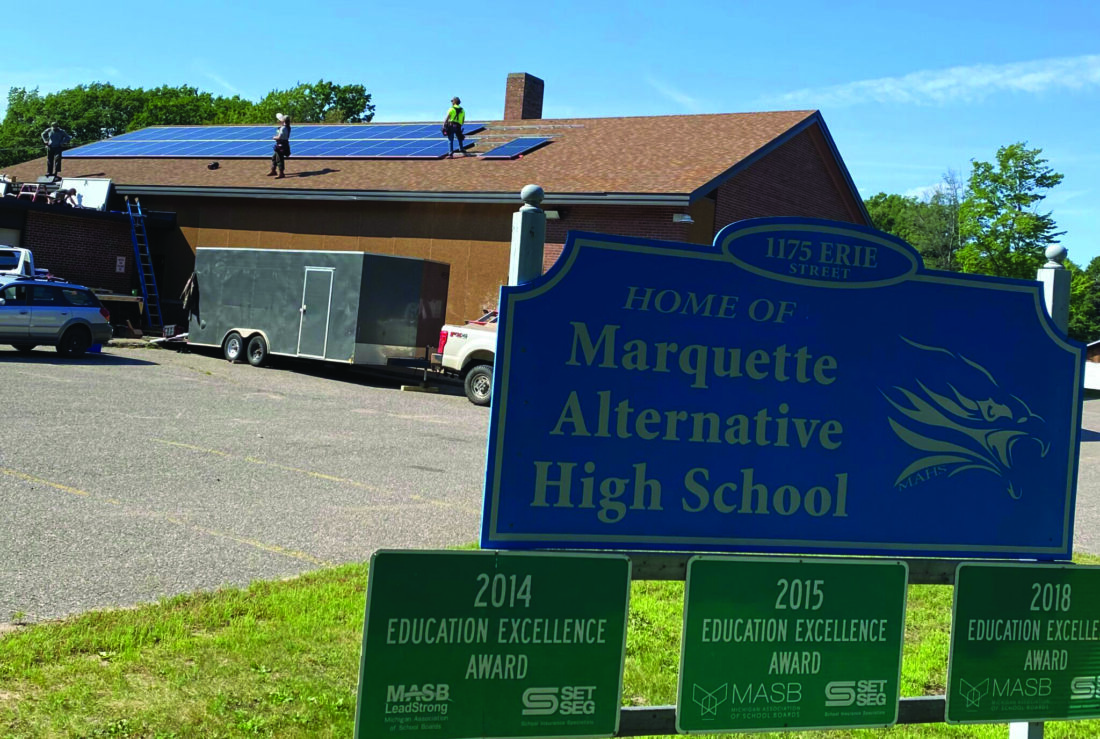
Solar panels are being installed at Marquette Alternative High School in Marquette Township. (Photo courtesy of Brian Prill)
MARQUETTE – Michigan is expanding efforts to move public schools toward zero-emission energy systems, as new initiatives focus on cutting utility costs and modernizing aging buildings.
The launch of the Michigan Climate Jobs coalition in February added new momentum to those efforts.
“We’re very focused on supporting the transition to a clean energy future and making sure workers are at the center of that,” said Sarah Roberts, the executive director of Climate Jobs.
The coalition brings together labor unions, including building trades, skilled trades and teachers’ unions, to support a worker-focused clean energy economy.
Roberts said the coalition’s early efforts focused on helping schools identify their building and energy needs through statewide studies.
“Before we formally launched, we worked with partners to support energy efficiency audits and solar feasibility studies in public schools,” Roberts said.
She said the effort helped secure $20 million in additional state funding, with about 67% of public schools participating in energy audits.
The energy audits identified heating, ventilation and air conditioning upgrades and geothermal systems as key opportunities to reduce energy use and costs.
“We saw a gap in how schools could implement these improvements, and we wanted to help provide solutions, including energy efficiency, solar and geothermal projects,” Roberts said.
Some districts are already putting those ideas into practice.
Ida Public Schools, for example, recently completed a geothermal project designed to improve energy efficiency and reduce long-term costs.
Geothermal systems use underground pipes to tap the earth’s constant temperature to heat buildings in winter and cool them in summer.
Chad Baas, the former business manager at Ida Public Schools, said the district’s geothermal system is expected to improve building conditions while cutting long-term expenses.
“Improved air quality, more consistent indoor temperatures and reduced environmental impact contribute to a healthier and more sustainable learning environment for students and staff,” Baas said.
After voters approved the project in November 2023, the district largely completed its geothermal project by June 2025.
“District administrators were interested in pursuing geothermal energy as a more sustainable and long-term solution, with the opportunity to apply for a federal Inflation Reduction Act rebate to help offset costs,” Baas said.
At Marquette Alternative High School, a student-led solar project shows how clean energy can also become part of the classroom.
The 18.1-kilowatt system took about four years to complete and cost just over $69,000. It now generates about one-third of the school’s electricity.
“I think it should be part of our education system to empower young people to understand they can change the world and make it a better place,” said Brian Prill, a teacher who led students in developing the solar project.
“We’re saving from our electric bill and putting that money back into expanding the system,” he said.
“The goal is to eventually power 100% of the school’s energy needs and expand the model to other schools in the district.”
Like the projects in Ida and Marquette show, many Michigan schools still need modernization.
The Michigan Education Association is also a member of the Climate Jobs coalition, and its vice president, Brett Smith, said aging infrastructure remains a major challenge across the state.
“The average age of a school building in Michigan is about 60 years,” Smith said. “That means many schools are much older and don’t always have the most efficient upgrades.”
Smith said transitioning schools to clean energy will take time and require skilled workers to ensure projects are done safely and effectively.
“This is a huge undertaking,” Smith said. “You have to use trained and certified workers so these systems are safe and built to last.”
Front Page News
Most counties in Michigan gained population last year
Converting public schools to clean energy will create jobs, group says

Deceased western U.P. child identified

Marquette United Way hosting egg hunts

Rapid River man arrested on multiple felony charges