
Room at the Inn executive director presents to MDDHS Human Resources Appropriations Subcommittee
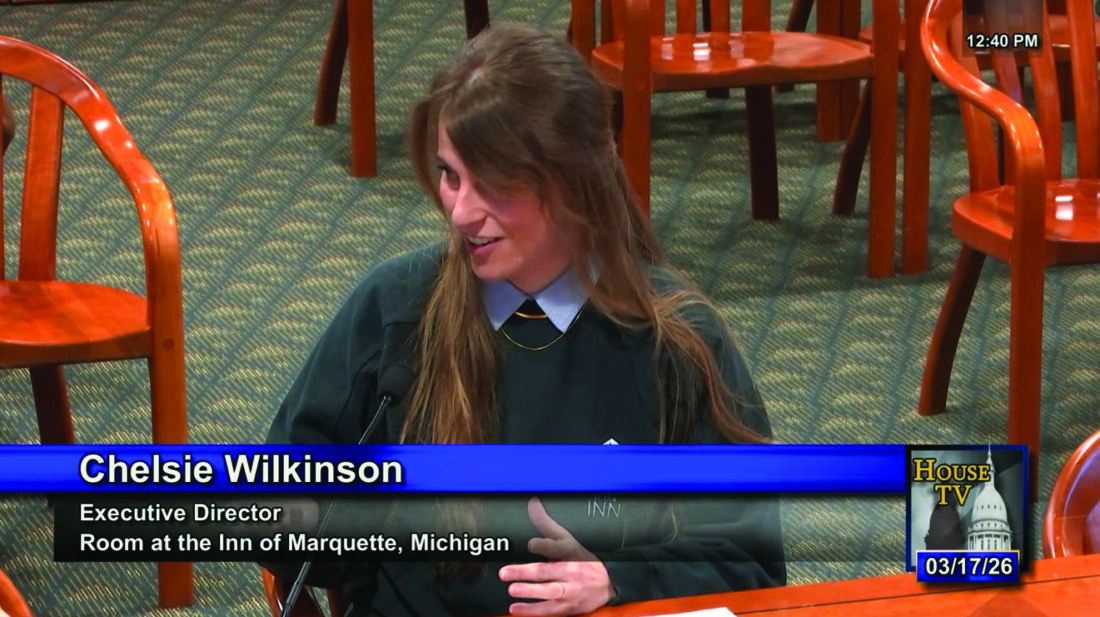
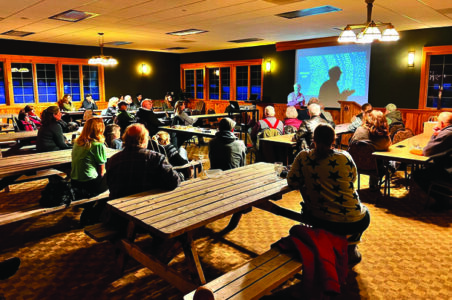
Executive Director of Room at the Inn Chelsie Wilkinson speaking in front of the MDHHS Human Services Appropriations Committee earlier this month. (Photo courtesy of Room at the Inn)
MARQUETTE — Room at the Inn Executive Director Chelsie Wilkinson recently got back from a trip to Lansing, where she presented to state legislators in the Michigan Department of Health & Human Services Human Resources Appropriations Subcommittee about Room at the Inn’s permanent supportive housing program, which helps those who are chronically homeless.
While she was downstate, Wilkinson also visited Hope Recuperative Shelter in Pontiac, which gives people experiencing homelessness a place to recover after being discharged from the hospital. Room at the Inn plans to establish a similar facility in Marquette.
“This testimony will hopefully help inform lawmakers who are considering a $20 million investment into programs across the state for Fiscal Year 2027,” said Wilkinson.
Room at the Inn’s permanent supportive housing program was started after Wilkinson took on her current position three years ago and noticed several gaps in support for people experiencing homelessness in Marquette.
“Other than the Harbor House, which is for families or folks who are fleeing domestic violence, there was no emergency shelter option for families with kiddos,” said Wilkinson. “The closest one was in Menominee.”
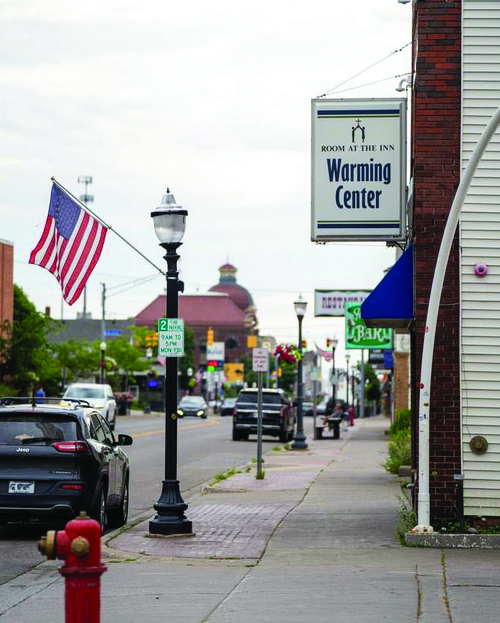
Room at the Inn’s Warming Center on West Washington Street in downtown Marquette. (Photo courtesy of Room at the Inn)
That wasn’t the only issue Wilkinson had to address.
“I had noticed that, year after year, we had an alarming increase in long stayers at the shelter; folks that had been there longer than 12 months,” said Wilkinson. “And these are employed folks … or folks that have maybe a $900 SSI or SSDI check in Social Security income, and they have a disabling condition. So they’re never going to increase their income.
“There’s a bottleneck at the shelter; there’s a lot of folks who maybe have a housing choice voucher in hand, but there aren’t enough units or landlords willing to participate in the voucher program … That bottleneck and that lack of support when somebody is rehoused was also something that we were tracking. How frequently are people coming back to us because they’re unable to maintain stable housing?”
When Room at the Inn first began looking at solutions to this issue, they looked to successful programs in other cities, like Avalon Housing in Ann Arbor. Avalon Housing helps over 900 people access supportive housing. However, these programs are often in larger cities, with different resources. Room at the Inn had to get more creative.
“As we know, there are a lot of really talented groups in the area that are working on increasing workforce housing, which means for people making between about 80% to 120% of the area monthly income,” said Wilkinson. “A lot of my folks who are getting stuck in the shelter are at or below 30% of the area median income, which is $18,000 per person, or $24,000 for a family of two … There is really no new housing being built for that income bracket.
“That means we, in this rural community, have to be really creative about utilizing our existing housing stock.”
Sometimes that creativity looks like working with local landlords and matching clients with case workers who will continue to help them on an on-call basis to navigate challenges and stay housed; whether that’s putting them in contact with mental health support, or getting them into job training, or giving them bus tickets to get to work.
“It’s really this unique catchall of understanding that there’s not a one-size fits all when it comes to stabilizing people who are in crisis,” said Wilkinson. “It’s really this unique investment into ensuring that the person remains stable … we really are trying to fix some of these ongoing systemic issues, instead of just being a band-aid on a broken arm.”
Wilkinson and Room at the Inn have since launched a permit-supportive housing program, and opened family shelters in Ishpeming and Gwinn. In Lansing, Wilkinson got to speak to lawmakers about the success of these programs, and advocate for their continued funding.
“There are over 7,000 households, individuals and families across the state of Michigan who benefit from supportive housing, and over 2,000 of those are families with children,” said Wilkinson. “I was representing a rural perspective on how we are utilizing our existing housing stock by improving relationships to the landlords, educating them about the program and how we can be a resource to the clients and to the landlords, to ensure that they’re getting paid … that was really important for us to explain to our policy makers and our legislators because they are in the middle of coming up with the 2027 fiscal year budget.”
At the MDHHS Human Resources Appropriations Subcommittee, Wilkinson spoke to Committee Chair Sylvia A. Santana, D-Detroit, as well as other state senators from both political parties.
“We, the statewide programs that benefit from this money, are requesting a $20 million investment into programs like ours for the fiscal year 2027,” said Wilkinson. “It was important for us to be there to represent a rural perspective on how we deploy these programs in a rural area, because it looks different, but the fundamentals of stabilizing people who suffer from chronic homelessness and the importance of that are the same.”
Wilkinson also talked with committee members about ongoing litigation between several states, including the State of Michigan, and the U.S. Department of Housing and Urban Development, who are seeking to implement a reduction in funding for programs like Room at the Inn.
“If that funding is pulled at the federal level, the (state) investment that we’re talking about would be a drop in the bucket,” said Wilkinson. “It would destabilize the entire network.”
At Room at the Inn, that destabilization would look like an uncertain future for the street outreach program, which helps people who couch surf, live in their cars, or live in abandoned buildings or outdoors.
“We’re watching that really closely, and we’re really concerned about what the implications of that loss of funding would mean for our street outreach team,” said Wilkinson.
Wilkinson’s presentation seemed to leave a positive impression.
“It seemed as though they received the presentations well, and understood the importance of the program,” said Wilkinson. “Hopefully we were able to move the needle a little bit on that.”
The other aspect of Wilkinson’s trip was visiting Hope Recuperative Shelter in Pontiac; a model for the recuperative care facility Room at the Inn is planning.
“I get calls from hospitals all over the UP with a client who is medically ready for discharge, but has nowhere to go,” said Wilkinson. “But their needs are still too high acuity for communal living spaces, which creates a really unstable environment … There are no less than 60 or 70 people receiving services at Room at the Inn on any given day.
“So you have someone who has just had open heart surgery, someone who has cancer treatment, someone who is maybe putting off a medical operation because their doctors have said that they have nowhere to recover properly … I’ve had people who have had frostbite and lost part of their legs, and then had to come back to the shelter and recuperate.”
Room at the Inn is currently in planning stages to open a recuperative care facility in Marquette, which would not only provide vital support for unhoused people recovering from medical interventions, but would also save hospitals money. Hospitalization costs $1,200 per person per day.
“Whether you’re the hospital, whether you’re a Medicaid payer or whether you’re us as the shelter provider, it just makes more sense to move into a more responsive space like that,” said Wilkinson.
“Touring the recuperative care facility in Pontiac was such a breath of fresh air, because they’ve been running that program for 10 years. So it is doable … At the end of the day, it’s just the right thing to do to treat somebody with dignity and respect when they are in a medical emergency. Healing from medical emergencies requires time and space and care and peace and access to followup appointments and access to on-site care.”
-
- Executive Director of Room at the Inn Chelsie Wilkinson speaking in front of the MDHHS Human Services Appropriations Committee earlier this month. (Photo courtesy of Room at the Inn)
-
- Room at the Inn’s Warming Center on West Washington Street in downtown Marquette. (Photo courtesy of Room at the Inn)
Wilkinson said that a recuperative care facility for people experiencing homelessness could open in Marquette within 12 months.
“I hope that work and advocacy like this shows the depth of what we’re up against as an organization and as a community,” said Wilkinson. “We see the suffering happening every day; it’s about getting the community to understand the importance of programs like these.”
Annie Lippert can be reached at 906-228-2500, ext. 550. Her email address is alippert@miningjournal.net.
Front Page News
Michigan measles outbreak: Confirmed cases grow to seven, including child under 5
YPSILANTI — Michigan is recording its first measles case in a child under 5 as the Washtenaw County outbreak ...
Dark Sky Festival returns to Copper Harbor — Speaking lineup announced
Room at the Inn executive director presents to MDDHS Human Resources Appropriations Subcommittee
MARQUETTE — Room at the Inn Executive Director Chelsie Wilkinson recently got back from a trip to Lansing, where ...

Bus to local casino crashes in Green Bay
Local teacher’s aide charged with child abuse