
It’s (almost) salamander time!
Portion of Peter White Drive to undergo closures for migration
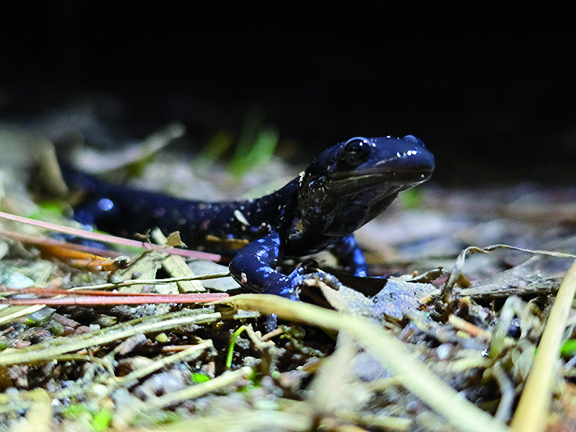
A blue-spotted salamander is pictured during a previous year’s salamander migration. (Photo courtesy of Jill Leonard)
MARQUETTE — The city of Marquette has announced that it will be closing a portion of Peter White Drive in Presque Isle Park, beginning on Sunday, to facilitate the safe migration of the blue-spotted salamander. The closure occurs in cooperation with the Superior Watershed Partnership and the Northern Michigan University Biology Department.
“The southwest bend of Peter White Drive from the Ice Cream Store Pavilion to the gate north of the pavilion will close to vehicular traffic daily at 8 p.m. from March 15 to May 15 or until the completion of the migration,” read the city’s announcement. “Road barricades will be placed and removed daily to prevent vehicular traffic use of the migration area. Foot traffic is permitted in the area during regular park hours.”
Ahead of the yearly salamander migration, Northern Michigan University Biology professor Dr. Jill Leonard led a Science on Tap talk at Blackrocks Brewery on Tuesday night titled The Secret Lives of Blue Spotted Salamanders. The talk was incredibly well attended, with standing room only on both levels of the brewery.
Leonard highlighted research conducted by NMU students Katie VanHise, Massimo Gulino, Abby Spegel, Jackie Westren and Abby Hill on the salamanders, including studies on their preferred substrate, how deep they burrow during the winter months to avoid below-freezing temperatures and how the salamanders react to street lights and flashlights during migration time.
Leonard made it clear that, though they might be cute, people should not take any salamanders home with them.
“This is my public service announcement,” said Leonard. “Blue spotted salamanders and other mole salamanders are not good pets … they’re hard to see in tanks when you keep them under leaves. They just don’t like you looking at them all the time. They are apparently not great tankmates for each other, they are challenging to feed properly and they are mildly toxic … and they’re easily harmed by human activity. So much better to leave them in the wild.”
Leonard also provided information on the famed salamander migration at Presque Isle, including information on how to respectfully observe the migration.
According to research conducted by former NMU undergraduate student Abby Hill, salamanders seem to prefer red or blue light to white light; achievable by using the red-light setting on headlamps, or by putting a colored filter over a flashlight beam.
“When you’ve got a filter on your light, it’s not that the animal’s gonna love it, but it’s gonna hate it a little less,” said Leonard. “Which is why last year, some of you may have seen us with rolls of blue tape. We’ll probably do this again this year. Putting a filter on some of those flashlights is a nice way to give those salamanders a little bit of a break.”
Leonard went on to present four years of data on the timing of the migration. The blue-spotted salamanders seem to move in the largest numbers when nighttime temperatures are above freezing, but “we almost always see animals moving before we get that temperature above freezing. Whether this is about local conditions, very fine scale meso-habitat kind of stuff, or they just don’t care, I don’t know yet. But clearly they’re moving before we get to these temperatures sometimes. And sometimes that’s weeks early.”
According to Leonard, during peak migration nights as many as 200-250 salamanders cross the road per hour.
“Thousands of animals walk across that road every year,” said Leonard. “…Sometimes they get going really early. Sometimes they stay going pretty late. That’s why there really is a need for that 6-8 week road closure.”
Leonard said that more salamanders tend to be on the road when the road is moist, whether that’s from rainfall or snowmelt, and that peak migration times are usually around 10 or 11 p.m.
Finally, Leonard talked about some ways that NMU students and the general public can help with the research.
“The student data collection is going to continue,” said Leonard.
NMU students can attend one of three volunteer training sessions, at 6 p.m. on March 12, 7 p.m. on March 16 and 6 p.m. on March 18 in JXJ 110, where they will learn how to use a new data collection app developed by NMU and EarthRanger.
This year, though, there is a new opportunity for Marquette residents to get in on the science.
“We are unveiling a new citizen science project,” said Leonard. “This can be done by anybody. Students, non-students, little kids, old people, whoever. You can participate and help us gather data.”
Student volunteers at Presque Isle will be providing citizen scientists with special rulers to place next to salamanders in photographs, that will then be submitted to a project in the application iNaturalist.
“That data will accumulate over time so that we have an enormous data set of photographs of our Presque Isle salamanders,” said Leonard.
Posters will be placed around town with a QR code link to the project.
“My students from my lab aren’t going to be able to take enough pictures, but you guys can,” said Leonard. “I encourage you to participate in this and know that we will be using your data.”
Annie Lippert can be reached at 906-228-2500, ext. 550. Her email address is alippert@miningjournal.net.
Front Page News
It’s (almost) salamander time!

Pathologist, domestic violence expert testify in Jackson trial

Michigan warns of tax refund delays amid a surge in early filing

State announces new jobs coming to U.P., $1.2 million expansion
Pothole season is upon us
Fire at Harbor Tower caused by lit cigarette
ESCANABA — The fire that damaged the Harbor Tower, a 175-unit subsidized housing facility and tallest building in ...