
Marquette Regional History Center to offer free digitization of Barnes-Hecker Mine-related documents
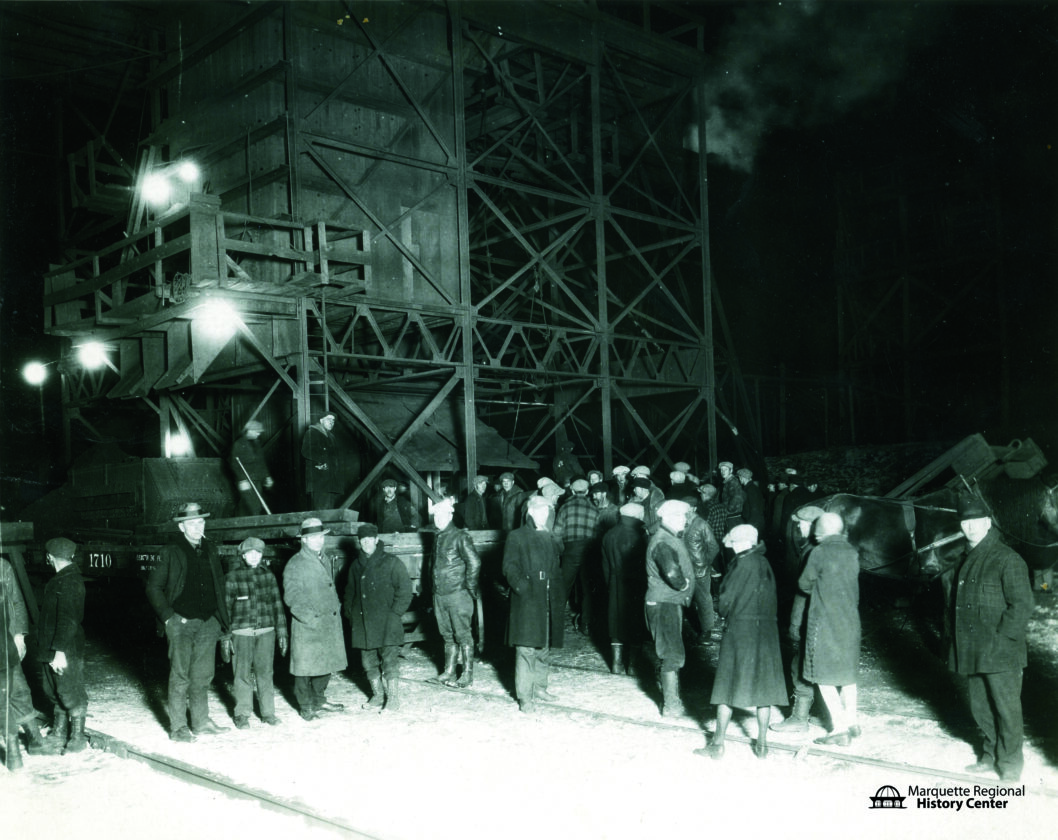
The Barnes-Hecker mine on the night of the disaster, taken at 11 p.m. on Nov. 3, 1926. (Photo courtesy of the Marquette Regional History Center)
MARQUETTE — In partnership with the Barnes-Hecker 100th Anniversary Committee, the Marquette Regional History Center will be conducting free digitization of Barnes-Hecker Mine-related documents on three days in upcoming months. Those dates are as follows: from 10-3 p.m. on March 7 at the Marquette Regional History Center, from 11-3 p.m. on March 13 at the Ishpeming Carnegie Public Library, and from 10-8 p.m. on March 25 at the Marquette Regional History Center.
“Digitization has two major benefits,” said Emi Tinder, cataloguing librarian at the John M. Longyear Research Library at the Marquette Regional History Center. “First and foremost, it makes the materials more accessible to a greater number of people, but allows families to hold onto cherished items. The information will become available to researchers and educators locally, and also allow for people from outside the area to learn more about the disaster online.
“The second benefit is that we can digitally preserve objects better than we can physically preserve them. Paper and photographs degrade over time no matter what you do to save them, so capturing them now gives us a version that we can hold onto over time.”
The goal of the project is to increase the volume of information available about the Barnes-Hecker Mine Disaster, an important event in local history.
“If community members don’t come forward with those records, we will have less to pass on to future generations,” said Tinder.
The Barnes-Hecker Mine Disaster remains the deadliest iron mining disaster in U.S. history, as well as the deadliest industrial disaster in Michigan History. The one-hundredth anniversary of the disaster will be in November.
“On the morning of November 3, 1926, miners set off a routine blast at 11:20 a.m.,” said Ann Tippett of the Barnes-Hecker 100th Anniversary Committee. “The blast caused a catastrophic cave-in, and the mine completely flooded with water, mud and debris. Fifty-one men were trapped underground and killed. Only one miner was able to climb for his life up a ladder to escape. Ten bodies were recovered. The remaining miners are entombed in the mine.”
“Forty-two women became widows, and 132 children became fatherless,” continued Tippett. “While none of the children are alive any longer, many grandchildren and great-grandchildren hold the miners close to their hearts with the desire to never let them be forgotten.”
The History Center is looking for any documents related to the Barnes-Hecker mine, including portraits or family photos with miners, documents related to their employment at the mine, photographs of the mine and/or surrounding areas, memorial scrapbooks, diaries or letters.
“We will be using a flatbed scanner to scan photos and documents that belong to community members,” said Tinder. “They will be able to keep the items, receive the digital versions on a flash drive we provide, and donate the scans if they desire. The donated scans will be placed in the Marquette Regional History Center’s permanent library collection, published online through the Upper Peninsula Digital Network, and made available for the upcoming exhibit at the Beaumier U.P. Heritage Center.”
Participants will not be required to donate any scans of their items, but those who decide to do so will sign a donor agreement stipulating that the materials will only be used for non-profit educational or research purposes.
“We are able to scan documents, photo prints, photo negatives, and photo slides; no film rolls or reels,” said Tinder. “We have an 8.5×11” scanner, but it may be possible to take multiple scans of oversized items and stitch them together.”
Appointments will be required in order to participate. Those who are interested can call or email the Marquette Regional History Center at 906-226-3571 or mrhc@marquettehistory.org. Participation in the digitization event is free.
“The Barnes-Hecker memorial provides an opportunity for the community to reflect on the human impact that mining had on our area,” said Tinder. “We still see the physical remnants of the mines and the names of the industry’s wealthiest individuals on our street signs, but we often don’t get the chance to know about the people putting in the work. We know generally about the dangers that they faced, but we can lose sight of the fact that many of them paid the ultimate price.
“Iron miners were some of the most important people in the development of our country, and for decades the Upper Peninsula was the country’s leading supplier of iron ore. They extracted tons and tons of the iron needed for railroads, skyscrapers, and automobiles, and they produced the resources that helped us win two World Wars. Our lives would look drastically different today if it weren’t for them, yet most people don’t recognize their impact and even fewer know about the sacrifices they made. This event is an opportunity for us to change that.”
Annie Lippert can be reached at 906-228-2500, ext. 550. Her email address is alippert@miningjournal.net.
Front Page News
Marquette Regional History Center to offer free digitization of Barnes-Hecker Mine-related documents

Trump says he’ll raise tariffs to 15 percent after Supreme Court ruling

We are the champions
U.P. Builder’s Show returning to Superior Dome March 6-8
MARQUETTE — From March 6-8, the U.P. Builder’s show will once again be held inside the Superior Dome, this year ...
Marquette County residents urge Marquette County Board of Commissioners to develop ICE-related policy
Ishpeming men arrested on meth charges in Roscommon County
ROSCOMMON COUNTY — Two men from Ishpeming were arrested on Feb. 10 downstate in Roscommon County and arraigned on ...