
The deadliest day
Friday marked 100th anniversary of fateful Marquette event

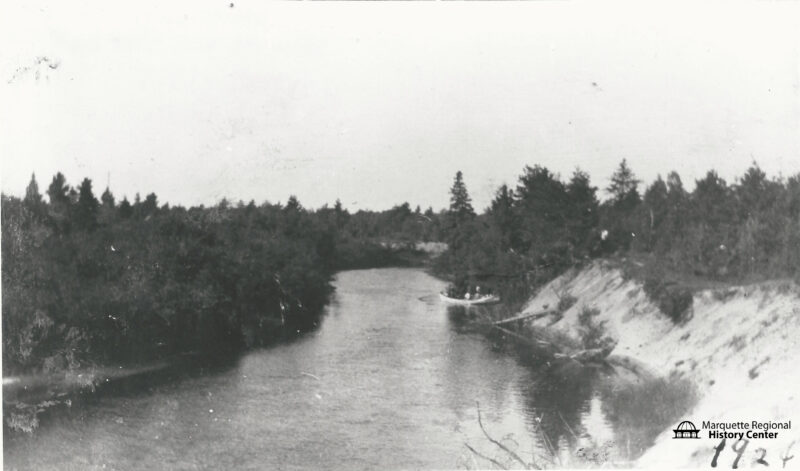
Captain Deegan’s life-saving crew drags the Chocolay River for Oscar Lampinen’s body. (Photo courtesy of Marquette Regional History Center)
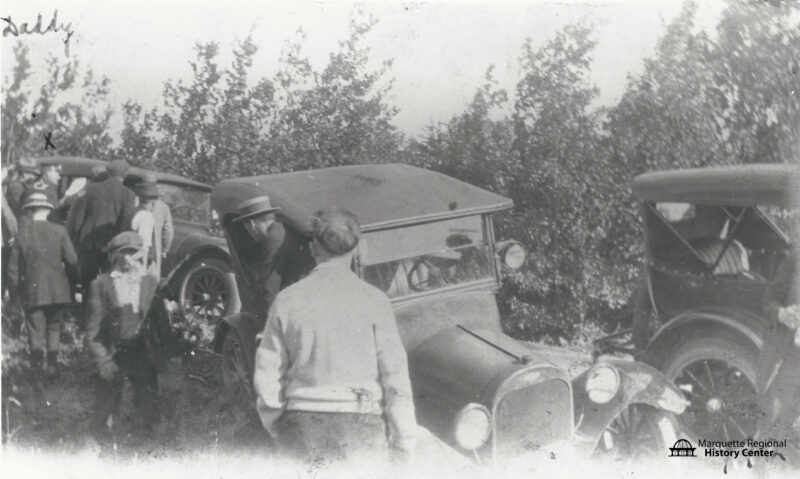 MARQUETTE — The deadliest day for the Marquette Police Department occurred 100 years ago on Aug. 23, 1924, when police Chief Martin Ford, patrolman Thomas Thornton and Ford’s 19-year-old son, Lloyd, were shot and killed.
Officers Thomas Thornton and Walter Tippett got off duty at 4 a.m. Saturday after a 10-hour shift. Thornton waited for the new issue of The Mining Journal while Tippett went to city hall to get a truck to drive home.
The police had been patrolling the alleys more frequently due to a break-in at the Stern and Field’s Clothing Store the previous week. Thornton made a check of the alley behind the Journal office between Third and Fourth streets. He surprised a man trying to break into Boucher’s Drug Store and told the man to halt.
Shots ensued with a foot chase leading onto the property of Harlow Clark on Fourth Street. Soon more shots were fired. Tippett and several other people found Thornton on the ground wounded near Harlow’s Wooden Man. He described the assailant as about 5 feet 9 inches tall with a blue suit and a soft brown hat.
At St. Mary’s Hospital, staff found Thornton had been shot at close range in the abdomen, hip and shoulder.
He shook hands with his partner, saying he had done his best, “Goodbye Tip, I’m going.” He died shortly after. Thornton was 26 years old and left a wife and two young sons.
The shooter was identified as 20-year-old Oscar Lampinen of Deerton. Lampinen always carried a gun and was known to show off his shooting skills. Calls were made to the prison and sheriff’s department to keep watch for the shooter.
Tippett testified to the subsequent events in a written inquiry two days later.
Police Chief Ford, his son Lloyd and Tippett drove over to officers Anderson’s and Betts’ homes to assemble a search party. Ford told his son to go home and get his gun. He returned with a .25 Luger automatic pistol.
After the suspect was spotted walking on the Duluth, South Shore and Atlantic Railway tracks, past the prison and heading to Harvey, the three men followed with Lloyd Ford driving. Tippett remarked that they ought to have rifles, but Ford stated that they could not afford to lose any time. They sped to the Lakewood Lane railroad crossing and saw a man walking on the tracks. Lampinen spotted the posse and ran into the woods toward the Chocolay River.
Tippett stated, “Just as soon as he got to the woods, I saw him throw his coat on the ground, reaching into his hip pocket. We three commenced firing at him and hollering and I saw him disappear over a little knoll into a thick swamp. Mr. Ford and his son stayed on the high land. Just as I went down into the swamp, I heard shots fired in rapid succession and I just got up where I could see the edge of river, about 20 feet, when I heard Martin Ford say, ‘Oh, he got me too Tip’ and he had his hand on his right breast and staggered and fell, and Lloyd says, ‘Yes, he got me too!’ Just then I saw a head raise above the bank and a bullet struck the tree right near me and I kept coming and Lloyd says, ‘He is in the water.’ I stepped up to the bank and he was beginning to swim 150 feet across the river, and I fired.”
Tippett then said he shot Lampinen twice, noticing blood at the back of his head. He watched Lampinen disappear into the Chocolay River and not resurface. Tippett told Lloyd Ford he had got him, and Lloyd said, “Good for you Tip.”
The police chief fell with his gun still in his hand, 15 feet from the river. He had served as an exemplary police chief for over five years. He was 55 years old and left a wife and three daughters.
The chief was beyond help, so Tippett got Lloyd Ford into the automobile and raced to St. Mary’s Hospital. Lloyd Ford had been shot twice, in the forehead and abdomen. Despite initial hopes for his survival, he died two days later.
The lifesaving crew and Capt. Deegan dragged the river, locating Lampinen’s body. His .32-caliber revolver was never recovered, just shells on the shore. A soft brown hat was later found in the woods with a Stern and Field label, proving that Lampinen had been the robber the previous week.
The Marquette community was shocked by the killings. The State Compensation Act would provide relief to the Thornton and Ford families of $14 a week for five and a half years. However, the community knew the need was immediate and within days had raised $5,000 in donations.
The tragedy of this event did not end here. Tippett had been on the police force for less than a year. Feeling badly about killing a man, he resigned. He worked at the Marquette Branch Prison until a riot in 1926. Originally from Ishpeming, Tippett wanted to work closer to his brothers. They found him a “safe” job in an iron mine in west Ishpeming.
As fate would have it, Tippett started at the mine on Nov. 3, 1926. He was on his first shift underground at the Barnes-Hecker Mine when a sudden cave-in of sand and water filled the shafts and entombed 51 iron ore miners including Tippett and his brother William. Another brother, Albert, was above ground at the time, while their stepbrother Rutherford Wills was the only man underground to safely reach the surface. This disaster is recorded in history as the worst iron mining accident in the Upper Peninsula.
Front Page News

Most counties in Michigan gained population last year

Converting public schools to clean energy will create jobs, group says

Deceased western U.P. child identified

Marquette United Way hosting egg hunts
Rapid River man arrested on multiple felony charges