
Salamander migration begins on Presque Isle
Trending
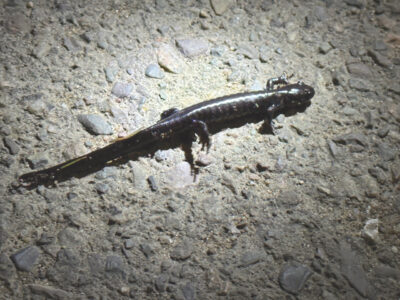
The city of Marquette, in cooperation with the Superior Watershed Partnership and Land Conservancy as well as the Northern Michigan University Department of Biology, again is closing a portion of Peter White Drive in Presque Isle Park to facilitate the safe migration of the blue-spotted salamander.
The southwest bend of Peter White Drive, from the Island Store pavilion to the gate north of the pavilion, is closed to vehicular traffic daily from 8 p.m. to 8 a.m. through April 30, or until the completion of the migration.
Road barricades will be placed and removed daily to prevent vehicular traffic use of the migration area, though foot traffic is permitted in the area during regular park hours.
The closure, which has received national attention over the years, was the brainchild of former NMU student Eli Bieri, who in 2018 noticed vehicles were running over and killing the migrating salamanders as they were migrating from the interior of Presque Isle Park across Peter White Drive to their breeding ponds.
As a result, road closures began in the spring of 2020, with the desired result of decreased mortality.
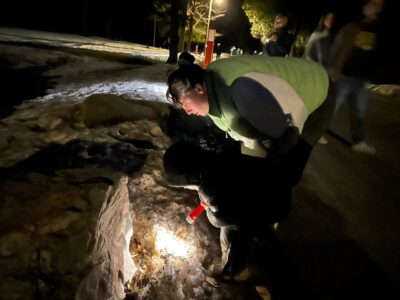
On Monday evening, many people came out with their flashlights and cell phone cameras to watch and record the salamanders that began to make their way to their breeding area, traveling slowly over snow banks and other obstacles.
Margaret Hartman of Marquette brought her 4-year-old son, Theodore, out to Presque Isle Park, even though it was past his bedtime.
"I just thought it'd be fun to bring him out and show him the blue-spotted salamanders," she said.
The Monday trip to the park wasn't her first time.
"It's crazy, because I remember back, maybe 10 years ago, before they started closing the road, this one night I walked down here and I saw all this massacre of the salamanders," she said. "So ever since then, I've been, 'OK, what are we doing about the salamanders?' So I'm so glad they closed the road now."
The salamanders brought out a lot of enthusiasm in the crowd, particularly from the younger set, one of whom named the salamanders.
He dubbed one of them Ethan.
It probably won't be known for sure when Ethan and the other amphibians will reach their destination, but the hope is that road mortality will continue to decrease.
SWP had a presence on Monday, as it had previously, asking people this year to stay off the snow banks to avoid stepping on the salamanders. People also were asked to record how many salamanders they saw and turn in their numbers at the end of their trip.
In 2019, cars killed more than 400 salamanders, said Tyler Penrod of the SWP and Land Conservancy and program manager for the Great Lakes Climate Corps, in an email. "After SWP partnered with the city of Marquette to begin closing the road in 2020, only three salamander fatalities were observed.
"In 2022, we saw an uptick in fatalities with nine salamanders most likely killed by careless footsteps from the significant increase in people coming out to view the migration. We encourage everyone who comes out to walk slowly and thoughtfully and to carry a flashlight with them."
Kathleen Henry, special projects coordinator and education specialist with the SWP and Land Conservancy, reiterated the need for people to watch their step.
"The citizen science data collection, in partnership with NMU, is continuing again this year," Henry said in an email. "We would like to remind folks that this is a sensitive time for our migrating spring species though -- they're breeding and depositing eggs -- and as such, we are encouraging folks to look locally, maybe even in your backyard, to spot the migrating spring species.
"If you are coming out to Presque, please continue to be respectful of your surroundings."