
Confirmed divide: Sexual identity and religion still at odds

Martin
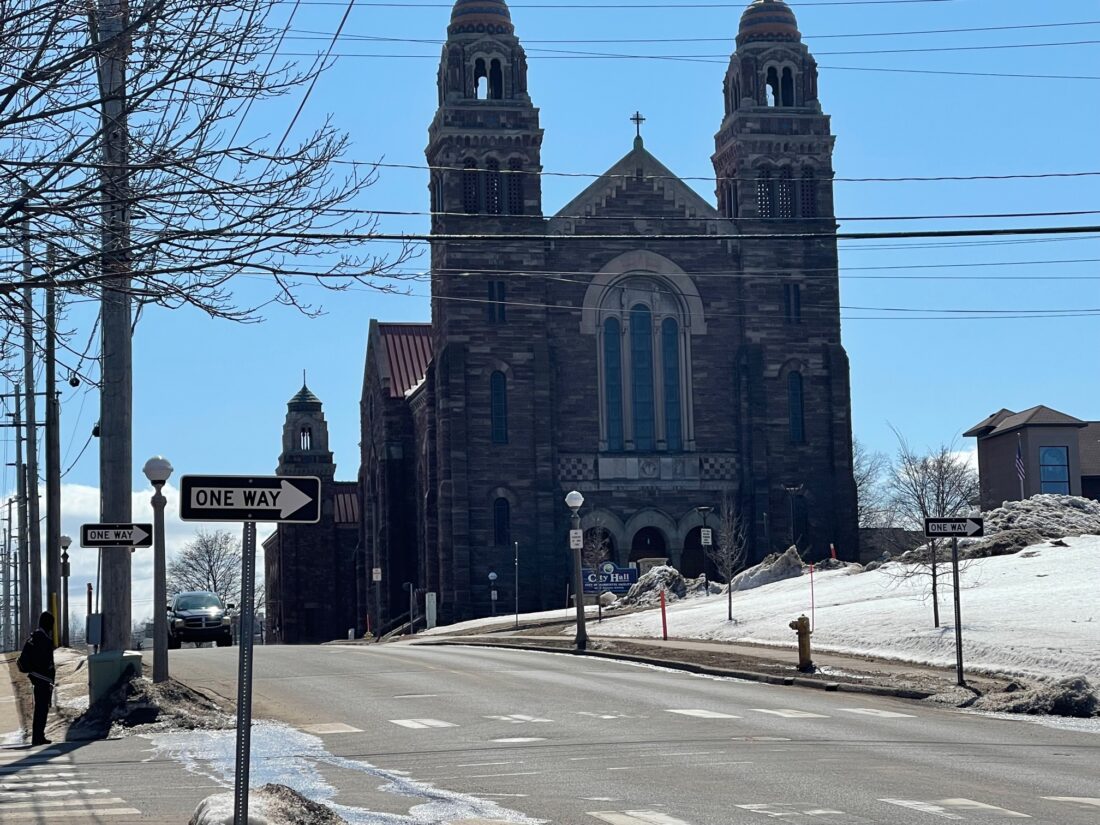
St. Peter Cathedral in Marquette is pictured. A group of concerned Catholics across the Upper Peninsula is still pushing back two years after Roman Catholic Diocese of Marquette Bishop John Doerfler introduced an instruction that denies LGBTQ+ people certain sacraments. (Journal photo by Lisa Bowers)

Doerfler
Martin
St. Peter Cathedral in Marquette is pictured. A group of concerned Catholics across the Upper Peninsula is still pushing back two years after Roman Catholic Diocese of Marquette Bishop John Doerfler introduced an instruction that denies LGBTQ+ people certain sacraments. (Journal photo by Lisa Bowers)
Doerfler
Trending
MARQUETTE -- Cathy is a devout Catholic. She grew up in the 1950s and went to a strict Catholic school. She attends Mass regularly at a church in Marquette County.
She also has a granddaughter who is transgender.
"To see her now, when I look at the pictures of her when she was (a boy,) it's like, how could that ever be? From the time she was little, people would say 'You're such a cute little boy.' and she'd say, 'I'm not a boy, I'm a girl.'" said Cathy, who agreed to be interviewed if her identity was protected. "And if you took her to the store in the boys toy section, she went right to the girls' to the dolls. She always carried dolls and still does. Even all the (Northern Michigan University) football players who knew her back then when she was (a boy) -- they say, 'Oh, that doesn't surprise me.' Even them, they could see it."
And the conflicting situations between church teachings and her family are not lost on the devout Catholic when she goes to Mass.
"I won't go to places of business that discriminate against LGBTQ people, so I almost feel like a hypocrite," she said.
It's been nearly two years since Bishop John Doerfler issued an instruction to the Roman Catholic Diocese of Marquette about how to care for people who identify as lesbian, gay, bisexual or transgender.
The instruction on "the pastoral care of persons with same-sex attraction and gender dysphoria" caused an uproar almost immediately, with opponents decrying the potential for people who identify as gay or transgender to arbitrarily be denied sacraments such as communion.
A statement on the U.P. Catholic Diocese website said the 2021 policy "focuses on accompaniment with dignity and respect for the person, while remaining faithful to the teachings of the Church."
For Cathy, the instruction made her second guess her church, but not her faith.
"When I heard this from the bishop, I was really upset because who is he to say?" she said. "And to refuse sacraments when even the pope says that you cannot withhold communion and withhold the sacraments. The pope even says, 'Who are we to judge?' And I thought, this is not right. It's not right."
The policy says people in same-sex sexual relationships and those who identity as a gender different than their assigned sex at birth should not receive the sacraments, including the anointing of the sick, but Doerfler said it's not really about denying people anything.
"We need to lead people to where they can be properly disposed to receive the sacraments," Doerfler said in a December interview. "We want people to receive the sacraments. We want people to follow Jesus. We want people to get to the point where they understand all of the teachings of Jesus all at once. We would not be authentically leading people to Christ if we did not, and at the same time, with the right timing, invite them to change their lives."
Pope Francis makes historic statements about same sex relations
Much has changed in state and federal governance and in spiritual and secular environments.
Pope Francis became the first pontiff to ever speak out against criminalized homosexuality, calling it "unjust" in a recent interview with The Associated Press.
According to the AP article, 67 countries or jurisdictions worldwide criminalize consensual same-sex activity. In 11 of those countries, such activity is punishable by death.
During the interview, Francis acknowledged that Catholic bishops in some parts of the world openly support laws that criminalize homosexuality or discriminate against the LGBTQ community.
And, while he himself referred to homosexuality in terms of "sin," the pope also said "being homosexual isn't a crime."
"These bishops have to have a process of conversion," Pope Francis told AP.
He said bishops should apply "tenderness, please -- as God has for each one of us."
While Francis' comments represent a significant shift, it stops short.
He has reaffirmed that same-sex orientation is not, in and of itself, sinful, but acting upon those feelings is still considered a sin -- a stance which seems to align with Doerfler's instruction.
"There has been a few common misunderstandings that I think it's good to clarify," Doerfler said. "There is a real clear difference in feelings that we might experience and how we act on them. And, just to take the example of anger. We get angry about things, and there is nothing sinful about feeling angry, but how do we act on those feelings? And people may have various sexual feelings or attractions that arise, and how we act upon them is where sin may come into play? So just having feelings of attraction to people of the same sex, or if someone has gender dysphoria, just having those feelings is not sinful.
"It's what people freely and deliberately choose to do."
Federal and state protections
On the federal level, President Joe Biden signed the Respect for Marriage Act, which changes the definition of marriage, which was previously limited to a union between a man and a woman. The RMA recognizes any marriage between two adults as valid under state law. The act also requires states to recognize same-sex unions from other states, according to Congress.gov.
Michigan government, where Democrats hold a legislative majority for the first time in decades, also made strides to protect the rights of people who identify as LGBTQ.
The state Senate voted to add LGBTQ+ protections to the 1973 Elliot-Larsen Civil Rights Act and the bill passed with bipartisan support with three Republicans votimg to pass it before it was sent to the House on March 1.
State Sen. Jeremy Moss, a Democrat from Southfield, and Michigan's first openly gay senator, introduced the legislation.
"And when this vote comes on the board, you will tell generations of people yet to come that they have a future, too," Moss said before the vote.
State Sen. Ed McBroom, R-Waucedah Township, spoke for nearly 30 minutes before voting no on the legislation.
"This legislation will create impossible-to-resolve conflicts for churches, individuals, employers and employees," McBroom said.
White Lake Republican Sen. Jim Runestad agreed with McBroom, saying that without religious protections, the law would be an invitation to "weaponize Michigan's civil rights law."
Runestad's request to include "religious orientation, religious identity or expression" in the protections failed to make it into the bill.
That same argument was made by the Michigan Catholic Conference.
"By failing to strike a balance and voting against amendments to ensure religious organizations are not targeted for their long-standing religious beliefs about marriage and gender differences," MCC vice president Tom Hickson said in a press release, "the Senate has signed off on creating a class of citizens against which discrimination and targeted litigation will be likely."
The bill was ultimately signed into law by Gov. Gretchen Whitmer without the protections on March 16. The Democrat said the action has "been a long time coming."
Pushback from some Catholic and political leaders
According to the National Catholic Reporter, two women south of Denver were reportedly denied communion after wearing rainbow masks to a Catholic Mass in support of a gay teacher who had been fired by the diocese.
The U.S. Conference of Catholic Bishops elected Archbishop Timothy Broglio -- a vocal opponent of marriage equality, among other LGBTQ+ protections -- as its president.
In 2013, Broglio, then archbishop of the U.S. Archdiocese for the Military Services, spoke out against the military recognizing gay marriage.
"This new policy under the guise of 'equal benefits,'" he said, "undermines marriage as the union of one man and one woman because it treats two persons of the same sex as spouses."
Several states have introduced or enacted laws that limit or eliminate transgender care for youth. Other laws prohibit certain adult cabaret performances, specifically drag shows. As of the end of February, according to an ABC News report, 10 states had enacted a ban on transgender care and more than double that number were considering similar bans.
A March 10 article in The Guardian shows that drag shows are under equal attack by many of the same states. Since the beginning of the year, dozens of bills have been filed across the country and more are expected.
U.P. representative of a nationwide divide/debate
On Jan. 22, 2022, 143 Catholics from across the Upper Peninsula signed a petition opposing Doerfler's instruction about how to treat LGBTQ+ persons. Several of those parishioners then met with the bishop personally twice to discuss the issue.
Members of this Concerned Catholics group have continued to call the instruction divisive. They are adamant that a great many people in the pews do not agree with it.
In some cases, they say the bishop's words makes them, or members of their families, feel excluded or even ostracized from the church, and by extension, their faith.
Group members say the instruction is "another example of defiance of Pope Francis by cultural warrior bishops" in the United States.
A prominent Jesuit priest, Father James Martin, who first brought Doerfler's policy to light nationally in 2021, has often been at odds with that conservative Catholic viewpoint, which is reflective of the impasse felt by some local Catholics.
"In general, since so many people -- psychologists, biologists, physicians and others -- are still learning about this complex phenomenon, so should the church," Martin said in an email with The Mining Journal. "So instead of issuing statements, I think it's better at this point for the church to listen, and part of that listening should be to transgender people and their families. There's nothing wrong with listening before you teach."
Members of the Concerned Catholic group say the words of Martin and the pope himself resonate with them.
"Tell me: when God looks at a gay person, does he endorse the existence of this person with love, or reject and condemn this person?" Pope Francis said. "We have to find a new balance; otherwise even the moral edifice of the church is likely to fall like a house of cards, losing the freshness and fragrance of the Gospel."
Negaunee resident Jim Paquette, who was raised Catholic and brought up his children in the Catholic Church, said he doesn't have any illusions that he is going to change Doerfler's mind or change the church.
"One of the reasons why I do what I do is just strictly -- more than anything -- is (out of) my love of other people. Just to reach out and to put up this fight," Paquette said. "It's to let those other people know that we're in this fight with them. And it's to support them. To show them that 'We love you, you are still my brother and my sister and we love you.'"
Maura Davenport of Marquette is also a lifelong Catholic who has worked in the ministry of the church for much of her adult life. She came away from those conversations with Doerfler last year with her own realization.
"What I do is separate the faith from the institution." Davenport said. "(A priest once said that) I was having a crisis of faith -- and I'm not because I feel like I am practicing my vocation and my faith and I love my faith community.
"But, the institution's over here, and I have nothing to do with it."
And while opponents continue to say that the instruction has "made a more divisive political and social atmosphere in the church," and has made people fall away from the church because they feel excluded, Doerfler disagrees.
"So, none of this is meant to exclude people from the sacraments, but just to take a look at, hey, you've done something that has really been something serious that has harmed your relationship with the Lord, and you need to change this in your life," he said. "(You need to) go to confession and be properly disposed to receive Holy Communion."
He noted that the instruction is in keeping with the teachings of the Second Vatican Council.
"In fact, the Code of Canon Law which was revised by the Second Council, has maintained that constant discipline that we've had going back to the first century. So we are not being unfaithful to the vision of the council or any of the practices of the church, it's a 2,000-year tradition."
Following the meetings, the Concerned Catholics group issued a statement which said in part;
"Bishop Doerfler came armed with numerous books and Scripture. Concerned Catholics came armed with lived experience and faith," the release stated. "As the bishop left the meeting on July 28th, Concerned Catholics expressed frustration that the bishop had not listened and refused to revise the Diocese's policy. But we hope we have planted a mustard seed of empathy in the bishop's heart -- that may someday help him realize that LGBT Catholics are deserving of being considered 'children of God.'"
Doerfler's position is not unique among U.S. Catholic leaders. On March 20, the U.S. Conference of Catholic Bishop's Committee on Doctrine published a "Doctrinal Note on the Moral Limits to Technological Manipulation of the Human Body."
The document refers to an excerpt the Catechism of the Catholic Church, which says:
"Man and woman have been created, which is to say, willed by God: on the one hand, in perfect equality as human persons; on the other, in their respective beings as man and woman. 'Being man' or 'being woman' is a reality which is good and willed by God."
Martin said although there has been a rise in the number U.S. bishops who are promoting policies that restrict participation of LGBTQ people in the church, it can depend on the church.
"In some dioceses and parishes in the United States, LGBTQ people are increasingly welcomed. Many parishes and Catholic high schools and colleges now have LGBTQ outreach groups," Martin said. "In other dioceses, the situation is quite different, not only in terms of formal policies, but in the kinds of 'off-the-cuff' remarks made by church leaders, which let LGBTQ Catholics know that they are unwelcome.
"Of course, in places like Eastern Europe and sub-Saharan Africa, the situation is far more restrictive. Some bishops in those regions have even sided with laws that criminalize homosexuality, even though Pope Francis has come out against that."
Doerfler, for his part, noted that only people whose sins are "publicly manifest" could be denied communion. In other words, the person giving the sacrament knows you are in a same-sex relationship, are transgender or have committed another sin such as adultery, theft or fraud.
"If we are looking to grow in our relationship with the Lord, we want to avoid anything that would rupture that relationship. So receiving communion unworthily -- in a state of sin -- ruptures that relationship even more," Doerfler said.
Even if the person giving the sacraments does not know about your activities, a sin in the eyes of the church is a sin in the eyes of God. So, hiding the activity does not make it right.
"So, it's not OK in that sense, because of the spiritual damage it causes the person. This is why we have this practice in the Catholic Church, it's not to be punitive, but it's for the spiritual good of someone. We're concerned about people's spiritual welfare."
He said the church does not keep track of those who have been denied communion.
Cathy and her family hold out hope that churches nationwide will become more compassionate toward Catholics who identify as LGBTQ.
"Everybody deserves to be loved. I mean, Jesus loved the sinner. He welcomed more the sinner than the rich man. All those parables have to do with the poor and the lowly. And taking care of your neighbor and doing good. It just upsets me that my granddaughter is being discriminated against, and how many other people in the community are being discriminated against? Where is it going to end?
"When you start with this, you know, where is it going to go next? They are taking us way backwards."