
‘Cannabis question’ mulled
Changing culture
Trending
MARQUETTE -- Cannabis is a multi-faceted topic, and those facets were the focus of a Monday community forum hosted by Northern Michigan University's Medicinal Plant Club.
The forum, which took place at Jamrich Hall, featured the movie "The Cannabis Question."
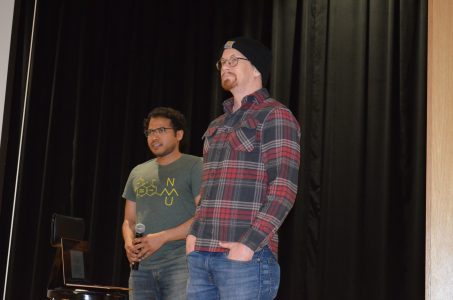
NMU seniors Darren Simmons and John Barfoot, club president and vice president, respectively, led a discussion with the audience after showing the film, which delved into the use of cannabis to treat a host of medical disorders as well as issues rising from it being legal in some states but not others.
The film also looked at the lack of data, for example, regarding long-term effects with medical marijuana.
The movie asked whether cannabis is a panacea or the "devil's grass."
It probably depends on the situation.
"What is your opinion on addiction?" Simmons asked the audience.
One man defined addiction as when drug use stops making sense and the user stops getting what they wanted from it, and becomes reliant on the drug.
"You don't think about why you're using it," he said. "You're just normalized that you use it."
Tolerance levels, including the influence on an individual's physique, for example, also were discussed.
Simmons said more research needs to be completed before certain regulations are imposed, although he believes studies have been focused on when a therapeutic dose becomes "intoxicating."
Whether cannabis is addictive also was brought up.
"I think people get addicted to not being in pain," said one man, who explained that such people are trying to pull themselves out of a situation they must face. "It's not really addiction, in my opinion."
Barfoot asked the audience if the film raised surprises for them.
One man mentioned a man who had a medical marijuana card in a state where it was legal, but was arrested in a state where it was not legal, which resulted in him serving a prison sentence.
"That's nuts that we have that disparity," the man said.
Barfoot said some states have a reciprocity agreement in which someone with a medical marijuana card in Arizona, for example, can get cannabis in Michigan.
"You still have to be super careful about crossing state borders," he said. "It kind of leads for a very messy system."
One woman believes cannabis education should be included in the high school curriculum.
Most people start using cannabis at around 14 to 15 years old, she said.
"You need to start teaching people before or during when they're starting to use it so they can use it more responsibility, buy a product that is more sustainable for their body and their brain to use, and not cause psychosis or these adverse effects," she said.
A part of the film that wasn't shown at the forum addressed adolescents using cannabis, Simmons said.
"One of the things they said was that during (the) teens, like age 14 to 17, our endocannabinoid system is at its peak during that time, and so I think that's interesting," he said.
To one woman, cannabis reform means it would be highly regulated -- and people not going to jail for it. She also believes in more research. However, another man noted that funding needs to come from the federal government for research.
Currently, the use and possession of cannabis is illegal under federal law and, according to the film, is classified as a Substance 1 controlled substance, with heroin also in that category.
In November 2018, Michigan voters approved Proposal 1, an initiative that legalized cannabis for adult recreational use in the state. Medical marijuana already had been legalized in Michigan.
The passing of the initiative ushered in a wave of cannabis-related businesses. However, NMU in 2017 already made a notable step in the industry.
NMU that year began to offer the first four-year undergraduate degree program of its kind designed to prepare students for success in the emerging industries relating to medicinal plant production, analysis and distribution.
NMU has added an associate degree in indoor agriculture and two online accelerated certificate programs in cannabis operations and plant-based wellness.
Cannabis also was the focus of Tuesday's Great Lakes Cannabis Education Conference, hosted by NMU. The event was to include showcasing current and developing trends as well as other topics.
Christie Mastric can be reached at 906-228-2500, ext. 250. Her email address is cbleck@miningjournal.net.