
Through the eyes of war veterans
Author and Negaunee native John Maino releases latest book
Trending
MARQUETTE -- When you think about war, what comes to mind?
War could be anything from spoken political conflict between countries, the card game that never ends, or military men and women physically fighting for their nation on a fierce, bloody battlefield.
More often than not, people think of the latter. However, it's a difficult thought to comprehend. When the average human thinks of physical war, they often think about guns, tanks and other weapons of mass destruction.
Many people find those things cool, particularly at a younger age. But often lost in the thought of war are the aspects of human life and reality.
Picture moving through the cold winters of Europe and seeing the bodies of deceased soldiers littered across the ground. Picture being a medic having to reassure the wounded they weren't going to die, even if they had no chance of living. Picture throwing together gifts for orphans who were without a home on Christmas.
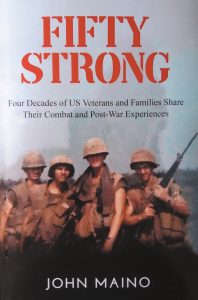
Those are just some of the stories author and Negaunee native John Maino attempts to depict in his fourth book "Fifty Strong," which was released earlier this year. In the book, Maino shares first-hand accounts of World War II, Korean War and Vietnam War veterans from Wisconsin and Michigan, includng six veterans from the Upper Peninsula.
"This one was about four years in the making," he said. "I wasn't sure what direction I was going to go, because there were still some World War II veterans I could speak to, which was great, but the one thing I first thought about doing was the Korean War vets, because I think that out of all of them, they were the most ignored, forgotten and in some ways disrespected, just because nobody cared.
"We came back from World War II like we had just conquered the world. These poor guys were sent off to this horrific land, horrific place to fight, against a really determined enemy when the Chinese came in. They came home, and because we didn't win the war, so to speak, there were no celebrations, no ticker tape parades, nobody respected what they did.
"So these guys buried their issues for a long time, and they had post-traumatic stress, but they didn't have a term for it. So these guys just had to struggle on their own, and I realized that by sitting and having coffee with them.
"That's why I thought to myself that one way or another, the one thing I can do for these Korean War vets is get their stories out there. That made me feel really good that their stories are finally told.
"And then the Vietnam vets, that was kind of my era. I graduated high school in 1975 just when it ended. I've got a couple of guys in (the book) who went 20 years without even telling anybody they were in Vietnam, because when they told where they were, they would get so much guff back at them. It was incredible.
"I don't know who coined the phrase 'baby killer,' but these poor, young kids who were 18 or 19 years old working at the gas station… now they get drafted and get sent to this horrible situation, they fight as hard as they can, they're as good soldiers as anybody from any generation. They come back and they're just shunned. They couldn't find jobs, everybody was looking at them like 'Is this guy crazed? Is he a druggie?' and all of those things. Same thing, they just buried it, so that's why they're very happy to finally tell their stories."
Anybody can go on the internet and research the stories of almost any veteran, but Maino is hoping the local and regional perspective "Fifty Strong" really connects with its readers.
"You read about some guy in Florida who did whatever, that's great," he said. "But when you read about somebody from your hometown or high school or something like that, you say 'Oh, this really brings it all into focus. I remember this guy, I know this guy.' I really try to personalize these stories and that's one reason I wanted to come to the U.P. and get a bunch. These are some of the people I knew, and I wanted to hear their stories firsthand."
The six Yoopers featured in the book are Richard Jenkins of Bruce Crossing (World War II, 8th Armored Division, U.S. Army), Larry Ebsch of Menominee (Korean War, 545th General Dispensary, U.S. Army), Rich Karki of Negaunee (Vietnam War, 5th Marine Regiment, 1st Marine Division), Jim Jaklin of Midway Location (Vietnam War, 12th Infantry Regiment, 1st Air Cavalry, U.S. Army), Col. Judith Lisa, Ret. of Negaunee (Vietnam War, Nurse Corps, U.S. Air Foce), and David Dellangelo of Negaunee (Vietnam War, 8th Cavalry Regiment, 1st Air Cavalry Division, U.S. Army, killed in action Oct. 3, 1968).
"The U.P. sent so many people to war it's incredible," Maino said. "If you were working in the mines and graduated from high school, you were gone, you were drafted."
So how did Maino compile each story? It's all about who you know.
"It literally started with one person," he said. "He put me onto another person. That put me onto another person. Then I kind of got the word out through my radio shows and other stuff I was doing. People would write letters and say 'Hey, you might be interested in my grandpa's story,' and it was just a total domino effect. There was no one way to do it. It was literally word of mouth, which is how every single one of these stories came to be."
Maino has had an extensive career, working in radio and television over the years before shifting to the real estate industry. Today, he serves as the executive director for the Wisconsin Veterans Village Association out of Appleton, which provides housing, support and community to veterans throughout their lives as they live among fellow veterans in a veteran-centric culture, according to its website.
Maino's previous titles include "Frontlines," "The Pacific" and "ETO: European Theatre of Operations." He was inspired to share each veteran's individual story through writing during his radio career.
"I've always had a passion for history," he said. "I've always had a passion for reading war books and things like that. On my radio show years ago on Veterans Day, we would host a breakfast for veterans. We would sit around afterwards with some of these World War II vets and they would open up with some stories. I remember thinking to myself that these are really good stories, these are compelling stories. I would ask 'Did you ever write these down?' And they were like 'No, nobody really wants to hear these stories,' and I go 'Yeah, I think people do.' So, I had no idea what I was going to do. I just somehow wanted these stories documented for posterity's sake or something.
"So that's what I just started doing. ("Fifty Strong") is my fourth book and I've been doing this now for 23 years. People say I'm an author and I go 'I'm not, I'm a transcriber.' Basically, all I'm doing is recording what they say and making sure I'm putting it in their words. I don't try to doctor anything up. I love it when somebody says 'I can hear my grandpa speaking in those words.' That's what I really try to do, is not just capture their stories, but capture their individual personalities."
The book is available on Amazon and local bookstores in the Green Bay area such as Seroogy's and Bosse's News & Tobacco. Paperback copies are $25 on Amazon or free with a KindleUnlimited subscription.
And why should people pick up a copy of "Fifty Strong"?
"They should read it so that these guys will know that their stories that they held back for so many years are being appreciated by people in a way that they never assumed would happen," Maino said. "They thought that no one ever wanted to hear their stories, they didn't want to tell their stories because sometimes they were almost humiliated, and when I can go back to them and say 'Hey, we sold "x" number of books or we got these comments from people,' I make sure I always pass those on to the veterans themselves just to reinforce to them that your sacrifice, your service, your trauma, your struggles, people appreciate it and have all the respect in the world for you. By somebody reading that book, and me hearing about it and passing it back onto them, that's what makes it all worthwhile."
The average civilian may never know what experiencing war is like firsthand. Soldiers fought for their nations. Some gave the ultimate sacrifice. Some have seen things humans should never see.
At the end of the day, however, people are just that, people. Take it from Jenkins, who finishes his "Fifty Strong" tale by saying this:
"People ask me about my biggest impression from the war. Here it is. People are just people, damn it. Get away from the politicians and the generals and you can get along with anybody. If you're nice to somebody, they will be nice to you. I don't care what else is going on. And when you're caught in a war zone, the civilians suffer just as much as the soldiers do. We saw the terrible situations the citizens went through; starving, hurt and killed from bombings, little kids without parents, war orphans. They had it every bit as bad as the people doing the fighting, but nobody ever talks about their sacrifice."