
AN ONGOING CHALLENGE: Pandemic exacerbates existing food insecurity for children, older adults
Trending
EDITOR'S NOTE: This is part two of a multi-part series. Part one was published in Tuesday's edition. Part three will be published in this coming Tuesday's edition.
MARQUETTE -- The local economy has begun to slowly recover from the effects of pandemic shutdowns and "help wanted" signs are visible in the windows of many local businesses.
However, food insecurity remains an obstacle for many. While the previous story in this series provided an overview of the issue among the region's general population, people who are part of vulnerable age groups -- such as children and older adults -- are generally at greater risk of food insecurity and related health risks, with elevated rates of food insecurity reported in these groups prior to the pandemic's onset.
This was observed at a local level by Laura MacDonald, executive director of the Marquette-based Start the Cycle program -- a nonprofit "dedicated to building confidence and self-esteem" in at-risk youth, as well as providing a constructive after-school activity in mountain biking. MacDonald's experiences demonstrate that food insecurity was not a new experience for many local families. Rather, the pandemic exacerbated the existing issue.
The need for nutritional food among the kids MacDonald works with became apparent after long biking practices, she said. Many of the kids were hungry after their trail rides, but at first, she assumed this might be due to the rigor of their mountain biking activities.
However, in some cases, children MacDonald transported home requested food on the way back from practices because -- as MacDonald realized -- there was a possibility they wouldn't get a fulfilling meal later.
In response, before the pandemic began, Start the Cycle began providing meals for the kids after each ride. It relied on donations from restaurants in the community to provide nutritional food until the nonprofit was able to raise the funds needed to purchase from those businesses.
Not too long after post-practice meals became regular, MacDonald said, "We found that the kids were wanting more nutritional options (and) were asking for fruits and vegetables, instead of just Cliff bars."
In this way, Start the Cycle not only provided a reliable food source, but the nutritional meals necessary for good health, which its participants may not be able to access elsewhere.
This is key, as food insecurity encompasses a lack of nutritional food that is "necessary for maintaining good health." Unsurprisingly, food insecurity correlates with elevated rates of poor health and development among children, as well as health concerns later in life.
"Studies have linked food insecurity in children to poor health, stunted development, behavioral issues and difficulty keeping up in school," according to Feeding America via Bridget Balch in her article for the American Association of Medical Colleges.
In addition, pediatricians Margaret Thomas, Daniel P. Miller and Taryn W. Morrisey provide specific consequences of a nutritionally deficient diet among food-insecure children in their article, "Food Insecurity and Child Health."
"Children in food-insecure households were far more likely to experience some chronic health conditions, including a lifetime diagnosis of asthma (16.3%), current diagnosis of asthma (19.1%), and experience of depressive symptoms (27.9%)," Thomas, Miller and Morrisey wrote in The Official Journal of the American Academy of Pediatrics article.
Thomas, Miller and Morrisey also reference a cycle of poverty, food insecurity and continued poverty as a result of impaired health.
"Previous evidence suggests food insecurity may impact children's health care use because children who are food insecure have a greater risk of hospitalization since birth, and food-insecure households have higher mean health care expenditures ($6,072) than food-secure households ($4,208)," the article states.
These added expenses and stressors, among many, perpetuate a cycle of food insecurity among families with children.
When combined with rising housing costs that push families farther out of the city of Marquette and transportation access inequity -- factors mentioned among many social workers, educators and food assistance program directors -- childhood food insecurity reveals itself as a complex systemic issue.
As Balch states in her article, food insecurity goes beyond the simple answer of poverty.
"The ability to eat a healthy diet is largely determined by one's access to affordable, healthy foods -- a consequence of the conditions and environment in which one lives," Balch wrote.
Over the years she's spent working with local children, MacDonald has seen the relationship between environmental circumstances and food insecurity.
For example, she has seen firsthand the effects of food insecurity on families who live outside of Marquette, noting that some experience stigma related to living in lower-income housing areas, as well as "food deserts" in communities -- such as K.I. Sawyer -- that may be miles away from grocery stores. Furthermore, many families may need to choose between their rent or mortgage payments and nutritional food, she said.
Similarly, existing food insecurity among seniors is largely a result of circumstances and barriers unique to the demographic.
Triad of Marquette County -- coordinated by the Retired and Senior Volunteer Program and partnered with the Marquette County Sheriff's Office and the Michigan State Police and police chiefs of Marquette County -- conducts an annual Senior Safety Survey to identify needs among the senior community.
This survey revealed that in 2020, 20% of older adults in Marquette County were concerned about transportation that would allow them access to groceries.
The biggest factor which contributes to food insecurity among community seniors, regardless of the pandemic, is "accessibility to food," Marquette Senior Service Manager Maureen McFadden explained.
"A lot of our clients here in the U.P. are rural," she said. "They can't drive to the grocery store."
In addition to concerns about transportation, a lack of familiarity with finding and accessing resources via the internet can be a unique barrier experienced by many older adults.
Especially with the onset of the pandemic, McFadden said the center's case workers found themselves assisting many seniors in meeting technology barriers.
"Signing up for a vaccine appointment was a nightmare for a lot of our clients," she said.
The ability to access and use the internet to find resources or schedule a vaccine appointment affects seniors' food security, but their food security, in turn, has major impacts on their health. "All of these things are connected," McFadden said.
With older adults being a more vulnerable population, trouble accessing nutritional food among older adults can be a major health concern, pandemic or not, according to an article titled "Hunger is a Health Issue for Older Adults: Food Insecurity, Health and the Federal Nutrition Programs," from the Food Research and Action Center.
"Older adults who are food insecure often experience negative mental and physical health conditions and outcomes, such as diabetes, fair or poor health status, depression, lower cognitive function, limitations in activities of daily living, hypertension, congestive heart failure," and many more complications, the article states.
Furthermore, older adults who are food-insecure are 19% more likely to have high blood pressure than food-secure older adults, 65% more likely to be diabetic and 66% more likely to have a heart attack, the article reported.
Especially for seniors with existing health concerns, the onset of the pandemic introduced a new Catch-22: attempt to mitigate health concerns associated with food insecurity by leaving the house for food assistance -- thus putting oneself in danger of COVID-19 infection and increased risk of complications -- or remain at home to prevent infection and potentially cope with increased food insecurity and its consequences.
For those in the older adult community who were scared that the virus might lead to serious complications, this situation seemed to leave few viable options. As McFadden said, many seniors were afraid to leave their houses for necessary goods.
And while senior food insecurity was compounded by the fear of COVID-19 infection and increased risk of health complications, child food insecurity was made more challenging with the nationwide shutdown of schools.
"Statewide school closures increased the number of children and families in need of food outside of traditional congregate school nutrition programs," according to the October 2020 Michigan Food Security Council's "Initial Report: COVID-19 Findings and Recommendations."
In fact, as Balch reported in her article for the American Association of Medical Colleges, "Nearly 30 million children in the United States qualified for free or reduce-cost lunches at school in 2019. The COVID-19 pandemic has complicated food insecurity among children, as the estimated number of food-insecure kids coud jump from 11 million to an estimated 18 million, according to Feeding America."
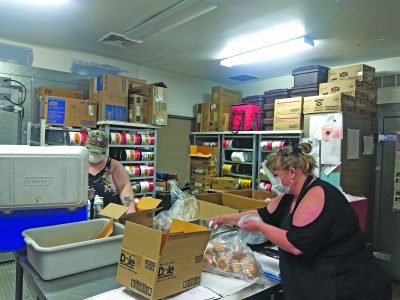
However, local organizations positioned themselves to meet these new challenges facing children. For example, JJ Packs is a volunteer-run organization in Marquette devoted to providing nutritious food to school children who rely on free and reduced meals at school.
While JJ Packs initially began in 2015 "to assist with the approximately 68 hours of hunger that some U.P. school children experience between the free lunch they receive at school on Friday afternoon and the free breakfast they receive at school on Monday morning," the onset of the pandemic and subsequent school closures introduced much longer, indefinite time periods in which these children could potentially go without those regular meals.
Kristin Marchiol, one of three volunteer co-directors, including Nicole Holder and Marla McEnaney, said that even throughout the school closures, JJ Packs continued to pack and provide boxes of nutritional food for those families they had been serving.
However, she said that recently the numbers of packs being distributed have decreased and the organization worries it isn't because of a decrease in need.
"This school year, our numbers are not as high," Marchiol said. "We feel that is because more students are remote learning and not coming into schools to pick up JJ Packs or families don't realize they are still available to them."
For the children and families served by JJ Packs, help was also available on a statewide level, Lori Stephens-Brown, community nutrition services director for Community Action Alger-Marquette, said.
For example, every parent whose child qualified for free or reduced meals at school was given a Michigan Bridge Card after school closures to assist with increased food insecurity for their children.
As a whole, organizations like Community Action Alger-Marquette have provided a variety of resources for those in need, Stephens-Brown explained.
CAAM itself also distributes a "tremendous amount of food to (local) pantries," she said, through its Emergency Food Program and local partners like The Salvation Army, St. Vincent de Paul and others.
The support through community organizations has also been available for seniors in the past year.
When the pandemic first began, CAAM's Meals on Wheels programs put two weeks of food into every home they served -- a combination of frozen and shelf-stable goods -- in case the risk was too great to have volunteers return at some point in their regular schedule, Stephens-Brown said.
McFadden noted CAAM's Meals on Wheels programs, among others, offered much-needed resources for area seniors.
"I can't speak enough to how successful and how wonderful that program and those volunteers were," she said.
In addition, McFadden said that -- thanks to CAAM's application to various food programs and receipt of funds, which were filtered through the senior center -- new resources, which were not solely income-based, became available.
One of these programs was the U.S. Department of Agriculture's Farmers to Families Food Box Program, a resource that secures fresh produce from local farmers and delivers it to seniors.
"Not only is it supporting local families and older adults, but it's supporting local farmers," McFadden said. "Feeding America will always be appreciated and I want to see that continue, but because of COVID, we saw these Farmers to Family boxes and other programs come out that I would like to see continue."
In terms of the Marquette Senior Center's own food programs, McFadden said that, thanks in part to the pandemic, those services have been made even more accessible to those who need it. "COVID made us rethink," McFadden said. "We were actually able to identify the clients based on needs."
Qualification requirements loosened and flexibility in how seniors receive meals expanded, according to McFadden. While congregate meals will continue to be offered when safe to do so, the center plans to continue providing drive-up meal services after the pandemic as well.
However, McFadden made a point to identify the local businesses and entities outside of those organizations that rose to the challenge of assisting senior and immunocompromised neighbors.
According to McFadden, both Marq-Tran's door-to-door service and Tadych's Econo Foods' grocery delivery service -- which began during the onset of the pandemic -- have proved to be invaluable resources to Marquette's seniors.
Econo's method for scheduling grocery delivery, she said, proved especially convenient for those seniors who did not have experience with internet usage, as they were able to order their groceries via phone instead of having to use an app or website.
Overall, while children and seniors have been identified as the age groups most vulnerable to food insecurity during this pandemic, local organizations have pursued a variety of approaches and offered many resources to help them remain food-secure during a year unlike any other.
While many in these populations experienced food insecurity before the pandemic -- and perhaps were aware of the resources available and how to access them -- the pandemic introduced another group of people to food insecurity who may not have experienced it before or who are less familiar with resources.
The next story in this series will look at the experience of the "invisibly" food insecure residents, those who fall somewhere into the space which exists between poverty and financial comfort, those who must stretch income to keep up with inflated costs of living, and in the process, make difficult choices about the food on their table.
Shannon Konoske can be reached at 906-228-2500, ext. 206. Her email address is skonoske@miningjournal.net.