
Borchert body found in flooded caving ground, mine pit
Fencing at Ishpeming site in disrepair
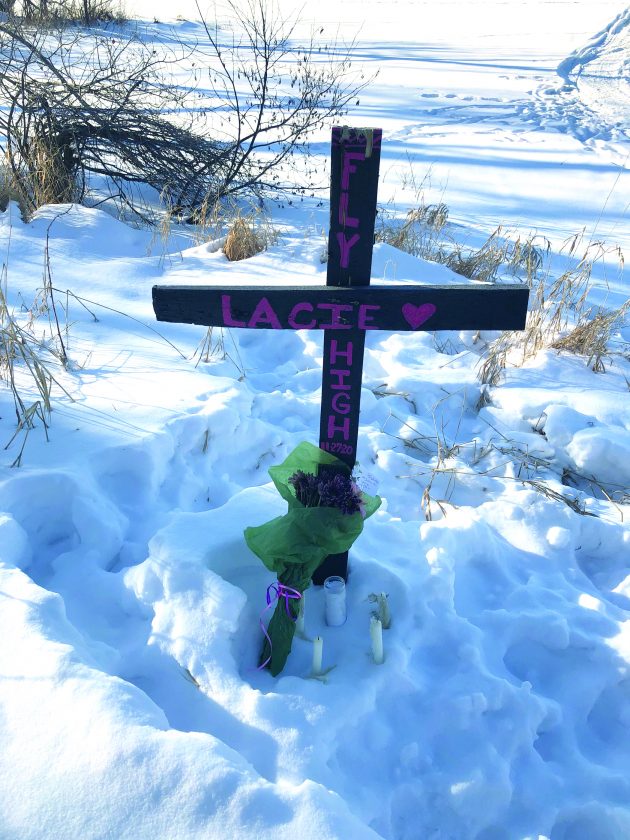
A makeshift memorial where the body of 25-year-old Lacie Borchert of Ishpeming was located is pictured. (Courtesy photo)
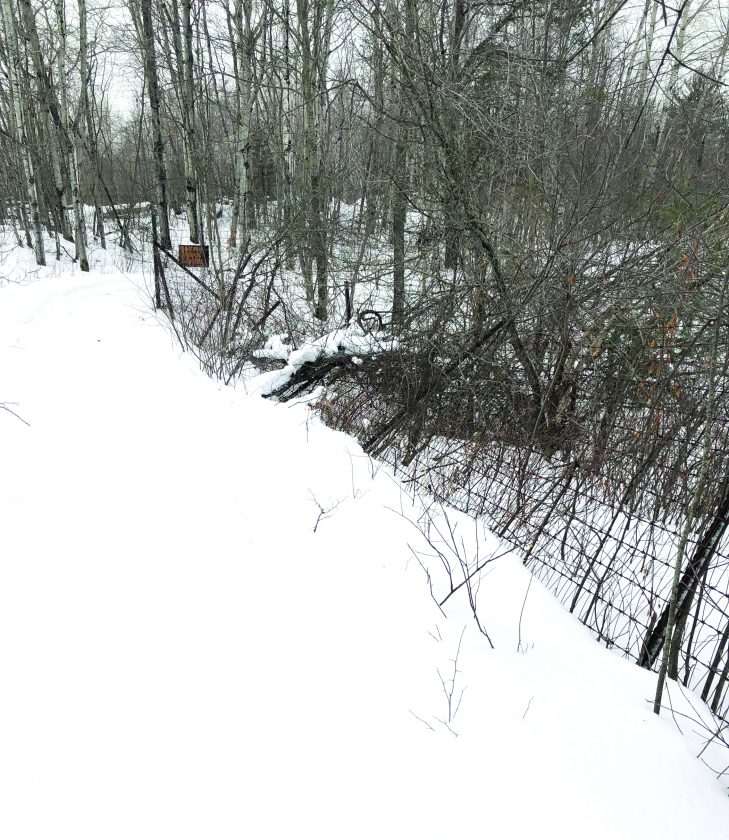
Fencing nearby the flooded caving ground and mine pit of the abandoned Section 16 mine site in Ishpeming is seen. (Courtesy photo)

Lacie Borchert
A makeshift memorial where the body of 25-year-old Lacie Borchert of Ishpeming was located is pictured. (Courtesy photo)
Fencing nearby the flooded caving ground and mine pit of the abandoned Section 16 mine site in Ishpeming is seen. (Courtesy photo)
Lacie Borchert
Trending
ISHPEMING -- The death of 25-year-old Ishpeming woman Lacie Borchert four months ago continues to haunt friends, relatives and everyone who knew her.
Borchert was found deceased in a body of water off of Excelsior Street in the city of Ishpeming Nov. 27, several hundred feet from where she lived, according to her family.
She was last seen at her home around 3 a.m. and was reported missing later that day at 5:45 p.m. Her vehicle was located in a ditch not far from where her body was discovered by officers from the Ishpeming Police Department.
While IPD has concluded its investigation and has ruled out foul play, friends and family of Borchert have disputed the investigation's findings and are still seeking answers relative to the sequence of events that led to her death.
What's no longer a mystery, however, is the body of water off of Excelsior Street in which Borchert was located. Often referred to in media reports as an unidentified "Ishpeming lake," the body of water is actually the flooded caving ground and mine pit of the former Section 16 mine, which is located between Excelsior and Washington streets and Marquette County Road 581 in the city of Ishpeming, according to Marquette County Mine Inspector Steve Bertucci. The Marquette County Medical Care Facility lies just south of the site.
According to local mine historian and retired Cleveland-Cliffs mine safety officer Jim Paquette, the Section 16 mine was originally owned and operated by a division of the United States Steel Corporation known as the Oliver Iron Mining Company, which was based in Minnesota at the time. Paquette said that Section 16 was a joint operation with the nearby Holmes Mine, which Oliver operated from the time it acquired the Lake Superior mines in 1935 until Section 16's closure in 1946.
"The Section 16 mine was one of a group of mines called the Lake Superior mines," he said. "There were several mines in that area, and depending on where the shaft was placed, each little mine had a different name. Oliver Iron Mining Company owned and operated it back then. Other than CCI, they were one of the primary mine operators that ran a lot of mines in the Ishpeming and Negaunee area.
"It was a mine that was there for many years. A lot of them were short-lived. Section 16 stopped operations around 1945 or 1946 … After (World War II), they shut it down as well as several other mines. A lot were still running because iron ore was needed for the war effort and that's basically when the Section 16 mine closed."
It's the duty of the county mine inspector to "check fences around caving grounds and abandoned mines to ensure that they are properly maintained; visit active mines to check for safety violations, respond to requests from county residents to inspect areas of subsidence discovered on their property; and help educate the public about the dangers that may exist in the fenced caving grounds," according to Marquette County's website, and also highlighted in Act 163 of 1911 which calls for the election of mine inspectors.
This law also states that "if a mine is idle or abandoned, the mine inspector shall notify the person, persons or corporation owning the land on which the mine is situated, or the agent of such owner or owners, to erect and maintain around all the shafts and open pits of the mine a fence or railing suitable to prevent persons or domestic animals from accidentally falling into the shafts or open pits."
Reviewing Marquette County mine inspection reports from 2009 to 2019, the Section 16 mine and nearby Holmes Mine were not present on any of the reports.
Bertucci was appointed to the mine inspector position in August following the death of previous mine inspector John Carlson. Bertucci said since stepping into the role, he's been focused on inspecting fences around abandoned mine sites across the county. In a previous Mining Journal article, Bertucci noted there are over 200 abandoned mine sites within the county and locating some of them can be a challenge. Safety surrounding abandoned mine sites and caving grounds has been a longstanding issue.
Another previous Journal article from July highlights the stories of seven children whose lives were claimed by the dangers of Upper Peninsula mine caving grounds over the years. While recent work has been done by some local municipalities to fence off certain sites, several areas have fencing that has deteriorated over time, been cut down or aren't fenced at all.
Act 91 of 1967 states that "any person who willfully destroys, breaks down, cuts or damages any fence, barrier or barricade erected for the purpose of protecting the public from dangers arising from past or present mining operations is guilty of a misdemeanor."
The city of Negunee spent over $8,000 on installing 360 feet of new fencing around abandoned mine locations in the Old Town area in the summer of 2020, a spot now heavily used for recreational activities such as hiking, biking and disc golf.
The Section 16 caving ground where Borchert's body was located is just one case of an abandoned mine site with deteriorated fencing.
According to the Marquette County Register of Deeds office, the city of Ishpeming is the current owner of the Section 16 property.
While the city of Ishpeming owns the surface rights to the property, the owner of the mineral rights beneath the land could not be determined for this writing. The party who holds the mineral rights is believed to be responsible for maintaining the fencing surrounding the site, according to Chapter 5 of Marquette County's Hazard Mitigation Plan, which states that "state law makes the owner of mineral rights responsible for capping and maintaining fencing around abandoned mines."
Bertucci, along with Marquette County Board Chairman Gerry Corkin and local mine employees and officials, met with state Rep. Sara Cambensy, D-Marquette, on Feb. 15 to discuss a solution to fencing maintenance. Corkin said as of now, local officials are seeking clarity on what needs to be done, due to the fact that the 1911 law is potentially outdated.
"Part of it is looking at the legislation that's in place that states that shafts and dangerous pits have to be fenced," he said. "There are questions as to whether or not there are certain abandoned areas that need to be fenced or not. The question has been asked to legislators to clarify the laws so the mine inspector has definitive information as to what needs to be fenced or not.
"… Rep. Cambensy brought up the idea of putting money into the state budget to have an inventory of all the abandoned mines in the county, go around and visit each one, and come up with a list of safety issues and whether it needs to be capped or fenced."
Cambensy's office told The Mining Journal on Feb. 18 that further information is needed and future meetings to discuss the matter are planned.
"The meeting Monday was the first of several stakeholder meetings that will take place over the coming weeks," the statement reads. "Rep. Cambensy and Sen. (Ed) McBroom (R-Waucedah Township) have been working on this issue together and are still waiting on some legal opinions and research reports before moving forward. There will be more information to come on this issue in the near future."
Corkin commented on those who have fallen victim to former mine site dangers and said Bertucci has stepped into his role well since being appointed.
"Over the last 50 years, there have been a number of youngsters that have died around the county in some of these pits," he said. "Those that have safety issues need to be fenced and maintained. That's the question some have raised, whether these abandoned sites have to be fenced or not.
"The mine inspector we have now is very good at his job and has been visiting (the sites) and making the decisions. He's got a lot of fenced areas improved in the four months he's been here. Cleveland-Cliffs Inc. has also done a lot of fencing in the last six months of the year. A lot of fencing has been put back up in all different parts of the county."
Bertucci said moving forward, he would like to see better clarification on what qualifies as an abandoned mine site.
"Here's the problem in the county, for years there have been lakes and there have been mine pits," he said. "Some were all mines at one time, but they're called lakes. Other ones that are fenced in are called mine pits. I don't know who makes that determination. That's what I'm trying to get clarified by the state. There's nothing in writing that tells me what to do next.
"I'm looking into it to try and find out what the next step is. The county is helping me out. If it has to be fenced and the city knows it, I'll approach them about getting it fenced."
Ryan Spitza can be reached at 906-228-2500, ext. 248. His email address is rspitza@miningjournal.net.