
MDHHS: Schools must provide case numbers; Agency also issues emergency orders for residential care settings, juvenile justice facilities
MARQUETTE — Michigan Department of Health and Human Services Director Robert Gordon on Tuesday issued an emergency order requiring K-12 schools to provide public notice to the school community about probable and confirmed cases of COVID-19 within 24 hours.
The order follows the Michigan Supreme Court decision on Friday that invalidated executive orders related to COVID-19.
“Under MCL 333.2253, if the MDHHS director determines that control of an epidemic is necessary to protect the public health, the director by emergency order may prohibit the gathering of people for any purpose and may establish procedures to be followed during the epidemic to insure continuation of essential public health services and enforcement of health laws,” MDHHS officials said in the release.
The Tuesday order requires local health departments to notify schools within 24 hours of learning of a probable or confirmed school-associated case of COVID-19. Upon notification, an impacted school must provide public notification within 24 hours in a highly visible location on its websites.
Schools are encouraged to provide information about measures in place at the school to prevent transmission of COVID-19, as well as measures that individuals can take to prevent transmission.
“Recent outbreaks throughout the country demonstrate that COVID-19 can spread quickly in the school setting,” Gordon said in a statement. “Timely communication from schools to parents, guardians, students, teachers, staff and other persons affiliated with schools enables members of the school community to take measures to prevent spread of the virus.”
Local health departments will continue to provide direct notification to individuals who are, or are suspected, of being a close contact of school-associated case.
Some schools already are making probable and confirmed student and employee cases public information. For example, Marquette Area Public Schools maintains a COVID-19 dashboard on its website at mapsnet.org that provides case numbers.
This order goes into effect on Monday. Information about school outbreaks is available at Michigan.gov/Coronavirus.
MDHHS issues emergency orders for residential care settings
Gordon also issued emergency orders Tuesday under MCL 333.2253 that “maintain protections for Michigan’s most vulnerable populations and staff in residential care settings,” MDHHS officials said in a news release.
The residential care order has three major components: notice requirements regarding cases, limitations on visitations and limitations on communal dining.
“Ensuring the health and safety of vulnerable Michiganders and those under our care is of the utmost importance,” Gordon said in the release. “This order re-establishes protections that have helped Michigan sharply reduce the loss of life in nursing homes. With the level of COVID in Michigan rising again, these protections are more critical than ever.”
With respect to notice, officials said that under the order, all covered facilities must:
≤ Notify employees and residents of a confirmed COVID-19 positive employee or resident within 12 hours of identification.
≤ Inform legal guardians or health proxies for all residents within the facility of a confirmed COVID-19 positive employee or resident within 24 hours.
≤ Post a notice in a conspicuous place near the main entrance of the care facility indicating the presence of a confirmed COVID-19 positive employee or resident.
≤ Contact the local health department in the facility’s jurisdiction to report a confirmed COVID-19 positive employee or resident.
The order continues restrictions on visitation to residential care facilities, which include nursing homes, homes for the aged, adult foster care, assisted living, independent living and substance use disorder residential facilities, according to the MDHHS.
As previously, visitation is permitted to assist with activities of daily living and for compassionate care. Restrictions on visits don’t apply to medical service providers, resident physicians and window visits when there is a barrier between the resident and visitor.
Outdoor visits are permitted under the order with precautions, such as allowing for at least six feet separation between all people. Facilities must also meet criteria specified in the order, including having had no new COVID-19 cases originate there within the previous 14 days.
The department continues to review experiences and feedback around outdoor visitation to inform additional changes to visitation rules, officials said.
There are different visitation rules for child-caring facilities and juvenile justice facilities.
They may permit entry of visitors as long as they provide information about COVID-19 prevention practices and symptoms of the virus; limit visitor entry through a designated entrance and screen visitors for COVID-19 symptoms prior to entry; restrict visitation to designated areas; and require advance scheduling, officials said. Social distancing and mask use are required.
Communal dining is permitted under the order at all facilities consistent with Center for Medicare and Medicaid Services and MDHHS guidance. The community dining rules apply for the first time to independent living, hospice facilities and substance use disorder residential facilities.
Consistent with MCL 333.2261, violation of this order is a misdemeanor punishable by imprisonment for not more than six months, or a fine of not more than $200, or both, according to the MDHHS.
This order is effective immediately and remains in effect through Oct. 30. Individuals with suggestions and concerns are invited to submit comments via email to COVID19@michigan.gov.
Governor releases video
Gov. Gretchen Whitmer on Monday released a video on social media urging Michiganders, the legislature, President Donald Trump and Congress to do their part to protect families, frontline workers and small businesses from the COVID-19 pandemic.
“For the past seven months, I’ve been making the tough decisions that took us from the state with the third highest cases of COVID-19 per million in March and April, to the 33rd highest in September,” Whitmer said in a statement. “We have one of the best economic recoveries in the nation, too. Studies concluded we saved thousands of lives.
“But after the Republican Legislature sued to take away my executive authority, this past Friday the Michigan Supreme Court struck down the statute under which I issued executive orders to save lives and protect Michigan families, frontline workers and small businesses.”
Whitmer said that as a result of the court’s and the Legislature’s actions, Michigan’s COVID-19 cases will likely go up.
“There will be uncertainty, disruption and possibly greater risk to our economy, more people quarantined and more deaths,” she said.
Whitmer pointed out that the ruling does not mean that the orders she issued violated the law.
“Although I disagree with the conclusion, the court held the law is unconstitutional, meaning the egislature did not have power to pass the law in 1945,” she said. “In fact, the court made clear that I interpreted the 1945 law correctly. And the ruling does not mean all of the protections we have put in place will go away. I have additional powers that I will use to protect our families from the spread of this virus.”
The video can be found on Twitter with the handle of @GovWhitmer and on Whitmer’s Facebook page.
Whitmer urged people to wear a mask, wash hands, maintain 6 feet of physical distance and get a flu shot.
“Taking this action is essential to keeping our small businesses and schools open,” Whitmer said. “COVID-19 didn’t stop being a threat because (of) the court ruling, or because we’ve tired of it, or because the Legislature left town.”
Christie Mastric can be reached at 906-228-2500, ext. 250. Her email address is cbleck@miningjournal.net
Front Page News

Star-spangled holiday
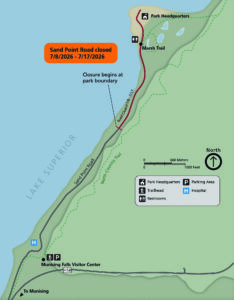
Sand Point Road at Pictured Rocks National Lakeshore to temporarily close

Innovate Marquette releases fiscal year 2025 impact report
Bark River Knives’ personal property to be sold
Teen missing on ATC found unhurt
MARQUETTE — A missing teenager who was reported riding an ATV in rural Marquette County was found unhurt. The ...