
Cybersecurity institute opens
Trending
MARQUETTE -- With billions of connected devices in the world, cybersecurity will be a continuing challenge.
To help deal with this ongoing threat, Northern Michigan University, along with the Merit Network and the Michigan Economic Development Corp., on Thursday hosted the grand opening of the Upper Peninsula Cybersecurity Institute at the Northern Center, formerly the University Center.
The institute -- one of only six in Michigan and the first facility of its kind in the U.P. -- offers non-degree and industry credentials relevant to careers in cybersecurity. It also augments NMU's existing cyber defense bachelor's degree and provides additional career exploration and training opportunities with K-12 school districts in the U.P. and postsecondary institutions.
Steve VandenAvond, vice president for extended learning and community engagement, said NMU believes the institute will be a "game changer," not only for NMU or area high school students, but for anyone interested in cybersecurity and businesses who want to protect their data.
"The 'Teach. Test. Train.' model that the Merit Network has come up with is going to be incredibly impactful," VandenAvond said.
The Ann Arbor-based Merit Network is involved in computer networking and related services.
William "Joe" Adams, vice president of research and security for the Merit Network, also is director of its Michigan Cyber Range, a publicly accessible and unclassified virtual test firing range that delivers cybersecurity courses and training exercises, and enables vulnerability testing.
"The NMU hub is the latest step forward," Adams said. "It's the growth of the range."
With 4,000 miles of fiber optic cable throughout Michigan and parts of Wisconsin and Ohio, he said the network can reach the farthest corners of Michigan.
"We have a commitment to give the student in Houghton or in Marquette the same experiences we do the students in Ann Arbor or any place else in the state," Adams said, "and I think we've done that, and this hub will just enhance that capability.
"What we want is this hub to become is a magnet site for the community. We want it to bring together industry, government, academia, students of all ages, to help grow a culture of security."
That culture, he said, will lead job seekers into the field, with those jobs being well-paying and able to be accomplished at home.
Sarah Tennant, strategic adviser of cyber initiatives and business development for the Lansing-based MEDC, said the hub has been a "labor of love" for many people.
"One of the primary focuses for companies when they're looking to locate in Michigan is talent, and this hub is going to be a driver of that talent," she said.
Jim Marquardson, an NMU assistant professor of information assurance and cyber defense in the College of Business, said people are the most important part of the institute.
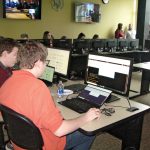
As an example, he mentioned the room full of high school students at the institute taking part in Thursday's Capture the Flag Challenge in cybersecurity, who might be getting their first hands-on experience in the field.
"I'm looking forward to seeing what kind of opportunities we can give our students, and excited to what our students will be able to do with these enhanced opportunities," Marquardson said.
NMU alumnus Keith Glendon, program director for worldwide sales, strategy and business development with key industry partner IBM Security and founder of LucidCoast LLC, took part in a panel discussion on Thursday with other industry professionals.
He acknowledged there's an awareness problem regarding cybersecurity.
"You hear 'cybersecurity,' your eyes glaze over," Glendon said. "You think, 'That's not me,' but we live in a connected world."
He noted there are 20 billion connected devices in the world, and it's projected that in five years, there will be 10 times as many of those devices as connected humans.
"We put -- happily -- our private information out there," Glendon said. "We wire up our cars. We wire up our refrigeration units, our water treatment plants, our nuclear plants, our electrical grids, our 911 system, so every single day, we're making ourselves as a species more and more vulnerable to manipulation and attack, and so this becomes maybe the single most aspect of human life, if you think about it in those terms."
Also scheduled for Thursday was a HackerOne class in the Digital Learning and Design Lab at 2702, which was designed to promote "ethical hacking." Ethical hacking involves searching for a company's potential security vulnerabilities.
Partnering with Merit, the MEDC and its Michigan Defense Center, and the Michigan Cyber Range, the institute is to be a magnet site for industry collaboration, testing, training and certification.