
A walk through time
An exploration of NMU architectural history
-
- Attendees of Saturday’s event A Walk Through the Past: 70 years of NMU Architecture walking tour head into The Woods, the newest residence halls on Northern Michigan University’s campus. (Journal photo by Trinity Carey)
-
- Beaumier U.P. Heritage Center Director Dan Truckey shows event attendees photos of buildings that previously rested on NMU’s campus such as Kaye, Carey and Longyear halls. (Journal photo by Trinity Carey)
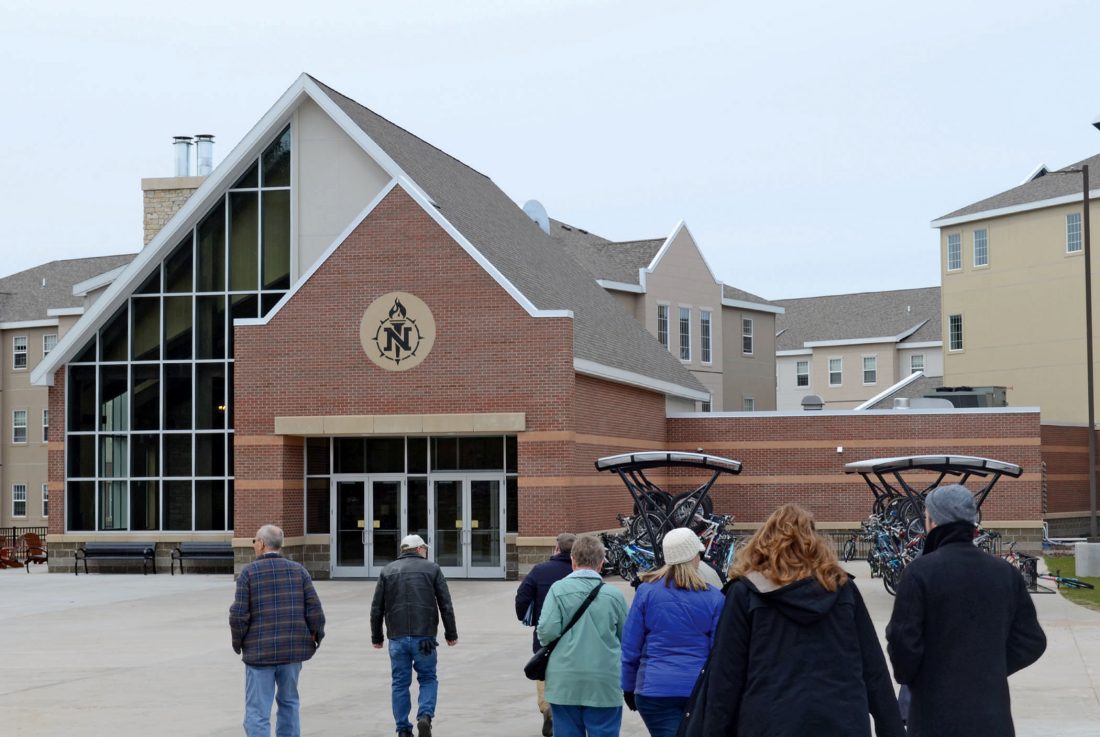
Attendees of Saturday's event A Walk Through the Past: 70 years of NMU Architecture walking tour head into The Woods, the newest residence halls on Northern Michigan University's campus. (Journal photo by Trinity Carey)
MARQUETTE — Northern Michigan University was first established as an educational institution in 1899. Its campus is home to many buildings that carry great historical significance, especially to those who at one time walked its halls, but over time buildings must be renovated, demolished and rebuilt. While this keeps the campus up to date and attractive for prospective students, university history often suffers.
Community members had the opportunity to learn the history of the school’s buildings at Walking Through the Past: 70 years of NMU Architecture hosted by the Beaumier U.P. Heritage Center.
Attendees were informed on the history of where buildings once stood, where new ones rest, and in what ways some have been renovated to meet current university needs. Dan Truckey, director of the Beaumier center, wanted the event to be an opportunity for people to realize the significance of the structures that stand on campus today and to find an appreciation for them.
“A lot of people are very frustrated by the first 50 years of campus not being here anymore that we forget that we have some really cool and significant structures and architecture that really do tell the history of the university and how it’s changed over time,” Truckey said. “I just want people to start having a greater appreciation rather for what we do have than being frustrated with what we don’t have anymore.”
Truckey began the event by discussing NMU’s first 50 years and its first buildings, the Longyear Building, Kaye Hall and the Peter White Science Building. These buildings once made up the center of campus, but in the following decades the student population expanded tenfold, and the buildings had to follow suit.
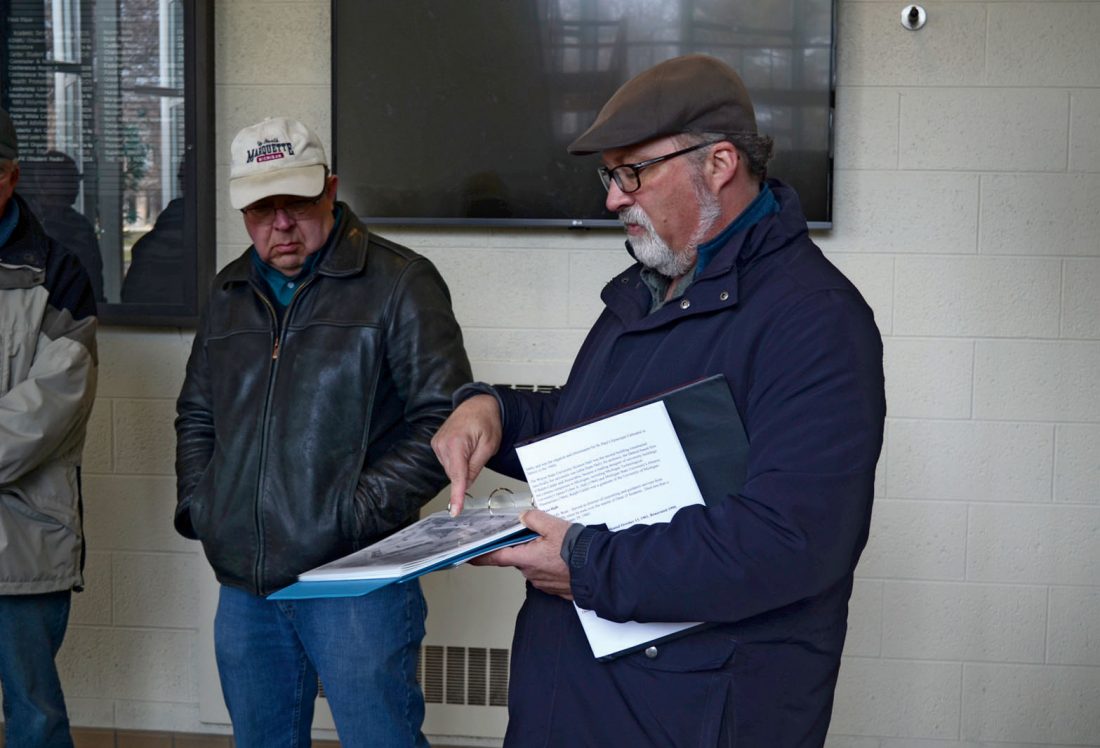
Beaumier U.P. Heritage Center Director Dan Truckey shows event attendees photos of buildings that previously rested on NMU's campus such as Kaye, Carey and Longyear halls. (Journal photo by Trinity Carey)
The walking tour started outside of the Cohodas Building, which opened on campus in 1975. Truckey explained that because of the slit windows on the first floor of Cohodas many believe the building to be riot-proof, but this is a common myth about administrative buildings on campuses across the country. The windows were simply a design choice.
With the Superior Dome in sight, Truckey told the crowd that when first built in 1991, many called the $21.8 million structure the Yooper Dome and even the Steel Dome because of its original silver color.
The group then headed to NMU’s oldest standing building, Lee Hall, which opened in 1949 and was once the home for student union meetings, ballroom dances, the art and design department and more. Today, Lee Hall sits empty, but the university plans to make use of this structure once again, Truckey said.
The story of some of campus’s newer structures were then discussed such as the University Center, which is currently under construction. The building is to be renamed The Northern Center and will feature a grand ballroom, a faculty/staff lounge and more. But when the former UC structure was completed in 1966, it was considered one of the first modern buildings in the U.P. at the time and was seen as a symbol for the future of NMU, Truckey explained.
The university’s latest master plan has Gries Hall slated for demolition as well as West Hall, which could potentially become a parking garage, he added.
Near the center of campus rests the C.B. Hedgcock Building. Opened in 1958, this structure has catered to the needs of the university for decades. Originally named the C.B. Hedgcock Health and Physical Education Building, this facility once housed a pool, practice courts and a 5,000-seat arena for sporting events, concerts, speakers and commencement ceremonies. While the building has since been renovated and now serves as the Student Service Center and various financial offices and a recital hall, its raised dome ceiling remains.
The walk continued with the history of McClintock, Thomas Fine Arts, Forest Roberts Theatre, West Science, New Science and Jamrich.
Red brick, an inexpensive yet pleasing to look at design choice, Truckey said, can be seen in each of these buildings and brings a sense of continuity to the campus. But there is beauty in each building having been constructed in a different period, he added.
“They go from this kind of 1949 style to this sort of art deco style right up to very modernistic buildings like new Jamrich, which are very much of the 21st century,” Truckey said. “I think that you want to have that in a university. You don’t want every building to look the same. You want this to look like the period that it was built in, you want that kind of continuity of time, not that they all look the same, but that they show how the university has changed over time.”
While buildings become obsolete and alterations and restoration are necessary, preservation is just as important. Finding the balance between the two is the most challenging part, but it is possible, Truckey said.
“We’ve done it many times,” he said. “You have a building like Hedgcock, which from the outside looks almost identical to what it looked like originally, so we’ve kept the structural integrity of it, but the inside has been completely changed for the new purpose. So people are frustrated it’s not an arena anymore and I get that, but it’s still serving a really good function.”
Moving forward, he hopes the administration will consider preservation in their master plans.
“We can’t save every building,” Truckey said. “Sometimes you do have to tear buildings down, but at the same time though, we don’t erase the memories of the campus for the people who went here and also create for the students a sense that this campus has a history, that they belong to something greater than just themselves.”
Truckey believes that university history should be a part of every NMU student’s education. A better knowledge of the university would give students an appreciation and attachment to campus. As for the community, many are still frustrated with decisions the university made regarding its previous buildings. This should be motivation to preserve the university history moving forward, he said.
“I think there are still a lot of vetted feelings about that in the community and what I would like people to see is yes, that happened, it’s never going to go back, we’re never going to get those buildings back,” Truckey said. “So we need to look at the campus in a different way and really start appreciating and preserving what we do have because I think that’s going to be the future. The first 50 years are gone. Let’s move on, but let’s keep in mind that what we do have is significant and we need to protect those as well.”
Trinity Carey can be reached at 906-228-2500, ext. 243.
Front Page News

More people fishing in Michigan as state considers license fee hikes

Olympian Nick Baumgartner to appear at Kaufman Auditorium

Meth lab bust in Houghton County
UTV crash results in death
STEPHENSON — A utility task vehicle crash on Caldron Falls Road near Fawn Lane Saturday in the Town of Stephenson ...
U.S. Ski & Snowboard Hall of Fame Class of 2025 named