
BLP solar garden marks first year in operation
Trending
MARQUETTE -- For over a year, customers of the Marquette Board of Light and Power have had the opportunity to benefit from renewable energy without having to install and maintain solar panels on their property.
Since the BLP's community owned solar garden, which is adjacent to the utility's main office along Wright Street, went into full production in October 2017, customers have purchased $194,000 worth of panels to date, or 388 out of the 480 available.
Solar panels can be purchased for a one-time payment of $499 and each panel is rated at 315 watts and will produce up to 382 kilowatt hours per year. Customers who purchase a panel are credited $.0633 per kilowatt hour.
The customer credit earned is currently $22.69 per panel for the year, according to Kevin Downs, supervisor of metering and energy programs at BLP. In 18 to 20 years, the solar panel will "pay for itself;" however, customers aren't necessarily buying the panels to decrease their bills, but to participate in green energy, he said.
"It's a good opportunity for folks who live in a heavily shaded neighborhood and don't have $40,000 to put toward their own panels at their homes," Downs continued.
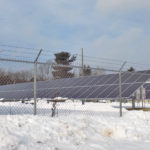
Since the winter season can bring snow showers for an extended amount of time in the Upper Peninsula, Downs said the BLP has received several questions from customers pertaining to how snow coverage impacts the solar panels.
According to the BLP's website, the construction of the solar garden's low maintenance non-tracking system and its location at the Marquette Energy Center was designed for maximum solar production during the peak solar months in the spring, summer and fall.
Winter production due to the low angle of the sun is minimal under the best conditions. Potential damage to the surface of the panels due to snow and ice removal outweighs any financial benefit when considering the possible long-term reduction of peak generation that could occur during the three high production seasons if the panels are damaged due to ice and snow removal.
"We don't shovel them off because it deteriorates the longevity of the panels," Downs said.
The BLP does, however, remove snow that slides off and builds up at the base of the solar arrays which allows the solar panels to continue to naturally shed snow cover based on the outside temperature and the sun exposure.
Solar power generated from the community garden goes directly onto the BLP's electric grid and participants will be credited against their electric consumption for the electricity production from their portion of the solar array. Credits will carry over from month to month for a period of 12 months from May 1 to April 30.
The solar panels have a lifespan of 25 years. Participants are able to license property and purchase solar panels for the term. If a participant moves but continues to be a BLP customer, the credit can be switched over to the new residence. Solar panels can also be sold with properties if the new owners are BLP customers, and so forth.
Tom Carpenter, executive director of the BLP, said solar energy technology has been improving at a very fast pace in recent years.
"Improvements in the technology have driven an increased interest in residential, commercial, and utility scale solar projects. It is important to us as a community-owned municipal electric company to be attentive and responsive to the needs of our customers," he said in an email.
The goal of the project, Carpenter continued, was to provide a path to solar ownership to those who wanted it but were unable to do so on their own.
"We were seeing that a number of our customers had a desire to own solar panels to help offset their energy use but did not have the ability to buy and place panels on their residence," he said. "The project has been a success and met the expectations of the owners.
"Industry wide utility scale solar is becoming an attractive option to add renewable energy and diversity of supply to electric utility power supply portfolios. With the operational flexibility of the new Marquette Energy Center we are in ideal position to integrate renewable options such as solar into our power supply mix. As these renewable projects develop we will continue to evaluate them for economic, operational and environmental benefits to determine if they are a good fit for the MBLP."
In 2017, a solstice study provided the BLP the green light to use the selected site adjacent to the MEC, minimizing construction costs. The cost of solar garden construction, including additional construction costs, landscaping and planting, is currently under $325,000.
Lifetime production of the solar garden productions since its initial generation date is 168.54 megawatt hours. This is also equivalent of planting of over 7,300 trees, or 284,608 pounds, of CO2 emissions avoided, Downs said.
The BLP and the Marquette County Conservation District recently partnered to determine what to do with the land occupied by the solar array to create a stop-over and reproductive area for the threatened monarch butterfly. Seeds were planted this fall.
In January, the owners of Rare Earth Goods at 200 E. Division St. installed the largest solar installation to date in Ishpeming and the second largest in Marquette County -- with the first being the BLP's community solar garden.
Sixty-seven solar panels power the 30-kilowatt system, which spans the entire 96-by-63-foot surface area of the building's roof.
Following suit is Tom Vear, owner of Donckers and The Delft Bistro, who recently had panels installed on the rooftops of both businesses.
Jaymie Depew can be reached at 906-228-2500, ext. 206.