
Moving on up: Elevators in the U.P.
Trending
MARQUETTE -- Elevators are not a recent invention. The Roman Colosseum, built in 80 A.D., included more than 20 man-powered elevators used to lift lions and other wild animals up to the arena, where they sprang out through trap doors out onto the floor. In the late 15th century, Louis XV had an elevator built at Versailles in 1743 and Catherine the Great had one installed at the Winter Palace in St. Petersburg in 1793.
Elevators, in the form of hoists and skips, have also always been an essential part of underground mining in the Upper Peniunsula and elsewhere. The Quincy Hoist in Hancock and the headframe at the Cliffs Shaft Mining Museum in Ishpeming are both reminders of the technology needed to get miners below ground and ore back up. Grain elevators were also widely used on the Great Lakes, including one at the Spear Dock in Marquette as early as 1871. Some homes also had dumbwaiters--manually powered small elevators that moved food and dishes between basement kitchens and upstairs dining rooms.
But passenger elevators did not start to become common in residential or commercial buildings until after Elisha Otis's invention of the safety elevator in 1853. Other inventions quickly followed, including ones that prevented doors from being opened between floors. By the 1870s, department stores, hotels, and commercial buildings in New York and London began installing steam-powered elevators.
Elevators were considered quite a novelty. Stories about the 1873 World's Fair in Chicago mentioned them. The Mining Journal regularly ran ads for the Michigan Hotel in Detroit "the first hotel in Michigan with a passenger elevator." Another regular advertiser was the London, Ontario, Hellmuth College "for the education of young ladies" featuring a gymnasium, riding school, and passenger elevator.
It is believed that the first passenger elevator in Marquette was installed by Alfred Swineford in the house he built at 424 Cedar Street in 1882. Although the Longyear family lived in that house while their own home was being built a block away, the Longyears did not include an elevator into their new home, perhaps because they had heard the story–widely shared but never verified–that a servant had fallen into the elevator shaft at the Swineford house and been injured.
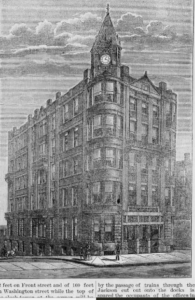
The first passenger elevator in a commercial building in Marquette was in the seven-story Savings Bank Building, still standing at the corner of Washington and Front streets. An April 1891 article discussing the plans for the building said that, "steel pumps will supply the heat for the building and also work the pumps which operate the first class...passenger elevator, which will be of the latest and best pattern used in any city in the country. It will work from the sub-basement to the top floor, seven floors in all, and will have a freight attachment which can be used when desired. The elevator will have high speed and will shoot the occupants of the top floors up in a hurry."
Things then moved quickly. Just a few months after the article about the elevator planned for the Savings Bank Building, the paper noted that the advent of the electric street railway meant that electricity could be brought to buildings all along the streetcar line. The Mining Journal said it was going to use the electricity to run its presses, that Sidney Adams planned to put an elevator in the Grabowers Store building to make it easier to reach the third floor, recently vacated by the Masons, and "Mr. Nestor will put one in his block as it is rebuilt and operate it by electricity." The plans for the "Marquette Hotel-Sanitorium," eventually opened as the Superior Hotel, called for a passenger elevator to move guests to the fifth floor.
None of these elevators were automatic, of course. They all required people to operate them and make sure they stopped level with each floor. An ad in the January 14, 1925, Mining Journal announced that there would be a civil service exam to hire an "elevator conductor" for the Marquette post office. The job carried an annual salary of $1,020–equivalent to about $19,500 today.
The Mining Journal ad for an elevator "conductor" shows that the terminology for the job had not yet been settled. Other stories referred to the elevator "pilot" or the elevator "man." One of the most unfortunately accurate terms, however, was the elevator "boy." Two stories from the Upper Peninsula illustrate the accuracy of that term.
In December 1923 a Mining Journal story said, "Wilfred Sandboom, who runs the elevator for the national grocery company in Escanaba, narrowly escaped a horrible death when his head was between the floor of the elevator and the third floor of the building...(How) he escaped decapitation is a mystery." Wilfred was 15 years old.
An even sadder story comes from Marquette, dated June 17, 1911. The lengthy headline typical of that time reads "Elevator Kills Charles Kelsey–Life of Deputy Clerk of Court Instantly Snuffed Out at Five O'Clock Last Night in the Nester Block–Two Boys Witnessed Tragedy–Skull Crushed Between Elevator Floor and Crossbar Above Cage Floor." The elevator boys, as the story calls them, were John Donahue, who had just turned 16, and Clifford Varden. The paper says that Clifford Varden said he was a week short of turning 16, "but he does not look more than fourteen or fifteen, though his parents are said to have filed a statement to the effect that he was 16 years old when he began working two days ago." In fact, Clifford Varden was just 13 years old. It was his 14th birthday that was coming up.
Fortunately, over the years, safety standards were developed and implemented for the construction and operation of elevators, and now it is safer to take the elevator than walk the stairs (though perhaps not as good for your heart). Marquette's last known manually operated public passenger elevator is in Getz’s Department Store. Towards the end of the elevator operator era, there were also women running elevators. Katherine Henrickson, wife of the Savings Bank's janitor, Toivo Henrickson, ran the elevator in that building for many years.
There are no longer jobs for elevator boys. But next time you notice an inspection certificate in an elevator, take a moment to remember Charles Kelsey and the history that went into your ride.