
Houses on the Move
Trending
MARQUETTE -- Marquette City Hospital was organized in July 1896 by Drs. Northrop, Foster, Youngquist, Harkin, and H. J. Hornbogen. Its subsequent history was one of nearly constant expansion. The first building was a converted home at 152 E. Prospect St. Quickly a larger home at 219 N. Front St. at the site of the current Peter White Public Library was acquired.
Within a year the hospital had outgrown its first two buildings and in June 1897, it moved its first purpose-built building at 123 W. Ridge Street. The name changed to St. Luke's Hospital later that year.
Even the Ridge Street building was soon outgrown. Starting in 1907 fundraising began for a new facility for St. Luke's. The largest fundraiser, a ball at the new Lake Shore Engine Works, was attended by more than 1,500 people and was "the" social event of the decade. The John Longyear family contributed the property near College Avenue and Hebard Court on which the new hospital was built.
The new St. Luke's Hospital opened in 1915 with a capacity of 50-60 beds. A local newspaper proclaimed it to be state-of-the-art, including "the latest electronic elevator operated by a push button control" and "two bath and toilet rooms for each floor." In 1917, the course at St. Luke's School of Nursing lengthened to three years. Students spent from 8 a.m. to 7 p.m. on duty with a two-hour break. Instruction was provided by the doctors and nurses, who received no extra pay for their time.
Over time, the hospital campus expanded with the construction of additional buildings. In 1931 the Children's Fund, founded by Senator James Couzens, built the Northern Michigan Children's Clinic adjacent to St. Luke's. The clinic brought specialists to the area, removing the need to send children downstate for treatment. Within a few years, the number of children treated by the clinic increased, causing overcrowding. The fund helped finance a new building at St. Luke's on the condition a pediatric ward be organized. Despite a stipulation that buildings erected by the Children's Fund not bear his name, the James Couzens Memorial Building, known as the "JCM" was completed in 1938. The clinic played an important role during the severe polio epidemics of the 1940s.
St. Luke's expanded with a five-floor patient care building in 1969. Then in 1973, lengthy negotiations resulted in the merger of St. Luke's and St. Mary's Hospitals into Marquette General Hospital, Inc. For the first eight years after the merger, Marquette General continued operations out of both the St. Mary’s facility (renamed Marquette General South), and St. Luke's (renamed Marquette General North). The merger eliminated duplication of practices and allowed for the upgrading of the community's medical services.
In 1979, ground was broken for a new $22 million Patient Tower, which was completed and dedicated in 1981. At that time all services were consolidated at Marquette General North, and Marquette General South (formerly St. Mary’s Hospital) was sold to the state of Michigan. That structure is now the D. J. Jacobetti Home for Veterans, visible from the U.S. 41 bypass. In 1984, the Upper Michigan Children’s Clinic building was demolished, and the $10 million East Building was erected in its place. The facility had lead-lined walls to accommodate a linear accelerator for radiation treatment of cancer.
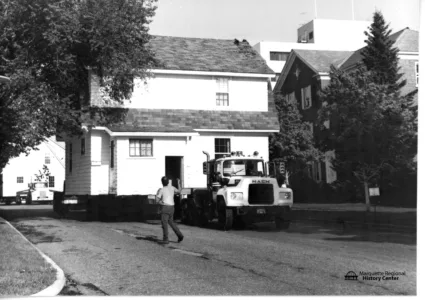
As the hospital continued expanding, they acquired land from their immediate neighbors. On several occasions including 1979, 1984 and 1985, homes in the neighborhood were purchased by the hospital and moved to new locations. The massive undertaking began by disconnecting the electrical and heating systems, water pipes, porches and the original foundations. Once free of their foundations, holes were knocked through the supports, and two massive steel I-beams were placed under the houses. Hydraulic jacks were used to lift the buildings onto heavy-duty trailers. Once at their new locations, the procedure was reversed.
One of the more complicated aspects of the move involved raising or dropping each overhead power, telephone and television line along the route.
To learn more about the vibrant neighborhood full of family homes near St. Luke’s Hospital and the huge effort to move the houses from West College and Magnetic Streets to allow for expansion of the hospital, join us for Houses on the Move: The Neighborhood Before MGH. This program at the Marquette Regional History Center at 1:30 p.m. Wednesday, Sept. 16 is part of our free daytime Senior Support Series. After identifying where 23 of these homes now rest, Cheryl Anderegg along with Jack Deo and others will tell the stories of many families who lived in these 1920-30s homes. Photographs, maps, and research will bring together this unique tale of our community.
For more info visit marquettehistory.org or call 906-226-3571.