
Presque Isle Bandshell: A look back
Trending
MARQUETTE -- The dedication and debut concert of the new Peg Hirvonen Bandshell at Presque Isle is taking place at 7 p.m. Thursday. With this milestone, it seems like a good time to look back at the history of the previous bandstands at the Island.
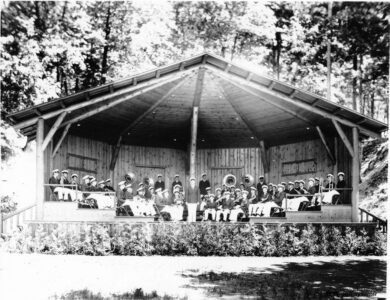
The original Presque Isle bandstand had been constructed in October 1903. The structure was a simple, uncovered platform, which stood opposite the terminus of the street railway company. It appears that the first concert at the bandstand was given by the Ishpeming Light Guard band in June 1904. The bandstand was still standing in the spring of 1935.
During the Great Depression, community business leaders began urging the city to add improvements to Presque Isle. They hoped to attract tourists to the area. Among the improvements suggested in May 1933 were shuffleboard courts and a new bandstand.
The city commission records for 1933 do not mention any discussion of the new bandshell but on September 11, 1933, they approved the payment of $150 to D.E. Anderson. David E. Anderson was an architect from Iron River, Michigan. Among the local buildings he designed are the Vista Theater, the Wallace Nurses Home and the Presque Isle Bandshell.
It appears that once the designs were done, the project was uncompleted for some time. In 1934 two shuffleboard courts were completed and players were soon asking for additional courts.
It wasn't until May 1935 that the city commission sought construction bids for the construction of the new bandshell and the salvage of the original platform. The construction contract was awarded to Frank Morin, of Marquette, who's sealed big came in $100 below budget.
Perhaps surprisingly, the Marquette Municipal band was not the first band to perform at the new venue. That honor was given to the Negaunee City Band on Sunday July 7, 1935. The Marquette band played their first concert there the following Sunday.
While the first few concerts appear to have gone smoothly, the new bandshell soon encountered a problem. On Monday, July 22, the city commission received a letter from the Marquette Musician's Union stating, "We regret to inform you that because of the refusal of the Marquette municipal band to maintain conditions under which members of the American Federation of Musicians may be employed, the band and band shell have been declared locally unfair and application has been made to have their names placed on the national unfair list." The city was given until August 8 to respond to the complaint.
The union unfair list or strike list is a roster compiled by trade unions of employers who have engaged in unfair labor practices, violated union contracts, or refused to bargain. The union was upset with the municipal band's pay gap, or perhaps more appropriately pay chasm between the musicians and the band's director, Martim M. Johnston.
One letter to the editor pointed out that in previous years the director had received 40% of the band's $2,000 appropriation, amounting to $80/week for 10 weeks. The remaining 60% was split between the musicians who received an average of $2/week.
In 1934, the band's appropriation had been reduced to $1,200 due to the Depression and the director was receiving only 33.3% of the funding, amounting to $50/week for 8 weeks. This allowed the musicians' wages to increase to an average of $2.50/week, although it was noted that the high school boys were paid between $0 and $2/week while the more experienced musicians were receiving $3-4/week.
The union had suggested a compromise- that the band's appropriation be kept at $1,200/year but that the director's salary be limited to no more than three times the pay for an individual player and that the individual players also receive a uniform wage.
In the end, the city chose to increase the band appropriation to $1500, with one third or $500 going to director Martin Johnson and $1,000 to the players. This was during the Depression, when all city employees received a 25% pay cut. It was pointed out that Johnston's salary was cut from $800 to $400, a 50% reduction which the city felt was enough of a penalty.
This, in turn, led to the Escanaba band (which was a union organization) canceling their Aug. 11, 1935, concert at the bandshell. Unfortunately, records have not been located to indicate when the band and bandshell were removed from the union's unfair practices list. Regardless of the rocky beginnings, the Presque Isle Bandshell served as a cornerstone of community gatherings and performances for decades.