National pastime- Early baseball in the Upper Peninsula
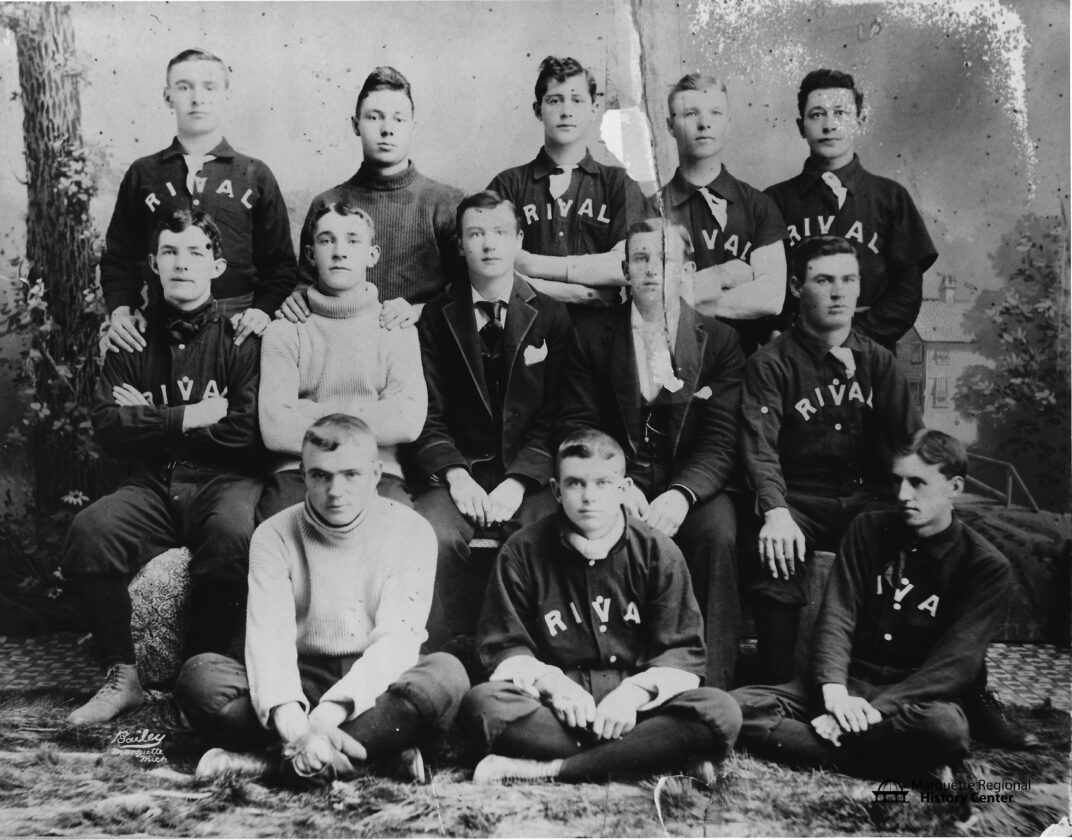
The Marquette Rivals baseball team from 1894-95. (Photo courtesy of the Marquette Regional History Center)
-
- The Marquette Rivals baseball team from 1894-95. (Photo courtesy of the Marquette Regional History Center)
-
- The Negaunee Lime and Kiln baseball team. (Photo courtesy of the Marquette Regional History Center)
-
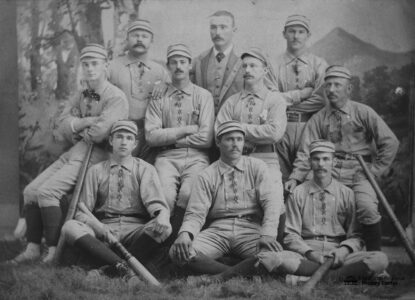
- A very early baseball team. (Photo courtesy of the Marquette Regional History Center)
Before it became America’s “National Pastime,” early baseball sports were variants of medieval bat-and-ball games that involved hitting, fielding, and sometimes base running, although the rules were few and flexible. By the mid-nineteenth century, two distinct versions of the game rivaled each other for supremacy. The Massachusetts Game was played on a rectangular field with overhand pitching while the New York Game had a diamond shaped field with underhand pitching. Eventually the New York version won.
Baseball was first described as the “National Pastime” by the New York Sunday Mercury newspaper in 1856. Beginning three years earlier, it was the first newspaper to regularly cover baseball as news. The American Civil War helped to cement the game’s popularity as soldiers spread the sport throughout the country. The game appears to have arrived in the Upper Peninsula not long after the end of the war, with references to the Hancock First Nationals team dating to 1869.
In those initial days it was reported that interest in the game was unusually great in the Copper Country. Whenever there was a game in the area, the mines, smelters, and stores would close at noon so that everyone in town could attend. It was also noted that there was a great deal of gambling.
Scores in the early years were remarkably high, rarely below 15. This was in part because pitching was underhand and there was no curve pitching. Also, the catcher didn’t stand up to the bat as they do now. Starting in the mid-1870s, regular overhand pitching became more common.
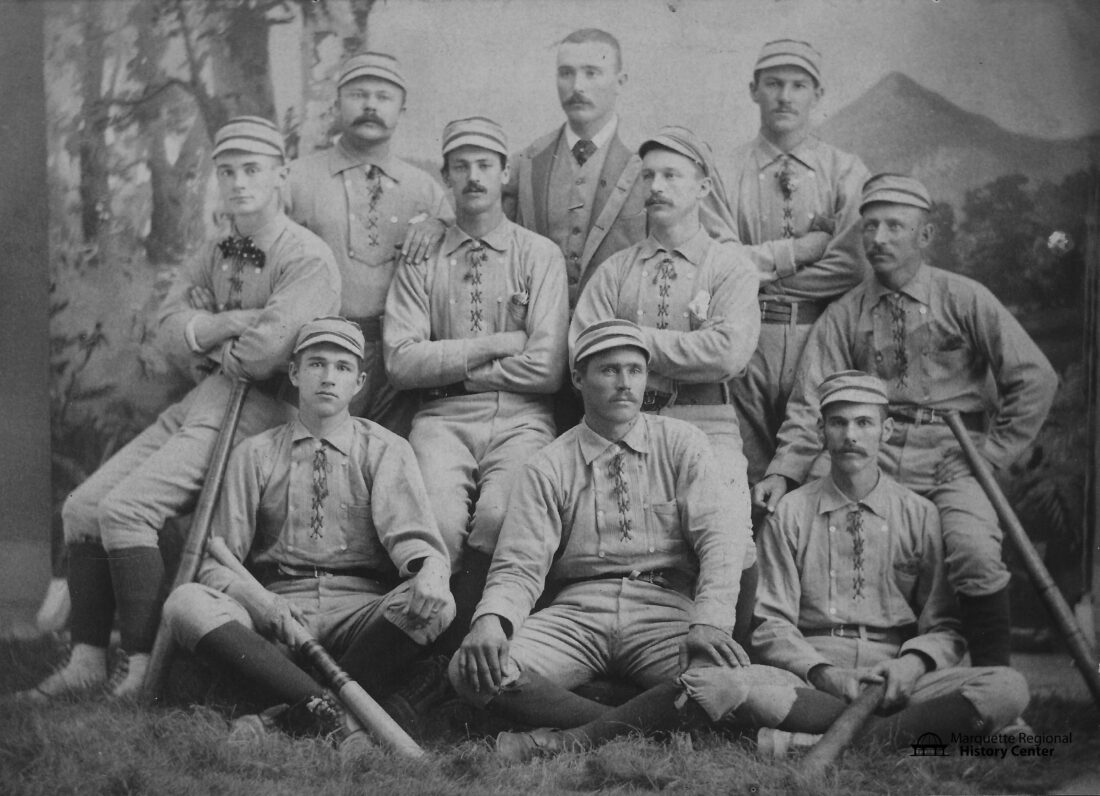
The Negaunee Lime and Kiln baseball team. (Photo courtesy of the Marquette Regional History Center)
Negaunee catcher Otto Londsdorf is credited with being the first in the county to stand directly behind the batter. He covered his mouth with a large chunk of rubber to protect his teeth but had no mask or breastplate to protect the rest of his body. Despite the dangers, his new arrangement allowed him to pick off more foul tips and led to his team winning by huge scores.
In 1890 six independent level teams formed the Upper Peninsula League. The charter members were the Marquette Undertakers, Negaunee, Ishpeming, Houghton, Hancock and the Calumet Red Jackets. The first title went to the Houghton team, with a 23-13 overall record. The following year, there were only four teams as the Hancock and Negaunee franchises had folded. By 1892 the Upper Peninsula League had evolved into part of the Wisconsin-Michigan League.
In the early 1900s local games were played at the old fairgrounds, in the area near the Berry Events Center on West Fair Avenue, which at the time was quite a distance from town. The field had two grandstands, with admission costing $0.25/each.
Occasionally indoor games were played at the old Casino on Main and Lake Streets. The building also housed dances, stage plays, wrestling matches, a type of hardwood hockey and other events before being converted into a livery stable. Later the indoor games were played in the old Fraternity Hall, the old Marquette County Historical Society building next to Peter White Public Library.
The record for the longest game in Marquette was set in 1906 when they played against the Soo. At the end of 18 innings, the score was still tied at 3-3 and the match had to be called on account of darkness.
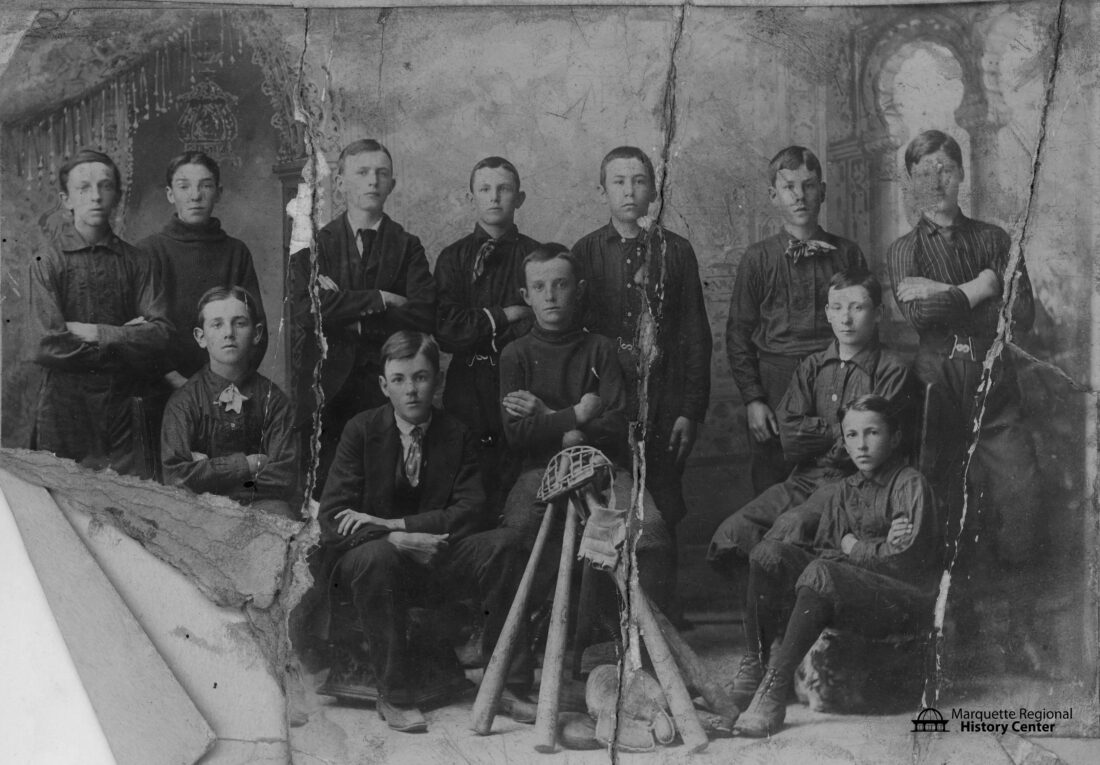
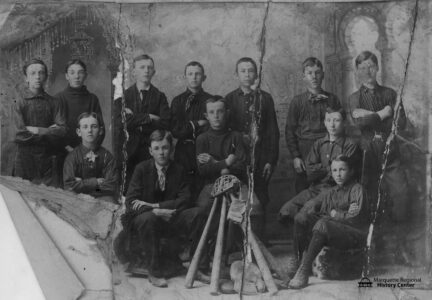
A very early baseball team. (Photo courtesy of the Marquette Regional History Center)
Another record came in 1876 for “one of the longest home runs ever hit” during a game between Baraga and Hurontown. Although the mileage and hitter weren’t recorded, the story reported that the field was near the river and someone hit a long ball. The ball apparently landed on a boat going to Houghton and was finally found when the boat landed.
Among the players who appeared in the Upper Peninsula and later went on to the major leagues, were William “Dolly” Gray of Atlantic Mine who pitched for Ishpeming before joining the Washington Senators (1909-1911). Joe Cantalion, who managed the Menominee team before serving as a major league umpire (1901-1902) and managing the Washington Senators (1907-1909). Art Nehf, who pitched for Negaunee in 1912 and later played for the Boston Braves (1915-1919), New York Giants (1919-1926), Cincinnati Reds (1926-1927), and the Chicago Cubs (1927-1929) including pitching for five world series.
Other Yoopers also left their mark on major league baseball including Clarence Lehr of Escanaba who played outfield, shortstop and second base for the Philadelphia Phillies (1911). Hank Olmsted of Sac Bay on the Garden Peninsula who pitched for the Boston Americans (1905). John Perrin of Escanaba played for the Boston Red Sox in 1921. Les Sweetland of St. Ignace played for the Philadelphia Phillies and the Chicago Cubs.
One final tie between the Upper Peninsula and Major League Baseball can be found in Trenary. Back in 1954 Hurk Aho and Joe Hytinen made a bet about who would win the World Series. The loser had to push a wheelbarrow full of potatoes from US Highway 41 to a local bar about ¾ of a mile away. Hurk lost, pushed the wheelbarrow and when he reached the bar, they auctioned off the contents. That first year the proceeds purchased libations but every year since, the proceeds of the “Potato Auction” are donated to the local Little League program. The October 2025 auction raised more than $6,200 which was used to replace the left field fence.
Superior History
History quiz
QUESTION: Prior to the 1937 Lumberjack Strike in Gogebic County, what were lumberjacks typically paid? a. ...
U.P. Moments in History
National pastime – Early baseball in the Upper Peninsula
MARQUETTE — This evening’s Major League Baseball marquee matchup between the New York Yankees and San Francisco ...
National pastime- Early baseball in the Upper Peninsula
History quiz