Samuel Carey: Black, Civil War vet, barber, Negaunee resident
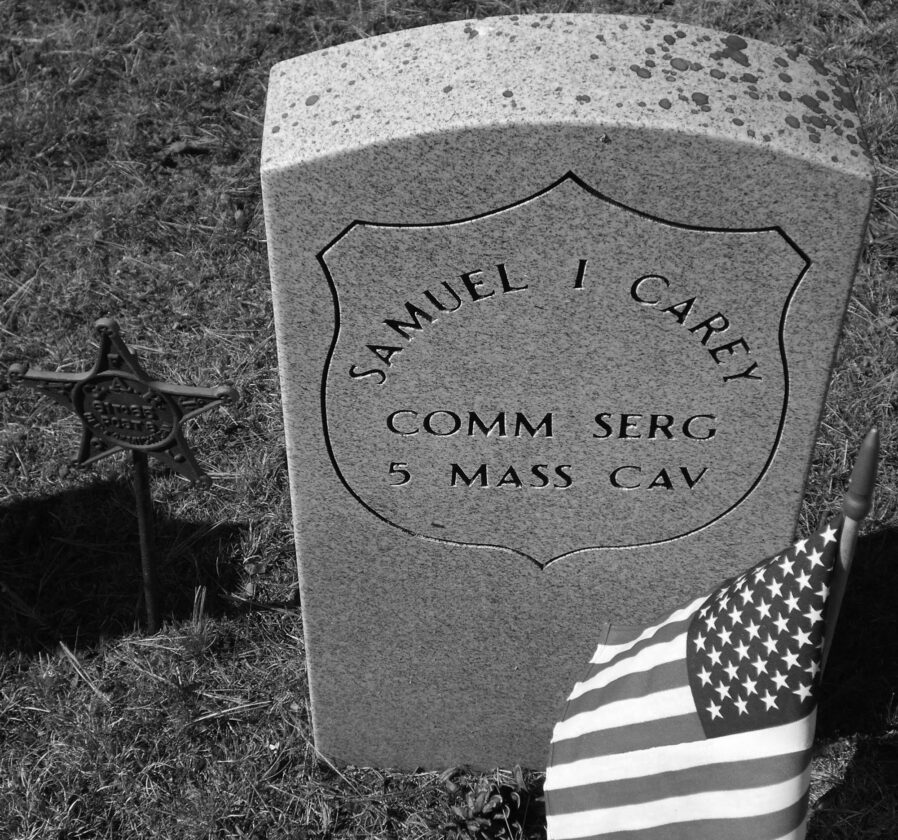
Pictured is Samuel Carey's grave in the Negaunee Cemetery. (Photo courtesy of the Marquette Regional History Center)
MARQUETTE — Samuel Carey (or Cary) is the only African American Civil War veteran known to have lived in Negaunee.
Samuel was born in Putnam, Ohio, between 1833 and 1838, with 1837 seeming like the most probable year. His parents, Isaac and Nancy Carey, were both born in North Carolina, probably into slavery. It is not known how the family came to reside in Ohio as free blacks in the years before the Civil War.
Samuel enlisted in Newton, Massachusetts on Dec. 22, 1863, receiving a bounty or signing bonus of $325 from the city of Newton. In January 1864, he mustered into Company A, 5th Massachusetts Cavalry as a private. The regiment was the only “colored” cavalry organized in Massachusetts. After just a month, Samuel was promoted to commissary sergeant in February 1864.
The 5th Massachusetts participated in the advance on Petersburg, Virginia in June 1864. At the end of the month, the unit was ordered to Point Lookout, Maryland, to guard Confederate prisoners, remaining there throughout the rest of 1864. The regiment returned to Petersburg in early 1865.
In June 1865, they were sent to Texas due to Confederate soldiers who were crossing into Mexico. It was feared that the Confederates would use Mexico as a base for an ongoing guerrilla war. Eventually an agreement was reached between the Union and the now former Confederate soldiers, allowing the 5th Massachusetts to muster out of Federal Service on October 31, 1865, in Clarksville, Texas.
Sometime between his discharge and the 1870 US Census, Samuel arrived in Negaunee where he began working as a barber.
In September 1873, Samuel Carey married Elizabeth Tifft in Negaunee. The marriage was performed by Rev. James Frazee of the Negaunee Methodist Episcopal Church (now the Mitchell Campus of the Marquette Hope United Methodist Faith Community). But according to Michigan law at the time, the marriage was illegal. Samuel Carey was black while Elizabeth Tifft was white. The state’s “anti-miscegenation” laws, forbidding black-white marriages were not repealed until 1883.
Regardless of the law, in the 1880 US Census, Samuel and Elizabeth were living in Negaunee along with Elizabeth’s sister, Lucy Tifft. It is not known how the couple were treated by the local community, but it appears that the rest of Elizabeth’s family may have disowned her due to her relationship with Samuel.
Unfortunately, Samuel and Elizabeth never had children and in May 1885, Samuel petitioned the Marquette County Probate Court to declare Elizabeth insane. She had already been residing at the County Poor House, probably as a patient of the county infirmary and after examination by two doctors, she was committed to the Northern Michigan Hospital for the Insane in Traverse City. Elizabeth remained at the hospital for 10 years until 1895 when she was transferred to the newly opened Upper Peninsula Hospital for the Insane at Newberry.
Samuel was known being “good-natured and generous to a fault,” but he was also described as an “inveterate gambler.” In 1896 he bet his barber shop on prize fight between Fitzsimmons and Maher in Texas, considered to be the unofficial 1896 World Heavyweight Championship. Unfortunately, Carey lost the bet and his shop. He spent the last years of his life working as a bartender for Henry Heisel’s tavern in Ishpeming.
Carey was working in the saloon in December 1898 when he suffered a cerebral apoplexy, a stroke. He died several days later having never regained consciousness. Samuel was buried in the Negaunee Cemetery with a military headstone.
In June 1904, the Newberry Hospital sent a letter to the Marquette Probate Court stating that Elizabeth was failing rapidly and would probably not survive long. It appears that they were not aware of Samuel’s death six years earlier. She died the day after the letter was sent, with the cause listed as exhaustion due to epileptic dementia.
Samuel and Elizabeth Carey endured a difficult life, but they are not forgotten.
“To die completely, a person must not only forget but be forgotten, and he who is not forgotten is not dead.” — SAMUEL BUTLER
Superior History
U.P. Moments in Time
Samuel Carey: Black, Civil War vet, barber, Negaunee resident
History Quiz
WUESTION — "Finland Calling" or "Suomi Kutsuu" was an iconic, long-running Finnish-American television show ...
History quiz
QUESTION: When did the legend of Heikki Lunta originate? a. During the Viking Age b. 1323 c. 1917 d. ...
U.P. Moments in History