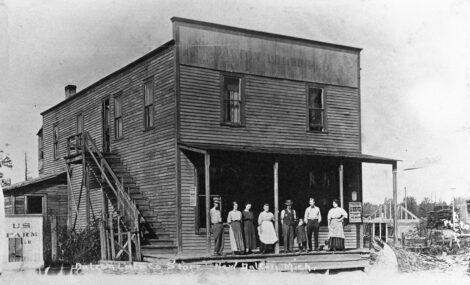
Ski jumping harkens back to 1880s in Marquette County
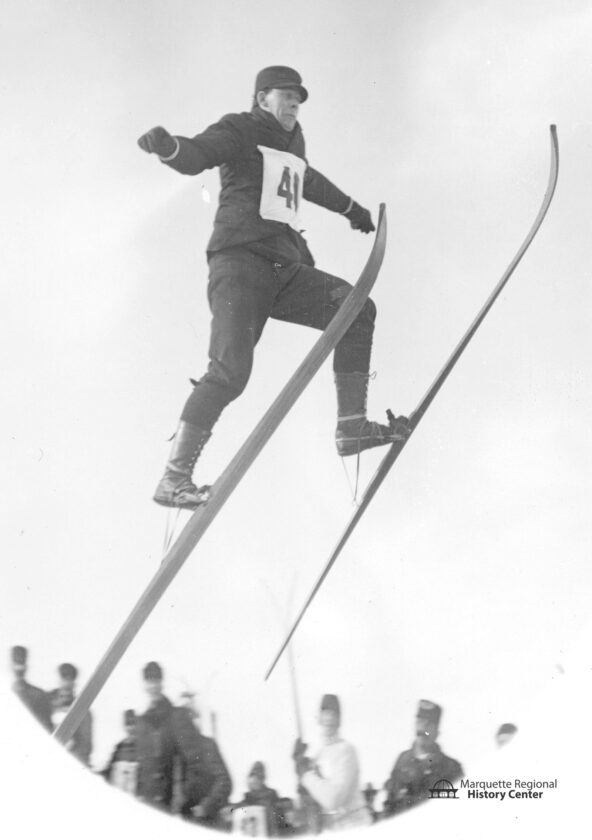
A ski jumper in Ishpeming from around 1901 shows his skills in the air. (Photo courtesy Marquette Regional History Center)
-
- A ski jumper in Ishpeming from around 1901 shows his skills in the air. (Photo courtesy Marquette Regional History Center)
-
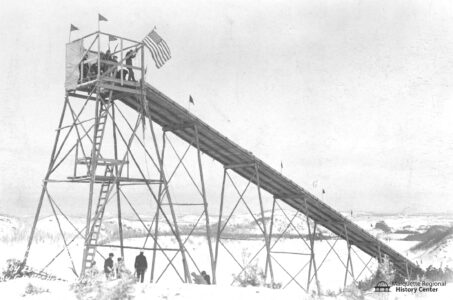
- This is the scaffolding for the top of a ski jump at a hill in Ishpeming, probably from 1905. (Photo courtesy Marquette Regional History Center)
The earliest world-record ski jumps were made in Norway. The first is credited to Olaf Rye, a Norwegian-Danish soldier, who made a 31-foot jump from an improvised hill of handmade-piled snow in 1808. The second official record jump was 64 feet made by Sondre Norheim in 1868.
In January 1886, The Mining Journal published this description:
“The long, wooden snowshoes, navigated only by the Scandinavians, can be seen at the furniture store of Hoken Asgaard. He has made a dozen pairs recently. They are four inches wide and eight feet long, with the fronts turned up like toboggans. There are thongs in the middle through which the foot is put.
“The hill is like a streak of lightning. Those accustomed to their use are wonderfully expert on these queer machines.”
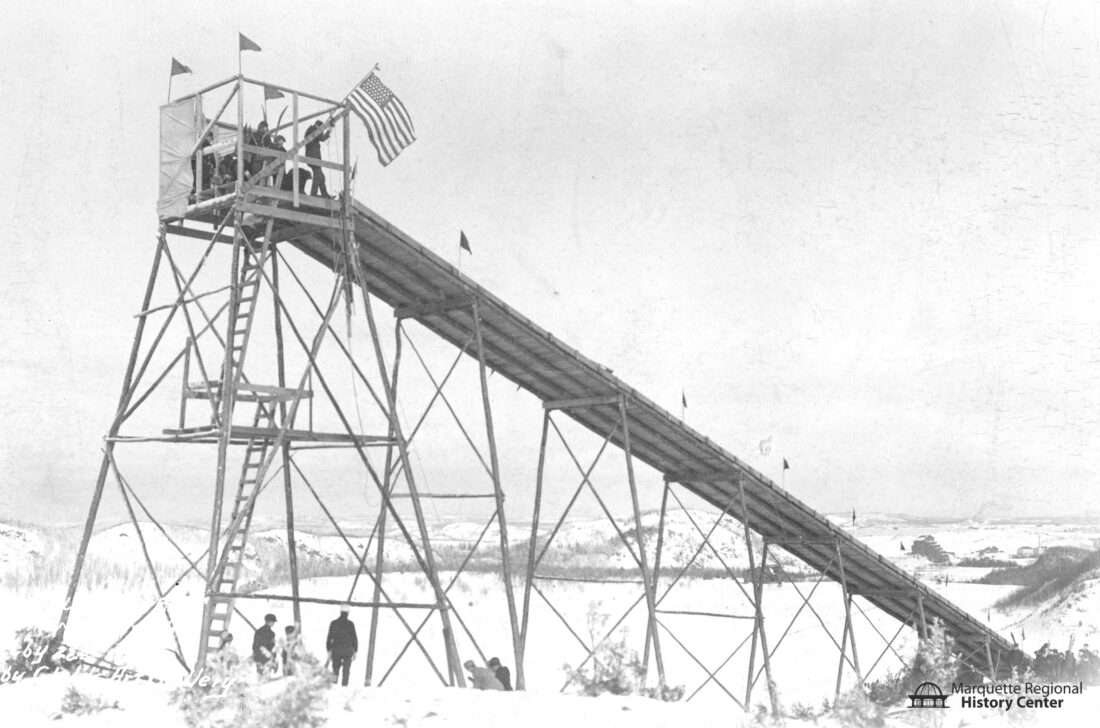
This is the scaffolding for the top of a ski jump at a hill in Ishpeming, probably from 1905. (Photo courtesy Marquette Regional History Center)
The more daring young men in the community began gathering on Sundays at various hills in the Ishpeming area to try their skill at jumping. After hearing that a club had been organized in Red Wing, Minnesota, the Ishpeming men organized their own club, the Norden Ski Club, in 1887.
The first public tournament was held Feb. 25, 1888, on the south side of the big hill at the Lake Angeline Mine, after a parade through town led by two bands. There were five in the first class and nine in the second.
Jumps averaged from 30 to 35 feet, the bump being small and the landing nearly flat ground. As interest kept mounting, different hills were used, jumps increased in length, and many outsiders became participants.
In 1904, Brasswire Hill became the permanent location for the meets. That year saw the largest meet-up until that time, with special trains bringing large crowds from all over the area. In front of an estimated crowd of 6,000, jumps of up to 79 feet were made. The day before the tournament, the National Ski Association was organized in Ishpeming.
Record jumps were being made at Ishpeming on a fairly regular basis.
In 1908, 10,000 people saw John Evenson of Duluth, Minnesota, jump 122 feet for an American record. In 1910, Anders Haugen of Chippewa Falls, Wisconsin, make a jump of 132 feet but was beaten out by August Nordby of Superior, Wisconsin, who set a new American record with a leap of 140 feet.
Haugen went on to break the world record with a jump of 152 feet in 1911 at Curry Hill in Ironwood, which won him the national championship. He made two additional world-record jumps, 213 feet in 1919 and 214 feet in 1920, both at Haugen Hill in Dillion, Colorado.
Ski jumping events proved popular with many mines, offices and stores closed for the day and special trains bringing hundreds of spectators to watch. Within a few years, the sport had spread throughout the region. In 1906, ski enthusiasts in Munising built a hill where jumps of up to 100 feet were recorded. Skandia joined the activity in 1909, with events held on what was called Olaf Hill.
Ski jumping has remained a cornerstone of Marquette County’s winter culture. Tournaments have been held in Ishpeming every year since the first one in 1888, making it the longest consecutively run ski jumping competition in the United States. In a few weeks, from Jan. 16-18, the Ishpeming Ski Club will host its 139th Annual Tournament, again drawing crowds of thousands to the area.
Beth Gruber is the research librarian at the John M. Longyear Research Library of the Marquette Regional History Center located in Marquette.
Superior History
History quiz
QUESTION: When did the legend of Heikki Lunta originate? a. During the Viking Age b. 1323 c. 1917 d. ...
U.P. Moments in History
Hamming it up in the U.P.
History quiz
Collecting folk music in the Upper Peninsula