
Marquette at the 1893 World’s Fair part 2
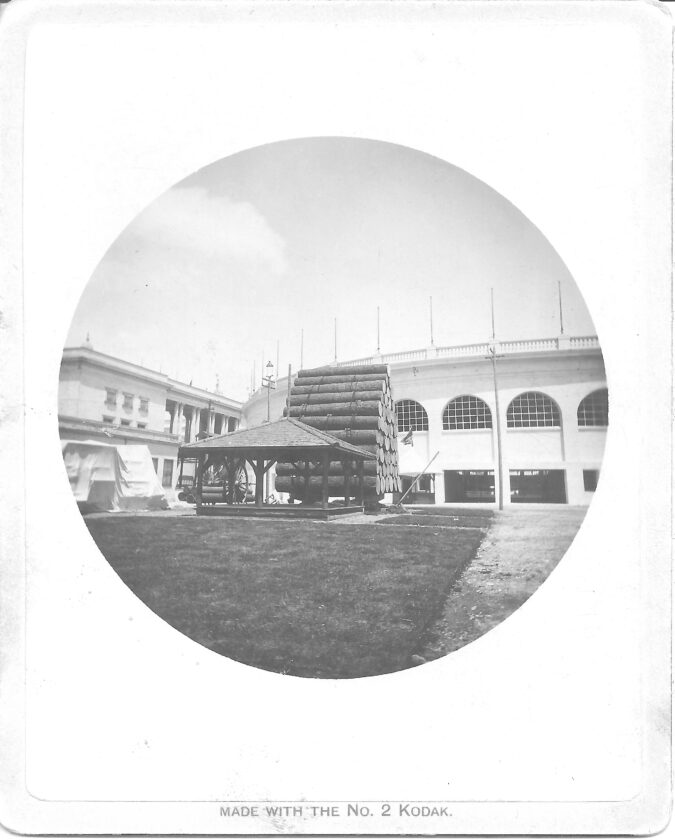
The Load of Logs on display at the World's Fair. (Photo courtesy of the Marquette Regional History Center)
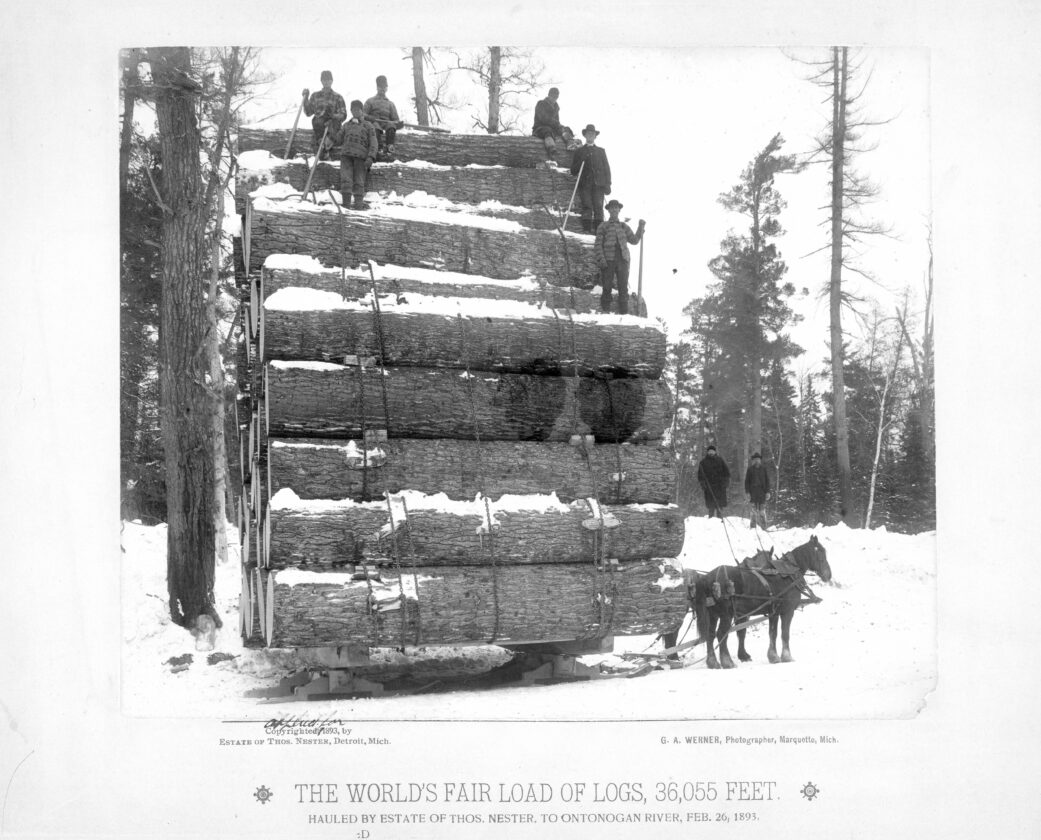
"The Largest Load of Logs, 18 feet long, ever Hauled in the world, and Hauled by One Team. Height of Load 33 Feet 3 Inches. Wight [sic] of Logs 144 Tons. Hauled on Bunks 16 Feet Long. Nine Flat Cars were required to Convey the Logs to Chicago. The World's Fair Load of Logs, 36,055 Feet. Hauled by the Estate of Thos. Nester, to Ontonogan [sic] River, Feb. 26, 1893. Photo by G.A. Werner, photographer, Marquette. (Photo courtesy of the Marquette Regional History Center)
The Load of Logs on display at the World's Fair. (Photo courtesy of the Marquette Regional History Center)
"The Largest Load of Logs, 18 feet long, ever Hauled in the world, and Hauled by One Team. Height of Load 33 Feet 3 Inches. Wight [sic] of Logs 144 Tons. Hauled on Bunks 16 Feet Long. Nine Flat Cars were required to Convey the Logs to Chicago. The World's Fair Load of Logs, 36,055 Feet. Hauled by the Estate of Thos. Nester, to Ontonogan [sic] River, Feb. 26, 1893. Photo by G.A. Werner, photographer, Marquette. (Photo courtesy of the Marquette Regional History Center)
Trending
MARQUETTE -- Last week's article talked about Peter White's responsibilities as a member of the Michigan Board of Fair Managers for the 1893 Columbian Exposition in Chicago. That piece ended with a description of the three trains of sleeper cars that took the entire Michigan legislature from Lansing to witness the opening of the Michigan Building on April 29. On that day Marquette's Peter White, who was in charge of the arrangements, introduced I.M. Weston, president of the Board of Fair Managers. President Weston then formally delivered the building to Michigan governor, John Rich.
The elected officials in Marquette were not far behind. On April 31, a crowd of a thousand watched a specially chartered Wagner Palace Sleeping Car leave the Marquette rail depot heading to the grand opening of the fair. Both sides of the train car were decorated with banners 60 feet long and three feet wide, showing a map of the region and announcing, "City Council of Marquette, Michigan -- Queen City of Lake Superior -- En Route to World's Fair."
Another crowd gathered in Negaunee to see the sleeper car attach to the Chicago and Northwestern train for Chicago. On board were Mayor Nathan Kaufman, who had underwritten the entire expedition, 15 of Marquette's 16 aldermen, and the city recorder of deeds. In addition to this official party, the special car also carried three of the aldermen's wives, a Mining Journal reporter, the mayor's father, Sam Kaufman, and the city controller. The newspaper reported, "It is safe to say that no other city at anything like the distance Marquette is from Chicago will be represented by its entire city government when President Cleveland touches the button today."
Throughout the rainy evening and into the night, passengers from the crowded sleeper car went through the rest of the train, bringing back various friends and acquaintances they found there. They were especially delighted to find a troupe of performers who had just done shows at the Marquette and Ishpeming opera houses, including Pete Baker, billed as "the leading German dialect comedian." These were also brought back to the special car, where Baker was persuaded to perform several of his dialect pieces, another performer gave his "famous Irish military speech," and another sang several songs.
Things got rowdier as the train crossed into Wisconsin, where a plot was hatched to arrest and try The Mining Journal reporter for libel. The reporter demanded and was assigned an attorney, a jury was empaneled and multiple witnesses were called to testify. He was found guilty and was sentenced to be "shorn of his beard and deprived of his glasses," and the sentence was "immediately put in force." The intrepid reporter, presumably after recovering his glasses if not his beard, noted that "the trial and the hard feelings engendered by it made the evening pass very rapidly."
The party continued to enjoy themselves once they reached Chicago early the next morning, where the rain had dried up and the sun was out as President Cleveland opened the fair. They stayed for a week, enjoying not only the fair, but also Buffalo Bill's Wild West Show and the stage show "America,” described as "a grand historic spectacle in four acts and seventeen scenes."
In addition to the Michigan Building, there were several other exhibits of special interest to the Marquette visitors. One that is perhaps still remembered best was the "World's Largest Load of Logs Ever Pulled by a Single Team." The exhibit, which stood outside the Forestry Building, included 50 virgin white pine logs, weighing more than 145 tons. The logs had been harvested near Ontonagon in February and carried, indeed by a single team of horses, six miles to the Ontonagon River. Ultimately it took six railroad flat cars to carry the load to Chicago.
Michigan's contribution to the Mines and Mining building was equally impressive. Michigan had been given the largest exhibition space of any state or country and received more awards than any other. Under Peter White's supervision, the display was designed by Marquette architects, Charlton & Gilbert. Visitors entered the display under a 25-foot-high arch of raindrop brownstone from quarries near Jacobsville. The arch was topped by two life-size bronze statues of resting miners being crowned by the goddess Victory. After the fair closed in October, the arch went to the new John Ball Park in Grand Rapids.
There were hundreds of ore samples, some weighing more than four tons. There was a glass model of the Aragon Mine, near Norway, Michigan. There were elaborate wooden models of hoists, shafts, and stamp mills in the Copper Country, "with each jig, pipe, and pulley in the correct place." A model of the DSS&A #4 Ore Dock in Marquette, showing the workings of the pocket dock, was 70 feet long.
During the six months the fair was open, hundreds more people from the U.P. visited the fair. The social columns of the Mining Journal were filled with reports of people coming and going. But Peter White still had several contributions to make. On May 12, he announced that he and a colleague from Milwaukee had rented a large furnished house with a view of Lake Michigan to be used for the newly created Michigan-Wisconsin Columbian Club. For a ten-dollar membership fee, visitors could use the clubhouse to meet with friends, hold business meetings, leave parcels, or accept messages and telegrams.
The fair closed on Oct. 30, 1893, but the work of Peter White and the Michigan Board of Managers was not done. All of the thousands of donated items had to be returned or passed on. Exhibits had to be dismantled and offered to anyone who could use them (many went to museums or schools). Contractors had to be hired to demolish the buildings. Certificates of commendation had to be distributed.
And then, finally, the Managers had to issue a final report to the governor and legislature. That report, which ran 200 pages of fine print and accounted for every dollar spent and every sheaf of wheat exhibited, was submitted on May 31, 1894. The committee appointed to prepare the report? Gov. Rich, President Weston and Peter White.