
UN: Iran increased weapons-grade uranium before attack
Trending
VIENNA -- A confidential report by the United Nations’ nuclear watchdog circulated to member states and seen by The Associated Press said Wednesday that Iran increased its stockpile of uranium enriched to near weapons-grade levels before Israel launched its military attack on June 13.
The report by the Vienna-based International Atomic Energy Agency said that as of June 13, Iran had 972 pounds of uranium enriched up to 60%, an increase of 71.2 pounds since the IAEA’s last report in May.
The report stated that this figure is “based on the information provided by Iran, agency verification activities between 17 May 2025 and 12 June 2025 (the day preceding the start of the military attacks), and estimates based on the past operation of the relevant facilities.”
That material is a short, technical step away from weapons-grade levels of 90%.
According to the IAEA, approximately 92.6 pounds of 60% enriched uranium is theoretically enough to produce one atomic bomb, if enriched further to 90%.
Calls for inspections
The confidential report also said Iran and the IAEA have not reached an agreement on resuming inspections of sites affected by Israeli and U.S. bombing in June.
It remains unclear just how much the Israeli and U.S. strikes disrupted Iran’s nuclear program. Israel targeted Iranian nuclear and military sites, saying it could not allow Tehran to develop atomic weapons and that it feared the Islamic Republic was close. Iran has long maintained that its program is peaceful.
On June 22, the U.S. dropped bunker-buster bombs on nuclear sites.
On July 2, Iran’s President Masoud Pezeshkian signed a law adopted by the Iranian Parliament to suspend all cooperation with the agency.
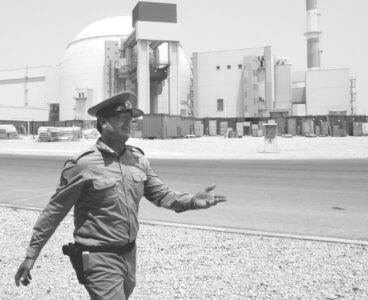
The only site inspected since the war has been the Bushehr Nuclear Power Plant, which operates with Russian technical assistance. Inspectors watched a fuel replacement at the plant on Aug. 27 and 28.
The director general of the U.N. nuclear watchdog, Rafael Grossi, said that “technical modalities to enable the full resumption of Agency inspection should be concluded without delay,” the report stated.
More negotiations
The report detailed the discussions between Iran and the U.N. nuclear watchdog to resume inspections over the past month and a half, stating that a technical team from the IAEA held discussions in Tehran with Iranian officials on Aug. 11.
The report states that on Aug. 14, Iran sent a letter providing a detailed draft of a “new arrangement,” under which the IAEA would have to submit its requests for inspections of undamaged facilities “on a case by case basis.”
With regard to damaged sites, the report states that Iran “undertook to provide the Agency with a report ‘up to one month after the finalization of this Arrangement.'” According to the Iranian proposal, only after the submission of such a report would Iran and the U.N. nuclear watchdog negotiate a new arrangement for cooperation.
The IAEA chief made clear to Iran that any cooperation arrangement must be in accordance with Tehran’s nuclear safeguards agreement that it has with the U.N. nuclear watchdog.
The report said that discussion between Iran and the IAEA will continue in Vienna “in the next few days.”
The report by the IAEA comes at a sensitive time as France, Germany and the United Kingdom on Aug. 28 started the process of reimposing sanctions on Iran.
The process, termed a “snapback” by the diplomats who negotiated it into Iran’s 2015 nuclear deal with world powers, was designed to be veto-proof at the U.N. and could take effect in a month.
The move set a 30-day clock ticking for sanctions to return unless the West and Iran reach a diplomatic agreement.
___
The Associated Press receives support for nuclear security coverage from the Carnegie Corporation of New York and Outrider Foundation. The AP is solely responsible for all content. ___ Additional AP coverage of the nuclear landscape: https://apnews.com/projects/the-new-nuclear-landscape/
An Iranian security officer directs media at the Bushehr nuclear power plant, with the reactor building seen in the background, just outside the southern city of Bushehr, Iran, on Aug. 21, 2010. (AP file photo)