
No easy solution to downtown’s vacant lots
Trending
ESCANABA -- The charred gap on the 1000 block of Ludington is going to get bigger before it gets better.
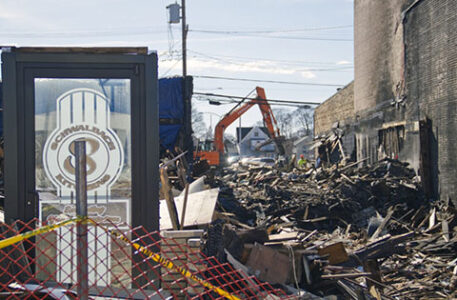
What used to be adjoining buildings at 1009 and 1011 Ludington St. -- Schwalbach Kitchens and Trinkets & Treasures, each with an apartment above -- burned to the ground on the morning of Jan. 24, and the damage didn't end there. The neighboring businesses on the block -- East Ludington Gallery to the east and The Beaten Path to the west -- suffered extensive damage and have been closed since.
The artists' co-op and the upstairs tenant had to leave the gallery building, and they won't be coming back to the same structure. Property owner Craig Woerpel said the building is coming down. Comparing it to a car that has been in an accident and been totaled, he said that it would be more difficult to salvage and repair the building than it would be to demolish and rebuild.
The structure at 1007 Ludington that locals now know as East Ludington Gallery was built between 1899 and 1906 and was identified as "Groos Block" on the National Register of Historic Places. The corresponding report notes that the Groos Drug Store occupied the building for "at least eight decades." It also identifies a number of architectural features still seen today on the structure that, as the gallery, brought together local artists and saw customers from near and far.
It's not a stretch to say that a gap occupying that much of central downtown isn't a good look, and the most recent hole just adds to a list. Peering just one block to either side -- still on Ludington, between 9th and 11th -- an onlooker counts six empty lots on just three blocks of Escanaba's main street. The others are: between Yao's Spa and Canterbury Book Store on the 9th block; between Elevated Exotics and Wishful Thinking, also on the 9th block; and between St. Vincent de Paul and The Morrison shop on the 10th block, directly across from the site of the January fire.
These examples aren't the end of the roster. Other places in Escanaba sit empty or boarded up. But each of the lots is privately owned, which makes a collaborative project difficult.
"We don't want that large of a gap within the downtown, especially in the core area," said Woerpel, executive director of the Downtown Development Authority (DDA). "So how can we repurpose the property?"
It's no use looking to the city's master plan for guidance; the current one that was created by the Central Upper Peninsula Planning and Development Regional Commission (CUPPAD) in 2016 bears little difference from the one made up in 2006 by firm Beckett and Raeder and is no longer relevant. A request for proposals for a new plan is currently open as of Feb. 5, and the City of Escanaba will be accepting submissions until March 29.
Incidentally, the area that burned is also near Center Court -- located on 11th Street -- around which a "town square"-type streetscape project has been one goal of the DDA.
Woerpel indicated that the authority has for some time now considered the possibility of acquiring properties for development. No specific plans are yet set in stone.
The Delta County Economic Development Alliance will be able to provide input in the near future; Executive Director Ed Legault said that it was too soon to address possibilities for the site until more details are gathered.
Progress is being made, though.
"Cleanup and disposal require coordination of the property owner, insurance, contractor, landfill, city, and utility companies," said City Manager Jim McNeil. "This has been taking place, and you will see more progress on the site in the next couple days."
So what possibilities or restrictions exist when it comes to rebuilding on Ludington Street?
Construction costs are likely to be the largest hurdle. Contrary to the belief of some, modern zoning regulations do not prohibit structures from being rebuilt as they were.
That stretch of Ludington is zoned as E-3, "Central Commercial." Required setbacks in this area are zero to five feet in the front and nonexistent on the sides. There must be a 25-foot-deep rear yard.
Types of premises permitted are: bars, restaurants, service establishments, public or governmental buildings, indoor retailers, cultural facilities (such as theaters or galleries), health services, medical or professional offices, minor food production, indoor recreation, and dwellings above the first floor. Allowable with a Special Land Use Permit are a handful of other operations, including banks, hotels, marijuana retailers and multi-family residences.
According to the city's Code of Ordinances, "The Central Commercial District is intended to permit both large and small-scale 'downtown' commercial development at an intensity which provides significant incentives for infill development, redevelopment, and the continued economic viability of existing development."