
Autumn gales – the maiden voyage of the Japan
Trending
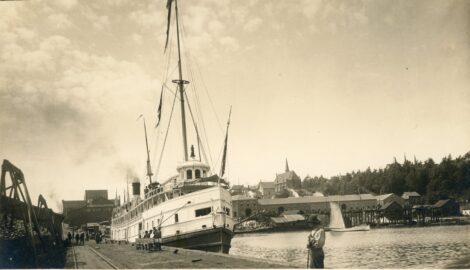
MARQUETTE -- In 1871, the Erie & Western Transportation Company, proprietors of the Anchor Line, had three "floating palaces" built by the King Iron Works, all to the same plans and specifications.
Known as the "triplets," the India was launched June 21; the China on July 19; and the Japan on Oct. 2. These propellers were designed for both passenger and general cargo service and were 210-215 feet long with a 32 ½-foot beam while the holds were 14-15 feet deep.
The Mining Journal described the "...new iron steamer India...The hull is iron, painted a pea green, and the upper works- wood- are white. The hull is divided into five water tight compartments, a guarantee against sinking...As further means of safety she carried two Raymond metallic life boats, two wooden life boats, with galvanized iron tanks, and three hundred life preservers...
"The cabin is of black walnut finish, with maple panelings and ornamented ground glass in the stateroom doors. Massive mirrors, a piano, luxurious chairs and sofas, tasteful and elegant hangings, velvet carpetings, tasty chandeliers, all combine to make the cabin 'a thing of beauty,' as well as of comfort, and give it an elegant parlor style.
"The staterooms are not exceptions in the general plan, and all that can be contrived for the convenience of the passengers is there provided. The wash stands are supplied with water from tanks on the hurricane deck. The carpets are Brussels, the double beds are of spiral springs, and the single ones hair mattresses, and curtains lace, and as much space is allowed to each room as comfort requires."
In early October 1871, Michigan Congressman Omar D. Conger, and his 20-year-old son, Frank, were invited to be guests on the Japan's maiden voyage.
The boat stopped in Marquette, unloading merchandise for use during the coming winter, then taking on a load of pig iron, before continuing its journey where it soon encountered a howling gale. What follows is Frank Conger's account of the storm, as told to Ernest H. Rankin.
"The Japan sought shelter, which, at best, was scant, behind one of the Apostle Islands. Due to the rolling and pitching of the boat, it was impossible to remain in one's bed. There was no going on deck and the passengers sought refuge in the long, narrow, dining room and parlor, many suffering 'mal de mer,' as did most of the crew.
"Some of the passengers lay down upon the cabin floor, too sick to dodge the tables and chairs which were sliding by in every direction. Others clung to the stanchions- every minute seemed an hour and many praying silently. There was no hot food as nary a pan or kettle could be kept on the stoves. Very few wanted such food as was available- cold roasted meats, bread and hardtack- to most it was not a time for eating.
"One of the passengers, who was weathering the storm without too much discomfiture, conceived the idea of turning the dining tables upside down. They were just the size of a single bed mattress and contained them nicely. The tables were jammed across the long cabin so they could not slide, and the sick were made as comfortable as possible in the improvised beds.
"That is, all but one passenger, a preacher. He remained in his stateroom with the door wide open and all could hear him above the roar of the wind and breaking seas. He remained kneeling on his bed, holding on the foot-rail that he might not be thrown to the floor. In one breath he was pleading with the Almighty to preserve them all from certain disaster and in the next, cursing his Creator for exposing them to the relentless fury of the elements. And frequently he burst into song, and from his trembling lips came verses from the hymn:
Eternal Father, strong to save,
Whose arm doth bind the restless wave,
Who bidd'st the mighty ocean deep
Its own appointed limits keep:
O hear us when we cry to Thee
For those in peril on the sea."
Whether or not it was the pleadings of the distraught pastor, or the seamanship of the captain and his crew which saves the Japan from disaster, will never be known. However, after endless hours of tossing, praying, cursing, singing and general discomfort to all, the gale subsided, the seas went down and the staunch Japan, little the worse for her first beating, proceeded to the next port of call.
Frank Conger never sailed again but the Japan had a long career on the Great Lakes. For many years, she ran the Buffalo to Duluth route, with calls at Erie, Cleveland, Detroit, Mackinac Island, Sault Ste. Marie, Marquette, and Hancock, taking two weeks to make a round trip.
In 1910, the Japan was sold to a Canadian company and renamed the City of Hamilton. She was placed in the passenger and freight service between Montreal and Detroit, with calls at Toronto and Hamilton along the way.
After being sold again in 1915, the City of Hamilton was removed from passenger service and began working the express package freight route between Montreal, Toronto, and Hamilton.
It soon underwent modifications to remove many of the passenger areas, leaving a configuration more suitable for its use in the general cargo trade. In 1927, the City of Hamilton was briefly renamed the City of Walkerville after a new City of Hamilton (II) was built.
By 1928, the City of Walkerville was sold again and transferred back to an American registry, returning to its original name Japan.
At this time, the ship was rebuilt as a tanker barge. In 1932, the ship underwent its final name change to the Roy K. Russell and was returned to a Canadian registry. It carried crude oil from Montreal to the Lloyd refinery at Port Credit, just west of Toronto and was usually towed by the big wooden steam tug Muscallonge.
In late 1935, the Roy K. Russell broke her mooring lines and ran aground near the Port Credit refinery. The cargo of crude oil was salvaged but the barge herself remained aground and was frozen in for the entire winter. She was refloated in April 1936, but it was not economically feasible to repair her.
The Roy K. Russell was towed to Hamilton, Ontario where she was broken up for scrap, ending 65 years of service on the Great Lakes.
Additional resources:
≤ https://greatlakes.bgsu.edu/media/474941
≤ https://www.maritimehistoryofthegreatlakes.ca//documents/scanner/17/06/default.asp?ID=c7