
Five lumberjacks perish in fire
Trending
By Rosemary Michelin
and Beth Gruber
Marquette Regional
History Center
Special to the Journal
The Big Bay Cemetery contains 5 white crosses in a row, marking a tragedy that happened a century ago in 1923.
In the 1920s, Big Bay was a small logging town that couldn't supply all the workers needed in the lumber camps.
Many of the men who worked in the woods were picked up by labor agents in either Chicago or Minneapolis. They'd be handed their tickets to Big Bay in exchange for their first week's work. To say that the men were typically shocked by what they found is an understatement.
They'd hop off the train in their fancy city shoes and clothing. Some went to work in the mill while others headed straight for the woods in their city clothes. They either slipped back to civilization after a few days of blistered hands or stayed to join the ranks of lumberjacks.
One of the dangers the lumberjacks faced in the forests were fires. In the fall of 1923, forest fires had been burning for several days near Birch, Sugarloaf Mountain, and on Highway M-35, known today as County Road 510.
On October 15th, strong winds drove flames over bone-dry ground towards the Big Bay area.
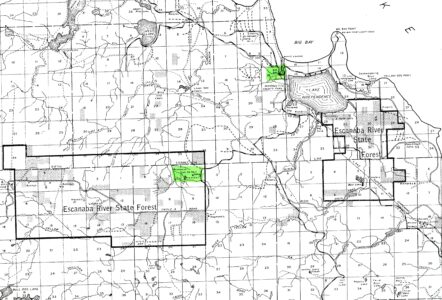
The Lake Independence Lumber Company foremen ordered all the workers to evacuate from the lumber camps. However, six employees of Camp #1, about seven miles west of Big Bay didn't receive the warning.
The men were given the job of carrying railroad ties to a new spur being built. Their path led through an area where fires were burning, but they were determined to fight their way through the smoke and flames. Eventually, one man threw his coat over his head and returned to camp.
When he reached the camp, he reported to the Camp #1 foreman that the other five men might be trapped. Efforts were made to reach the men, but the smoke and flames prevented a rescue.
The bodies of the five lumberjacks were found the following day, all lying face down and burned beyond recognition. It was determined they had only continued a few feet after the other man turned back. Had they traveled 50 feet further, they would have reached the relative safety of the spur track.
The bodies were wrapped in blankets and brought to a temporary morgue set up in the Big Bay Town Hall. The 5 men who perished were:
¯ Sam Klemens, 52
¯ Simon Valeski, 50
¯ John West, 38
¯ August Dauder 32
¯ Benjamin Arthur "Ben" Suskie/Suskey, listed as 20 but actually age 26.
Suskie, the youngest, had just arrived in the camp from Chicago at noon the day before. In the morning, he told the foreman he was ready to do any kind of work. Three hours later he was dead. He was survived by his wife Gertrude, two sons and an unborn daughter.
All the men were believed to be from Chicago. Unfortunately, while their names were known, the bodies themselves were never individually identified because few personal effects were found on the men.
Aside from Suskie, it is unknown if any of the families learned of the circumstances of the men's deaths because no one had contact information for the families.
Over 100 employees of the Lake Independence Lumber Company continued to patrol the fire lines until the rains fell a few days later. The fires were believed to have been started by a lighted cigarette stub.