Current archaeology at colonial Michilimackinac
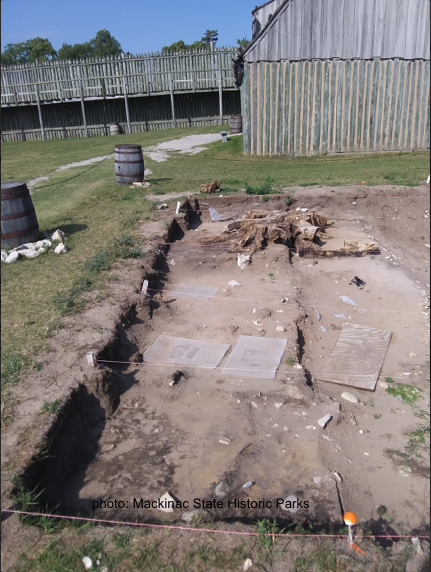
This is a picture of the archaeological dig site House E of the Southeast Rowhouse. (Photo courtesy of Mackinac State Historic Parks via the Marquette Regional History Center)
EDITOR’S NOTE: The author thanks the Mackinac State Historic Parks for use of their publications.
Last week’s article discussed the archaeology of Grand Island in Alger County. More than 200 archaeological sites have been identified on the island, showing four thousand years of continuous occupation from the Late Archaic Period (circa 2000 BCE), through the Woodland Period (circa 0-1600 CE), the Protohistoric/Contact Period (circa 1600-1840) and into modern activity associated with the hotel and resort era.
After some questions regarding the article and the Grand Island Archaeological Research Project, a partnership of the Hiawatha National Forest and Illinois State University, we want to clarify that the digs ran from 2001 to 2015 when Dr. James Skibo, one of the co-directors of the project, retired from Illinois State. There are no current plans to continue archaeological investigations on Grand Island, although historic restoration of buildings on the island continues.
Following his retirement, Dr. Skibo joined the Wisconsin State Historical Society in 2021, becoming the State Archaeologist of Wisconsin. In 2022 he participated in the recovery of two ancient Native American canoes from the bottom of Lake Mendota in Madison, Wisconsin. Sadly, Dr. Skibo passed away in April 2023 while preparing for another underwater archaeology project in Lake Mendota.
Another long-running dig in the region is Colonial Michilimackinac at the original site of Fort Michilimackinac in Mackinaw City, which recently wrapped up its 65th season of excavation.
Although the Straits of Mackinac have been inhabited by Native Americans for thousands of years, Fort Michilimackinac was constructed by French soldiers in 1715 at the northern tip of the Lower Peninsula.
This fortified community became a transportation center and refueling post for the Upper Great Lakes fur trade. It was here that fur traders and Indians rendezvoused, French and later British officers organized war parties, and explorers began their journeys into the vast western unknown.
Following the French and Indian War, the British took control of the fort in 1761. Two years later, in June 1763, the fort was attacked and captured by local Ojibwa as part of Pontiac’s Uprising.
It was returned to the British the following year. During the American Revolution, in 1780-81, the fort was moved to Mackinac Island, a more secure location that was less vulnerable to naval assault.
Several buildings were dismantled and reassembled on the island. What was not moved was burned and the site was eventually covered by blowing sand.
In 1959, the Mackinac Island State Park Commission contracted with Michigan State University to carry out a season of excavation at Michilimackinac in Mackinaw City.
Thus began an archaeological project that has continued every summer since, one of the longest ongoing projects of its kind in North America. Approximately 65% of the fort has been excavated and over one million artifacts have been recovered.
Most of the west half of the fort was excavated in the 1960s. Work moved outside the palisade walls during the early 1970s. The most notable building excavated in the 1970s was also the most intact building at Colonial Michilimackinac, the powder magazine. In the 1980s, the home of Ezekiel Solomon, Michigan’s first Jewish settler, was excavated. Work continued in the southeast corner of the fort throughout the 1980s and most of the 1990s.
In 1998, archaeologists returned to the southwest corner of the fort to tie together current results with excavations done in the 1960s. This project resulted in the reconstruction of the South-Southwest Row House in 2013.
This year’s dig focused on the site of House E in the Southeast Rowhouse, which has been excavated over the past 17 years. Research has shown that the Southeast Rowhouse was built in the 1730s. It was owned by Charles Gonneville, who traded at Michilimackinac from 1727 through 1754 and owned the house at least through 1758.
Recovered Roman Catholic devotional artifacts including a rosary and a crucifix are linked to the Gonneville residence of the house.
By 1765 the house was in the hands of an unnamed English trader. The main research question for the excavation was “How does a British trader’s house look different archaeologically from a French fur trader’s house?” In one example, trade silver, a hallmark of the British-era fur trade in North America had not been commonly found at Michilimackinac.
House E has been an exception to that pattern and the 2017 excavation produced the most trade silver in a single season. Another surprise from House E was the large number of personal adornment items recovered as well as the number and variety of ceramics present.
Among the notable finds from this year’s dig were remnants of the house itself. It was one of the structures burned when the community relocated to Mackinac Island in 1781 and the charred wood of the house was partially preserved in the sandy soil the fort was built on.
The 18th-century fort and fur-trading village at Colonial Michilimackinac have been reconstructed based on the archaeological evidence provided by the ongoing excavations.
From mid-June to late August, Mackinac area visitors can watch archaeology in progress every day from 9 a.m. to 5 p.m. (weather permitting). An interpreter is on-site to answer visitor questions, explain the process, and show sample artifacts.
To learn more about Upper Peninsula archaeological sites, visit the Marquette Regional History Center’s Eleventh Annual Archaeology Fair! Held on International Archaeology Day, rom 11 a.m.-3 p.m. Saturday, the fair is an open-house event at the History Center.
As an official Collaborating Organization with the Archaeological Institute of America, the History Center explores and celebrates local historical evidence and world-wide archaeology.
Enjoy hands-on learning for all ages. Multiple booths feature various regional and global displays and activities, including a scavenger hunt and the screening of a Fresh Coast Film Festival short titled: A.A. Parker: One Ship, Twice Sunk.
The fair is included with general admission and membership at the sponsor level on up.
Superior History
U.P. Moments in Time
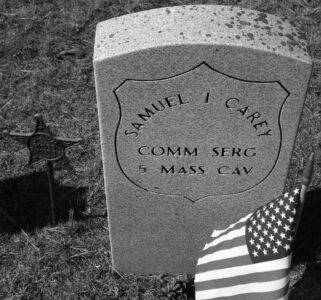
Samuel Carey: Black, Civil War vet, barber, Negaunee resident
History Quiz
WUESTION — "Finland Calling" or "Suomi Kutsuu" was an iconic, long-running Finnish-American television show ...
History quiz
QUESTION: When did the legend of Heikki Lunta originate? a. During the Viking Age b. 1323 c. 1917 d. ...
U.P. Moments in History