
Historically speaking
St. Paul’s School fondly recalled
Trending
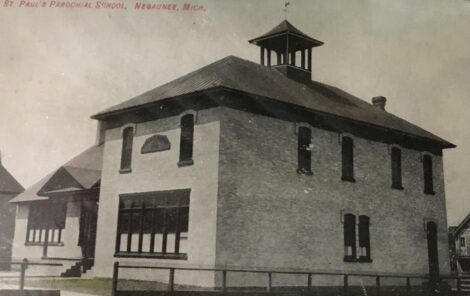
NEGAUNEE -- In addition to its public school system Negaunee was also served by a Parochial school provided by the St. Paul parish.
In November 1880, the Rev. Frederick Eis was assigned to St. Paul's church, Shortly after his arrival the parish was free of any debt and at once they took steps toward building a Parochial school.
The congregation at that time was about 350 families.with approximately 500 children that were of school age. A brick building, 30x 60, two stories high was constructed at a cost of $5,000.
The parish school opened its doors in 1882, and at the invitation of Pastor Eis it was staffed by the Sisters of St. Joseph of Carondolet. The first Superior was Sister Mary Philomena Joyce and the enrollment was 350 students.
In 1890 Rev. Langner was serving the parish and he personally solicited parishioners for subscriptions to add three classrooms to the school. This building served for many years and with the change in pastors the Rev. Joseph Dittman had hopes and dreams of a new school and convent.
On April 11, 1932, his dream was realized. and ground was broken and the school opened on Sept. 19 1932 serving elementary students through eighth grade.
In September 1934, the new high school was opened with only a freshman class and a new class was added each successive year. There were nineteen members in that first graduating class that received diplomas on June 12, 1938.
They were, Anthony Russo, John Motto, Joseph Baldini, Dominic Jacobetti, Mario Spelgatti, Lucy Spelgatti, Lena Suardini, Elizabeth Kratz, Lucille Torreano, Marcella Laforest, Florence Dompierre, Teresa Ghiringhelli, Loretta Fosco, Rita Chiri, Mary Nicoli, Beatrice White, June Dushane, Sister David Joseph Migliarini and Frances Saladin.
In 1938, the school was fully accredited by the University of Michigan. With well qualified teachers and an approved curriculum, St. Paul's high school received its accreditation every year. In 1955, under the direction of Father Cordy numerous changes were made in keeping with the times Incorporation of modern math into traditional math courses.
The science and library departments were expanded with new equipment. In 1959, the first full time physical education instructor was appointed and a complete physical training program for all students from the first grade through the twelfth grade was made part of the curriculum.
Forensics was added as an extra-curricular activity. Basketball became part of the extra curricular program in 1936 and in two short years the Emeralds, as St. Paul's team was named, won district and regional tournament runner-up honors competing with class D schools in the Upper Peninsula.
In March 1963, St. Paul's won their first regional Class D basketball title in school history under Coach Alan Dighera. The high school closed in 1966 and the grade school was in operation until 1975.
The teaching staff consisted primarily of nuns. The history of St. Paul's school is matched by the colorful historical background of the Sisters of St. Joseph.
Founded in LePuy, France, they were disbanded during the French Revolution but thirteen years later they were reorganized.
With financial assistance from a French countess they came to Carondolet, a French settlement located six miles from St. Louis, in 1836.
A drafty log cabin on the banks of the Mississippiwas their first convent. their initial effort was work among the Indians, children of Negro slaves and the deaf and the daughter so of the French families.