
Strong opposition
Houghton County board passes resolution against septic code bills
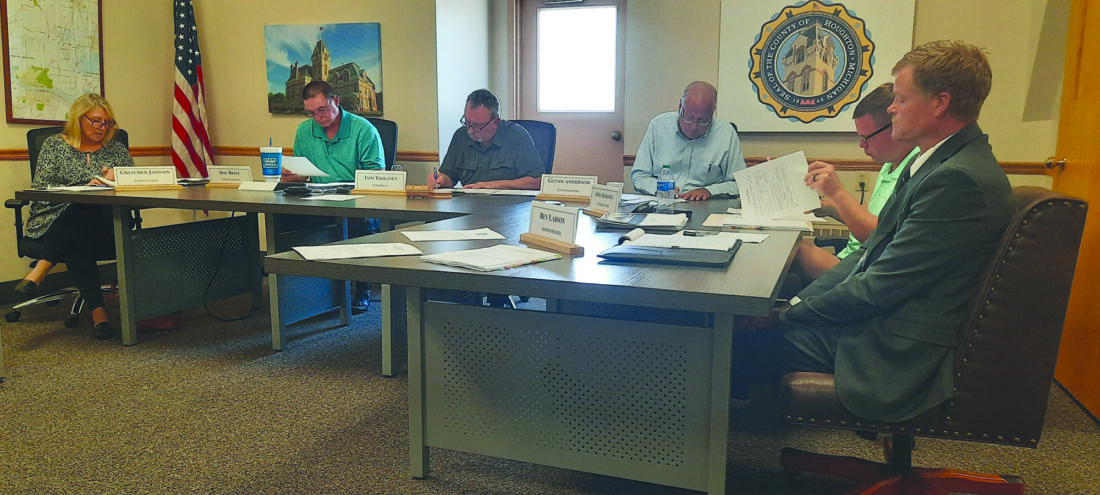
The Houghton County Board, seen here during Tuesday’s meeting, unanimously approved a resolution opposing bills that would create a statewide septic code. (Houghton Daily Mining Gazette photo)
HOUGHTON — The Houghton County board unanimously passed a resolution opposing a package of state bills that would create a statewide septic system code and require inspections of residential septic systems every five years.
Senate Bills 299 and 300 and House Bills 4479 and 480 were introduced earlier this year.
Board members said the state code would impose more costs for both property owners and local health departments. The increased certification requirements for septic inspectors would also make it harder to find and retain personnel, the board resolution said.
The Western Upper Peninsula Health Department’s Board of Health also unanimously passed a resolution at a recent meeting opposing the bills.
An estimated 12,000 septic tanks are in the department’s five-county area, though there is no concrete number, said Commissioner Glenn Anderson, who also sits on the WUPHD board. (A database locally does exist, but only includes new construction within the past 20 years, he said.)
The area’s long winters would mean a burden for the health department, which would be forced to squeeze the necessary inspections into the few warm months, Anderson said.
“Just for Houghton County, you’d be inspecting eight or nine septic systems a day during the summer season when you could, and of course the property owners would presumably be billed for that,” he said.
Inspections in Houghton County currently cost $300, and are only required for new construction, Anderson said.
In the resolution, the board said it recognizes the importance of protecting Michigan’s water resources, but “concludes that the bills as presented do not provide a sustainable nor financially feasible solution for areas that do not have the benefit of municipal sanitary systems.”
Michigan is the only state without statewide system inspection regulations. Proponents say the statewide code will make it easier to identify and repair failing septic systems, thereby reducing contamination.
“We have a patchwork of local ordinances that aren’t even covering the majority of septics,” lead sponsor Rep. Phil Skaggs told mLive in May.
There have been other legislative attempts to create some form of statewide code in previous years, including ones with Republican co-sponsors.
State Rep. Greg Markkanen, who attended Tuesday’s meeting, said the Republican caucus agrees the current bill unwisely removes local control and creates too many burdens on local governments and property owners.
The geology of the Keweenaw is different than that of southeast or southwest Michigan, he said. So is the local oversight.
“We have a health department here that takes care of our septic, and we have really good contractors that put in good systems, so it’s not an issue here,” he said. “Downstate, not so much.”
Markkanen said he also feels the proposed bill is overly punitive, including a $1,000-a-month fine for property owners who do not bring their systems into compliance within six months.
“If this passes, it’s going to put an undue burden on this government,” he said. “And obviously, you’re going to have to raise taxes or find funding to pay for it. And that’s an undue burden on the taxpayers in my opinion.”
Commissioner Joel Keranen, who voted for the resolution against the code as a Western Upper Peninsula Health Department Board member, said he wanted an amendment to the board’s resolution. He said he wanted the resolution directed to members of the Democratic legislative majority, which Markkanen said forms nearly all the support of the bill.
The board eventually passed an amended version: in addition to Markkanen, State Sen. Ed McBroom and State Rep. Jenn Hill also sends it to State Senate Majority Leader Winnie Brinks, House Speaker Joe Tate and House Committee on Natural Resources Chair Laurie Pohutsky.
During a phone interview Wednesday, McBroom said he was glad the board passed the resolution, calling a statewide code “excessive, and entirely unnecessary.”
“Michigan’s got a diverse environment, and having the codes created at the local county level is far more efficient and effective to respond to that diverse environment,” he said. “The system that we have should continue to be utilized for that purpose. Local control over the codes is far more responsive to the individual needs of different geographic locations than one statewide code for everybody.”
At a county commissioners’ meeting last spring, Hill said she supported the bill, Anderson said. A message was left with Hill Wednesday seeking comment.
An infrastructure agreement approved last year put $35 million toward a state revolving fund to aid homeowners with the cost of fixing their systems. But the bill does not have a sustainable, ongoing funding source attached, the Houghton County board said.
McBroom said Wednesday he wasn’t sure where all of his colleagues stood, but thinks that “the more my colleagues are informed by their local communities, the more likely they are to say that a one-size-fits-all approach is inappropriate and unnecessary.”
The House bills were referred to the Natural Resources, Environment, Tourism and Outdoor Recreation Committee in April. The Senate bills were referred to the Committee on Energy and Environment the same day.
Region
Man charged with arson in Rapid River Pub fire
By Escanaba Daily Press staff ESCANABA — A Rapid River man faces arson charges after being accused of setting ...
Labor Day celebration set for Monday in Escanaba
By SOPHIE VOGELMANN Escanaba Daily Press ESCANABA – The route will be different but the parade will go on for ...

Isle Royale wolf killed after repeatedly going into park campsites

Fun and games at the fair
New principal appointed at Holy Name Catholic School in Escanaba
ESCANABA — Michelle Brief of Menominee has been appointed principal at Holy Name Catholic School in Escanaba. She ...