
Historically speaking
A history of fires in city of Negaunee
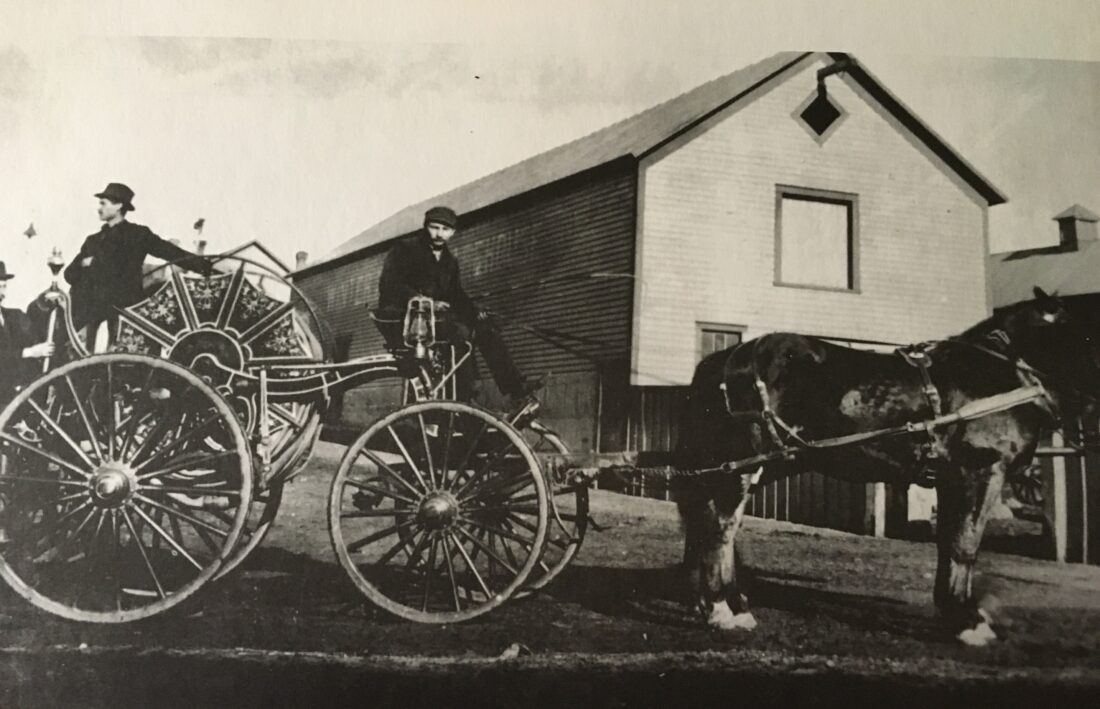
The first Negaunee Fire Department wagon is pictured in 1872. (Photo courtesy of the Negaunee Historical Society)
NEGAUNEE — The Negaunee Fire Department will be hosting the Upper Peninsula Firemen’s Tournament at the end of of July and the Negaunee Historical Society pays tribute to those firefighters who put their lives in harm’s way.
The Negaunee fire hall has been added to the National Register of historic buildings, based on its historical value as a symbol of wealth and optimism in the 20th century iron range.
The building is the third fire station and has served the city of Negaunee since it was constructed in 1910. At the time of its construction it was considered one of the more modern buildings. To have a large brick building with electricity was a big deal back then.
One of the most impressive features of the building was a 76 foot tall hose drying tower that was topped with a flag pole. A four sided clock was installed to fill the holes in the hose tower, but was removed and installed in the city hall during its construction in 1914.
Negaunee has had its share of fires. The Iron Street fire, February 1916, destroyed buildings that were erected in the years between 1870s and 1890s. Two business blocks starting at Silver Street going west, consisting of five stores with residences upstairs were completely destroyed. five families escaped without injury. Cause of the fire was believed to have originated in the second floor of the Kuhlman building used by Swanos and Chase for their undertaking business.
In april of 1919, the St. Paul’s church which was a frame structure was leveled and with winds at the time it looked like every frame building from Case Street to Iron Street would be leveled.
The Sisters of St. Joseph went into the church and removed the altar communion ware. The furnace had been started up to prepare for services that evening, and it was determined that a spark may have landed in a place of dry timbers.
Fire destroyed the Negaunee Hospital on Teal Lake Avenue (Masonic Lodge) Mrs. Johanna Sjolund and William Eddy were patients who lost their lives and the orderly, Axel Martinson, lost his life trying to save Mrs. Sjolund.
Axel Martinson’s mother was presented the Carnegie Medal of Honor which is displayed at the museum. On a bookmark found among Axel’s belongings was the inscription, “Greater love hath no man, than when he gives his life for a fellow man.”
The historic Breitung Hotel, a city landmark, was reduced to a heap of ashes on Jan. 15, 1988. Built in 1879, the three story brick structure was constructed by cigar manufacturer , Andrew Seass, and was named after his friend Edward Breitung, who helped develop several Marquette Iron range mines.
With 50 guest rooms, a bar, billiards room and a restaurant, the hotel was considered the “showplace of the Upper Peninsula.” Its guests included U.S. Presidents, Theodore Roosevelt and Grover Cleveland. Western hero, Buffalo Bill Cody, Jesse Stone the founder of the National Biscuit Company (Nabisco) and sausage baron, Oscar Mayer.
The fire was considered arson by a transient and was unoccupied at the time but had been gutted for renovation for historical purposes.
On Feb. 6, 1947, Dominic Francisco, Frank Bessolo and Nestor Erkkila, Negaunee policemen who were on patrol discovered a fire on Lincoln Street housing the businesses of Wolfe Motors, Arts Auto Repair and the Lincoln Street Body Shop.
While the fire was raging, Abbott finished putting a wheel on a car in his shop and saved it, along with other cars in Wolfes garage.
Twenty cars were destroyed. Firemen had to combat zero temperatures.
Another landmark, the MacDonald Opera House on the corner of Pioneer Avenue and Jackson street went up in flames on Feb. 9, 1960. Donald MacDonald erected the building in 1873, utilizing the ground floor as a general store and the second floor as the opera house.
It was used as the U.S. Post Office from 1926 until 1936 when the post office was built. It housed several hardware businesses until it was taken over by Selins and operated as a furniture store and warehouse and were the owners at the time of the fire.
In the mid 1960s, a fire destroyed the VIGA bowling alleys that were located at 552 Iron St. This building was also a Negaunee landmark in the early mining years operating as the Kings Inn.
On Feb. 5, 1979, an early morning fire gutted a portion of the Eagles Club on Iron Street. Below zero temperatures and a wind chill factor combined, forced the firemen into working half hour shifts battling the blaze.
Negaunee police determined that a late night fire on Dec. 30, 1991, at the Depot Art Gallery on Rail Street that damaged the train coach adjacent to the gallery was arson.
The red coach had been used as an apartment for artists in the summer and for storage of art supplies in the winter. The depot and the coach were both on the state’s register of historic buildings.
March 16, 1986, fire destroyed Karki’s Jewelry and Pauls’s barber shop on Iron Street. It started in the basement and quickly spread to the upper floors where two apartments were destroyed.
On May 22, 1986, a fire gutted a two story building that caused extensive damage to the VFW Post and Barr’s Bar. The fire began in a vacant building at 505 Iron St
On Aug. 7, 1986, a fire gutted a ten unit apartment building on Maas St and 23 people were left homeless. That fire was considered accidental. A blaze destroyed a residence at 324 Gold St. on Nov. 3, 1987. Four men were trying to start a pickup truck when gasoline in the carburetor exploded.
The garage was below the house and it quickly set the house on fire. No one was injured.
Two families escaped a burning home on Case Street and a woman lost her life in a home on Main Street.
More complete stories on all these fires are available at the museum.
West End
Remembering old businesses
Historically speaking – classic
Historically Speaking
Christmas was spectacular in one small corner of Marquette County
Peter Pan and Tinker Bell glide along the ceiling rafters. Captain Hook grimaces from a darker corner. Sylvester ...
Historically speaking classic